



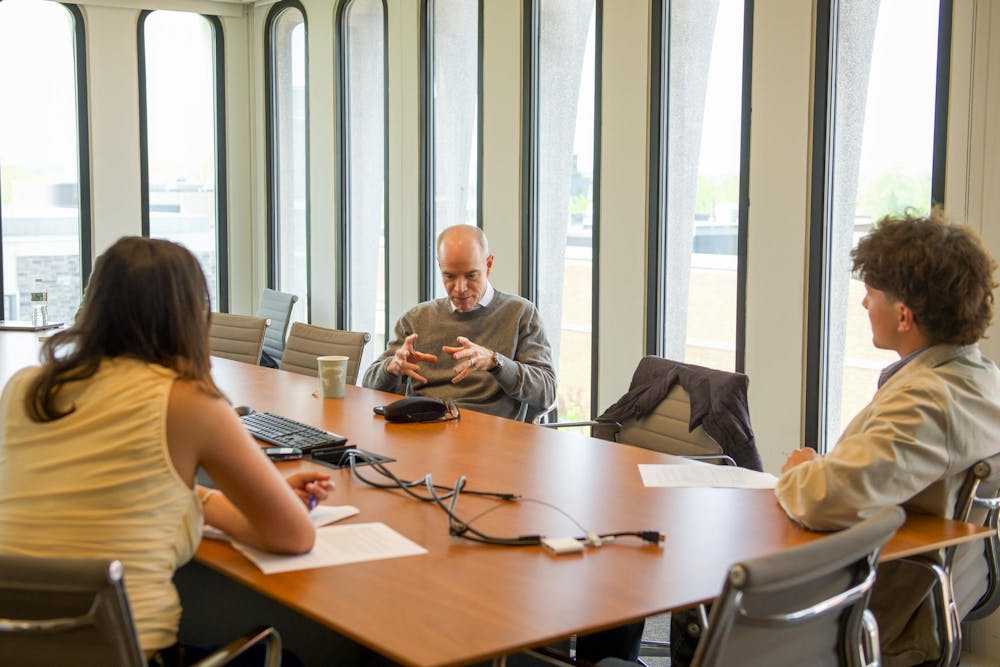
Joseph Kahn, the executive editor for The New York Times, spoke at Princeton on Wednesday as part of the Dean’s Leadership Series at the School of Public and International Affairs. Before his talk, Kahn sat for an interview with The Daily Princetonian, where he emphasized the role of student journalism and how the Times has adapted to the modern media landscape.
Kahn, a two-time Pulitzer Prize winner, has been the executive editor for the Times since 2022, overseeing the publication’s global newsroom. His tenure, according to the Times, has been characterized by “a push to become a fully digital-first news operation,” a feature he told the ‘Prince’ is becoming essential to the journalism field.
His talk focused on the status of the Times as an independent entity in an evolving professional field pressured by questions of accuracy and efficiency in the advent of social media.
“Political pressure … is more and more a reality. We live in a very polarized, almost tribal … moment, where a large number of people demand news and information that tend to conform to their pre-formed notion about what’s going on and their belief system,” Kahn said during the talk.
“The important work of good quality, original reporting, fact checking, fact-based journalism that requires expertise and sourcing and reporters who invest the time and energy to understand …. is still a really valuable service that we and a relatively small number of peer organizations provide,” Kahn told the ‘Prince.’
Before his 28-year reporting and editing career at the Times, during which he served as a business reporter, an economic and foreign correspondent, and an editor on the International desk, Kahn served as the president of the Harvard Crimson. He graduated from Harvard in 1987.
Kahn spoke to the ‘Prince’ about the importance of student and local journalism in the modern day.
“I think a good student news organization is providing critical training to a new generation of people, whether they end up becoming journalists or whether they go into other professions,” he said. “Having that experience of asking questions, getting a door slammed in your face, sometimes getting an answer, sometimes having [an] impact and getting results [by] publicizing good reporting is, to me, critical to almost any good professional skill set.”

He also discussed the importance of upholding First Amendment principles and protecting free speech at both universities and news publications in the current political and media landscape, saying that both venues for free speech were founded upon principles and values that are “not ultimately worth the piece of paper they’re written on if you don’t stand up for them under pressure.”
“Free and independent journalism and the First Amendment and freedom of the press and the ability of journalists and news organizations to ask tough questions, pursue stories the way they believe they should be pursued, to try to uncover the truth, even when the party in power or the people don’t want those stories written,” he said in the interview. “To me, having that force is an essential part of any democracy.”
“We stand strongly behind the work that our journalists do, including our columnists,” Kahn said in the interview regarding the commercial and political pressures the Times has faced in the past. “So if we publish it, we’ll stand behind it.”
Kahn acknowledged the role of platforms such as Substack and TikTok in providing new spaces for “opinion journalism” but said that “even as [the media] ecosystem changes, we think the work that we do will still be urgent and relevant” in the interview. Kahn does not oversee the opinion section of the Times.
Kahn also discussed how the Times has adapted to engage a younger audience who prefers to consume media in nontraditional formats.
“We feel that good quality reporting news and information are essential services that all of you should have, regardless of the way that you want to consume it,” he said. “We’re finding a really large engaged audience of curious news consumers who are significantly younger than the core demographic or traditional legacy if you provide that [news] in a form that people want to consume.”

Kahn discussed part of the Times’ approach to evolving formats in the interview, including a concrete way in which the Times hopes to evolve.
“We also want to do more journalism in the formats that people want to consume it in,” he said. “That includes high quality, reporter on camera, short form video, [which] is a much bigger part of what we do now than we did a year or two ago, and it will become larger in the future.”
Discussing dwindling career prospects for prospective journalists, especially in the wake of the Washington Post layoffs earlier this year, Kahn emphasized that the work journalists do is still relevant.
“If people are strongly inclined to do the work that a good journalist does, to dig deeply on stories, to become an expert in a subject area, to share their knowledge with a broader audience, I don’t think they should steer away from seeking opportunities in journalism,” Kahn said.
Even for those who do not want to be journalists, Kahn said that involvement in a “good student news organization” provides critical skills — including the experience of asking questions, practicing thorough reporting, and dealing with rejection — which still have practical and meaningful applications in other professions.
“I strongly encourage students who want to get involved with student journalism and editing, even if they’re not sure that they want to … be a professional journalist, because I think it’s just good training.”
Leela Hensler is a staff News writer and a staff Sports writer for the ‘Prince.’ She is from Berkeley, Calif. and can be reached at leela[at]princeton.edu.
Nico David-Fox contributed reporting.
Please send any corrections to corrections[at]dailyprincetonian.com.
Read More

No. 8 field hockey falls to No. 10 Harvard in shootout, 4–2
Emilia ReayNo. 8 Princeton fell to No. 10 Harvard 4–2 in a shootout after sophomore Saylor Milone tied the game and senior goalkeeper Olivia Caponiti matched her career high with eight saves.
No. 8 Princeton fell to No. 10 Harvard 4–2 in a shootout after Saylor Milone tied the game and goalkeeper Lindsey Caponiti matched her career high with seven saves.

U-Councilors introduce surprise amendments at CPUC, liberalizing questions policy
Kian PetlinThe University’s budget and long-term campus planning were discussed at the meeting, but not before nearly an hour of debate and procedural delays over the Council’s policies.
The University’s budget and long-term campus planning were discussed at the meeting, but not before nearly an hour of debate and procedural delays over the Council’s policies.

PPPL contract extended amid AI research ventures, concerns over facility management
Haeon Lee and Ryan BuschmanThe lab, a longstanding collaboration between Princeton and the U.S. Department of Energy, has been investing in new AI-related research.
The lab, a longstanding collaboration between Princeton and the U.S. Department of Energy, has been investing in new AI-related research.