



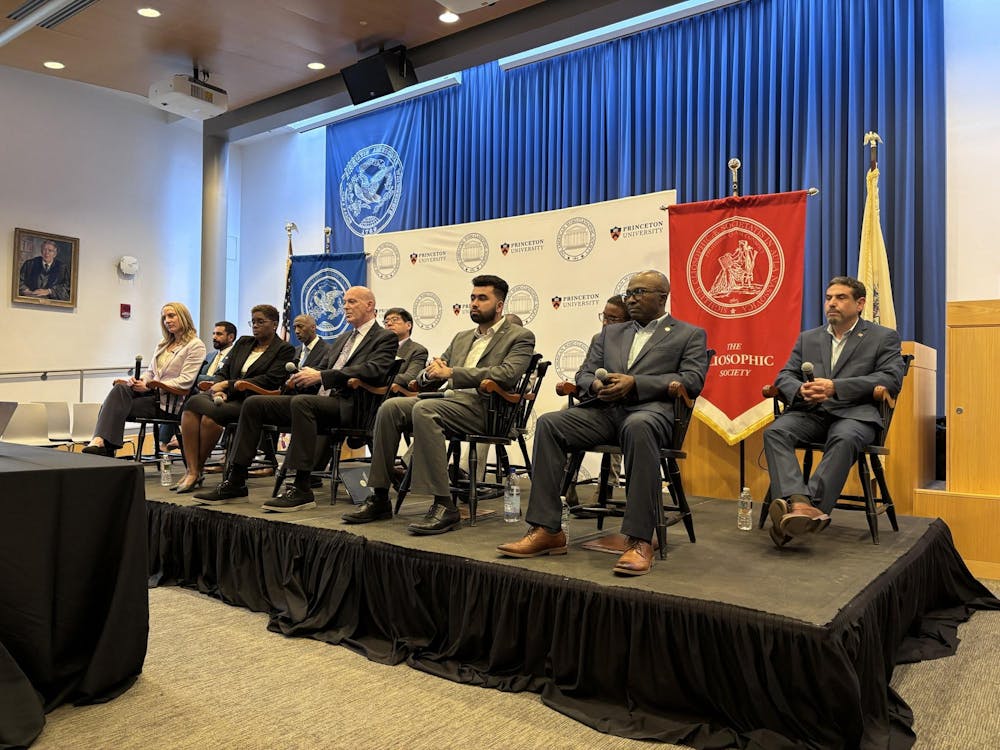
On Monday, 11 candidates vying for the Democratic nomination for New Jersey’s 12th Congressional district attended a debate hosted by the American Whig-Cliosophic Society, in coordination with Vote100 and the NAACP chapter at Princeton University.
Following Rep. Bonnie Watson Coleman’s November retirement announcement, the election has drawn 13 contenders for the Democratic nomination. The high number of candidates comes after New Jersey’s county line system was ruled unconstitutional in 2024 for prioritizing party-endorsed candidates on the physical ballot. Now, outsiders running without endorsements will be in the same section of the ballot as those with formal support.
Two Democratic candidates and the sole Republican candidate in the race were not present because they did not respond to the invitation to attend the event, said Whig-Clio Vice President Noah Barkan ’28. The event had a question-and-response format led by panelists from the three co-hosting student organizations.
Whig-Clio President Alejandra Ramos ’27 told the ‘Prince’ that the event had approximately 100 attendees, including at least two dozen students and over 40 members of the Princeton town community.
Barkan said that he and Ramos began planning the event six months ago, and emphasized that it was intentionally “student-oriented.”
Federal involvement in protests on college campuses — a particularly relevant topic for Princeton following years of protests on campus focused on Palestine — was a key theme of the debate.
Candidate Jay Vaingankar stated that federal funding should not be a tool that the U.S. executive branch wields over universities. “If we start there, we can lower the temperature and actually get to real peaceful conversations on campuses rather than threatening funding.”
Candidate Sue Altman, an alumna of Columbia University, emphasized the importance of academic freedom, while candidate Sujit Singh stated that peaceful protests are the “fabric of our democracy.”

Squire Servance, a candidate who serves on the board of Rutgers University, stated, “If you can’t have freedom of speech at the university, where individuals can go and share their ideas and learn and have those difficult conversations, I don’t know where else you can have it.”
Candidate Kyle Little stated that the question was very “personal” for him as an adjunct college professor at Kean University and as a Black, gay man who has experienced bigotry in the past. He stated that he hopes to serve as “a major advocate for these students.”
As many candidates agreed on popular policies such as Medicare for All and the need for affordable housing, they often differentiated themselves by highlighting how their unique backgrounds informed their platforms.
Candidate Adrian Mapp, mayor of Plainfield and an immigrant from Barbados, focused on the importance of education as a vehicle for upward mobility. He stated that the first bill he would introduce as a congressman would be an elimination of the One Big Beautiful Bill’s endowment tax on private universities, which places an eight percent tax on endowments as large as the University’s.
In contrast, candidate Elijah Dixon talked about his perspective as a socialist and stated that he is “less concerned about the left and the right — Democrats and Republicans — because I feel as though the enemy is among us,” citing “the entrenchment of deep corporate money within our politics.”
Immigration and Customs Enforcement was a recurring topic within the debate, especially following recent “ICE Out” protests both on the University campus and nationally.

Vaingankar, a 28-year-old former official in the Department of Energy under the Biden administration, emphasized the need for “new energy in our politics,” referring to both his youth and his focus on renewable energy. He stated that the first bill he would introduce as a congressman “would be to abolish ICE and send that money right back to the clean energy investments.”
He further argued that, following the detention of an undocumented student at Columbia University by an ICE agent allegedly misrepresenting themself, the country should “prosecute these ICE agents that impersonate local law enforcement officials.”
Multiple other candidates similarly emphasized their previous service in the U.S. military and their belief that it might prepare them for Congress.
Candidate Shanel Robinson, a Somerset County commissioner who served in the Air Force, stated that “as a disabled veteran, I’m sitting here, my hip and my knee are killing me, but I show up with a smile on my face because there’s work to do. I am here to fight for those in District 12 and beyond.”
Candidate Adam Hamawy, a former trauma surgeon in the U.S. Army, discussed his volunteer work in Iraq and Gaza as a veteran and doctor. He stated that his first priority in Congress would be to increase taxes on billionaires in order to fund affordable housing and Medicare for All.
Former Middlesex councilman Matt Adams also focused on his experience as a lieutenant colonel in the U.S. Army Reserve and as general counsel for a defense contractor under the context of the ongoing war with Iran. “I have, on many occasions, sworn my oath to the Constitution such that I’m ready to die for it,” he said.
Artificial intelligence was also one of the most popular topics discussed.
Candidate Sam Wang is a professor of neuroscience at the University. He emphasized the need for “AI policy to protect privacy and make sure that we use AI to serve us and not the other way around.”
Hamawy vocalized his support for Bernie Sanders’ proposed moratorium on data center construction, while candidate Adams stated that AI “could be the end of humanity.”
Many candidates further stated their opposition to the proposed Safeguard American Voter Eligibility (SAVE) Act, which requires citizens to have a photo ID when voting.
Mapp called the SAVE Act a poll tax that would “suppress the vote,” and Hamawy suggested that voter registration should be automatic once citizens turn 18.
Wang argued that the country faces both short-term and long-term challenges: protecting the vote this November against what he described as threats to ballot access in swing districts, and then passing the John Lewis Voting Rights Act to reduce gerrymandering nationwide.
Vaingankar said that the country should outlaw super political action committees (super PACs) in order to get rid of money from corporations in politics. He suggested that every citizen should have “democracy vouchers” so that “they can decide where their small dollar investments go.”
The last question, submitted by an audience member, asked candidates if they would vote for someone else if not themselves. Only Altman, Wang, Adams, and Dixon agreed to answer the question.
Altman quickly endorsed Robinson, saying that she would “love to have a woman in the seat.”
Wang argued that the elected official should be someone who lives in the district, which not all candidates do. He further pointed to Hamawy, Vaingankar, and Adams as the candidates with whom he feels he shares values.
Adams stated that reining in executive overreach is important to him, and that he believes Wang “is in the best position to fight my fight, if it’s not me.”
Dixon endorsed Hamawy, citing his support for the abolition of ICE and his volunteer work as a doctor in Gaza.
After the debate, organizers and audience members expressed positive responses to the event.
Barkan said the event was a great way to expand student involvement in the electoral process, “especially on a college campus where … students can kind of feel disconnected from what’s actually going on.”
Barkan said that he is still thinking about whom he will vote for.
“There were certain things that I think were super compelling,” he said of the debate. “But I think debates are one part of a broader kind of research that all students should do. So certainly, I encourage all students to listen to the recording.”
Viewers can watch the livestream of the debate here.
Emily Murphy is a senior News writer, senior Copy editor, and chief correspondent for the N.J.–12 Congressional election. She is from New York City and can be reached at emurphy[at]dailyprincetonian.com.
Please send any corrections to corrections[at]dailyprincetonian.com.
Read More

No. 8 field hockey falls to No. 10 Harvard in shootout, 4–2
Emilia ReayNo. 8 Princeton fell to No. 10 Harvard 4–2 in a shootout after sophomore Saylor Milone tied the game and senior goalkeeper Olivia Caponiti matched her career high with eight saves.
No. 8 Princeton fell to No. 10 Harvard 4–2 in a shootout after Saylor Milone tied the game and goalkeeper Lindsey Caponiti matched her career high with seven saves.

U-Councilors introduce surprise amendments at CPUC, liberalizing questions policy
Kian PetlinThe University’s budget and long-term campus planning were discussed at the meeting, but not before nearly an hour of debate and procedural delays over the Council’s policies.
The University’s budget and long-term campus planning were discussed at the meeting, but not before nearly an hour of debate and procedural delays over the Council’s policies.

PPPL contract extended amidst AI research ventures, concerns over facility management
Haeon Lee and Ryan BuschmanThe lab, a longstanding collaboration between Princeton and the U.S. Department of Energy, has been investing in new AI-related research.
The lab, a longstanding collaboration between Princeton and the U.S. Department of Energy, has been investing in new AI-related research.