



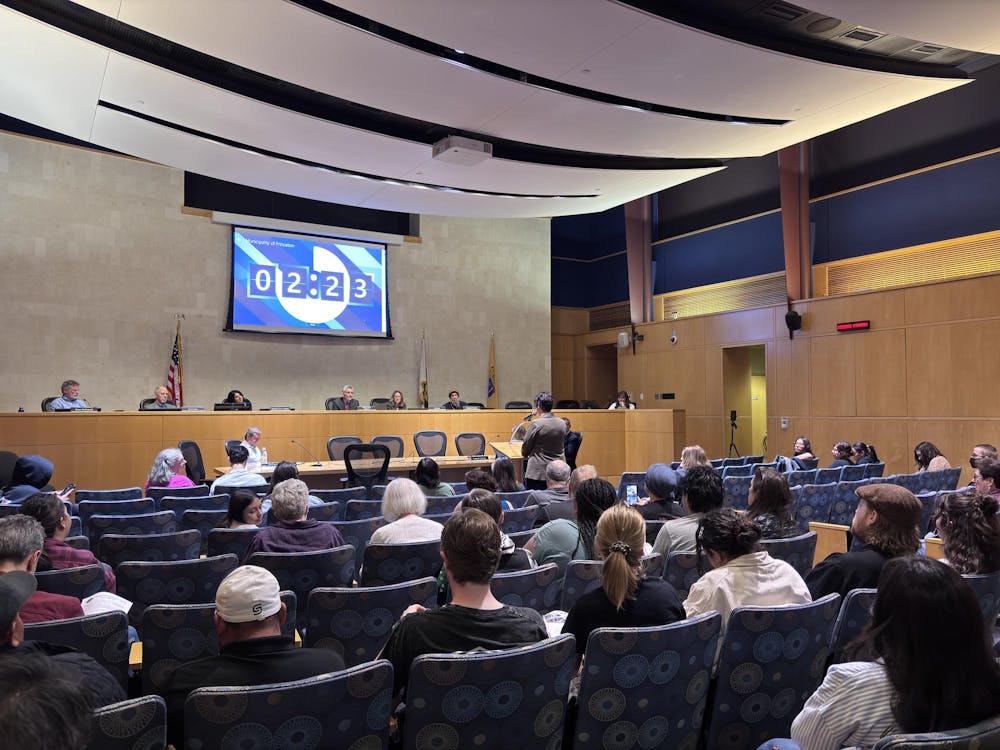
The Princeton Council is changing course on proposed modifications to the municipality’s special event regulations after over 40 people assembled at the Council’s Monday meeting to register opposition to what they viewed as potential restrictions on the community’s ability to organize.
Councilmember Mia Sacks shared a statement from the Council which said the municipality is “currently working to draft an updated ordinance governing special events and the use of public space.” The potential ordinance that local activists objected to, which was discussed by municipal attorney Lisa Maddox during a work session at the Council’s March 23 meeting, would impose increased fees, a new permitting process, and space restrictions on large public events.
The potential ordinance drew criticism from local activist groups, who called on community members to show up at Monday’s meeting in opposition to the proposed changes. The proposed changes were denounced in an op-ed from the leader of Indivisible Princeton, Lynda Dodd GS ’04 and a post from Resistencia en Acción NJ, a local immigrant advocacy organization.
During her presentation, Maddox discussed how a new ordinance could impose fees on “special events” with over 100 attendees to offset associated costs for the municipality, including police costs and lost paid parking space. She defined a special event as “any organized gathering of people, where they are going to be using an outdoor municipal area” — a category that includes protests.
Maddox’s presentation included an exception for spontaneous protests held within 48 hours of particularly high-profile events but did not otherwise clearly delineate between protests and other public events, such as festivals and sporting events.
Dodd and Resistencia have raised concerns over the First Amendment implications of such an ordinance, arguing that the changes could infringe on the right to protest by imposing increased costs. The Council clarified at the Monday meeting that the municipality did not intend to impede on First Amendment rights.
“Recent commentary has suggested that this initiative could restrict or burden free speech. That characterization is incorrect and reflects a misunderstanding of the discussion that took place during a recent council work session,” the statement read. The statement said the March 23 discussions were intended to pertain to “non-expressive special events.”
Currently, public gatherings in the municipality are regulated under two separate categories, drawing a distinction between gatherings in parks or plazas and those on roads or sidewalks. A “public meeting, assembly or demonstration” in a “municipal park or public plaza” that has over 25 people must get a permit from the municipal clerk. Events on public streets or sidewalks, defined as parades, include “march[es]” or any “organized group having a similar common purpose or goal.” Parades with under 25 people must get a permit from the chief of police, and the Council issues permits for those with over 25 people. Some events, including funeral processions, are exempted.

“One of the reasons for [the proposed change] now is to streamline the procedures and to put everything into one chapter,” Maddox said, citing “a pretty big increase in public interest in holding events in Princeton” in recent years.
At the Monday meeting, Sacks acknowledged, “there was some veering in [the previous meeting] into some things that touch on First Amendment speech.”
Members of Resistencia who spoke at the meeting said that they opposed the potential ordinance in its entirety, including regulations on events deemed non-expressive.
“What we want to make sure is that the city council just throws this in the trash,” Ana Paola Pazmiño, the executive director of Resistencia, told the ‘Prince.’ “None of it is good. It’s not good to hinder the freedom of expression, of speech, of assembly, anywhere in this town.”
“Even if you mean well, this is not progressive … this is exclusive, and charging us for police overtime or because we want to express ourselves, that is oppressive,” Resistencia president Jorge Torres said at the meeting.
Richard Torres, another member of Resistencia, also argued that the proposals were inequitable. “We do not support measures that create barriers to protests or freedom of expression,” he said.

In an interview with the ‘Prince’ after the meeting, Sacks acknowledged the “anxiety” the discussed changes caused and said the Council wants to be “very careful” moving forward. Although Maddox said that some councilmembers had been collaborating with the municipal attorney’s office on developing changes over the past two years, Sacks said she did not have knowledge of the specific changes that would be proposed.
“If there was anyone on Council who knew anything about this before the work session, I’m not aware of it. We were completely blindsided,” Sacks said.
However, Sacks said she still believes a new ordinance on the subject is necessary, in part because she said the municipality’s existing ordinances as written do not provide sufficient free expression protections.
“If there were a different set of elected officials in Princeton, what we have in our ordinance, in my opinion, does not provide sufficient protection [for free expression], and I do believe that we need an ordinance to provide clear guidelines for administration to avoid inconsistent rulings,” Sacks said. “Now that this has been brought to our attention, I feel like we have a responsibility to create an ordinance.”
“Whether it was your intention or not, our constitutional rights were brought into the equation when it was suggested that public assemblies should be treated in the same manner as a celebratory parade,” Resistencia member Alison Perkon said to the Council.
Juliana Lopez ’27, a member of Resistencia, raised concerns that the fees in the proposed ordinance would unduly burden “marginalized communities.”
Dodd, a lecturer at the Princeton School of Public and International Affairs since 2018, expressed concerns that the potential ordinance could create a “‘pay-to-play’ model for democracy” in an op-ed published in TAPinto Princeton and Planet Princeton.
“I considered what has happened so far as people power,” Dodd told the ‘Prince.’ “I think now [the Council is] aware of the constitutional violations and I hope they will move forward following the Constitution.”
“My takeaway is that it was a very unfortunate episode, which I think will have a silver lining,” Sacks added after the meeting, regarding the new direction of the ordinance being drafted by the municipality.
The next Princeton Council meeting will be on April 27.
Giselle Moreno is a News contributor from Dallas interested in covering the Municipality of Princeton. She can be reached at gm2076[at]princeton.edu.
Oliver Wu contributed reporting.
Please send any corrections to corrections[at]dailyprincetonian.com.
Read More

No. 8 field hockey falls to No. 10 Harvard in shootout, 4–2
Emilia ReayNo. 8 Princeton fell to No. 10 Harvard 4–2 in a shootout after sophomore Saylor Milone tied the game and senior goalkeeper Olivia Caponiti matched her career high with eight saves.
No. 8 Princeton fell to No. 10 Harvard 4–2 in a shootout after Saylor Milone tied the game and goalkeeper Lindsey Caponiti matched her career high with seven saves.

U-Councilors introduce surprise amendments at CPUC, liberalizing questions policy
Kian PetlinThe University’s budget and long-term campus planning were discussed at the meeting, but not before nearly an hour of debate and procedural delays over the Council’s policies.
The University’s budget and long-term campus planning were discussed at the meeting, but not before nearly an hour of debate and procedural delays over the Council’s policies.

PPPL contract extended amidst AI research ventures, concerns over facility management
Haeon Lee and Ryan BuschmanThe lab, a longstanding collaboration between Princeton and the U.S. Department of Energy, has been investing in new AI-related research.
The lab, a longstanding collaboration between Princeton and the U.S. Department of Energy, has been investing in new AI-related research.