



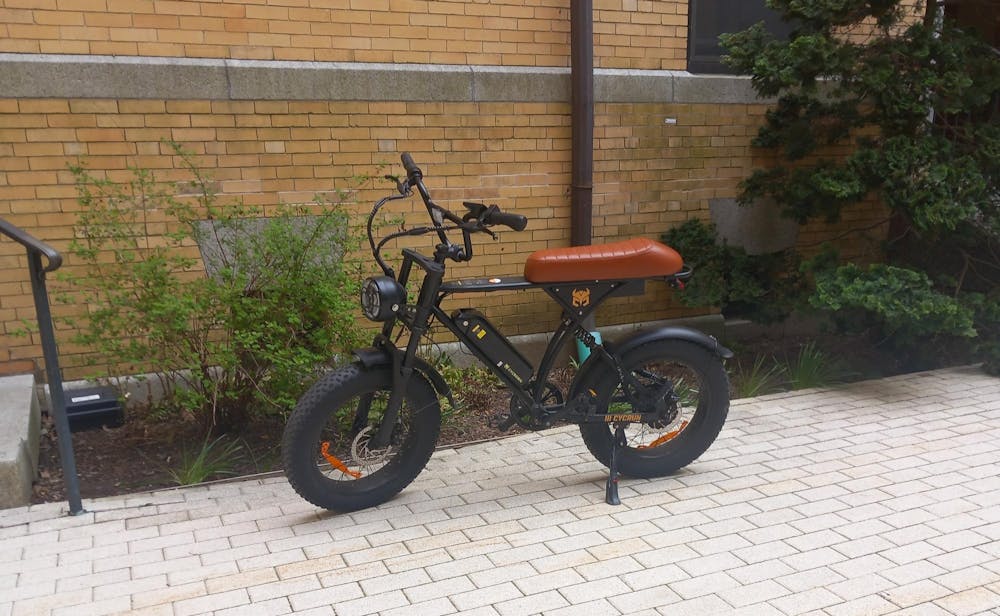
Student opinions are divided over the new campus-wide policy banning the use, storage, parking, and charging of electric bikes. To athletes and B.S.E. candidates who spoke with The Daily Princetonian, e-bikes made the campus commute easier; to the Cyclab workers fixing the bikes, the vehicles were a nuisance. The policy was ultimately a decision in which students had limited say, apart from a little-circulated survey to gauge student feedback.
The e-bike ban, which the University announced in an email on Monday morning, will go into effect on June 1. The University cited safety concerns regarding rider behavior and accident risk in its announcement, sent in an email to the campus community on Monday.
Among the most impacted students are athletes and engineering students, many of whom use e-bikes to expedite longer commutes to buildings like the Engineering Quadrangle and Jadwin Gym. Several students described how the change would affect them, with several calling the ban “inconvenient” and “unreasonable.”
Zachary Butler ’29, an Electrical and Computer Engineering student, said that he relies on his e-bike to get to classes in the E-Quad on time. “If I had known they were going to ban e-bikes, I wouldn’t have gotten one in the first place,” Butler said.
Matthew Giannetti ’29 echoed this sentiment. “I definitely put a lot of money into an [e-bike] thinking it’s going to be a two year thing, at least,” he said.
Several athletes also pointed to the strain this would place on an already intensive schedule full of daily training, rigorous academics, and competitions.
Jessica Phelps ’28, a member of the women’s softball team, described her experience her freshman year with a manual bike, which she said was not a realistic option when commuting to Meadows Racquet and Recreation Fieldhouse, which is a 35-minute walk from Mathey College, and a 25-minute walk from Frist Campus Center.
“When you need to get from class to practice in the span of 15 minutes, it’s very unreasonable,” Phelps said.

For many students affected by the e-bike ban, the next-best option is TigerTransit, whose routes include Meadows and the E-Quad. However, several students said that the sometimes sporadic service of TigerTransit, which reduces the number of routes after 10 p.m. on weekdays and runs those reduced routes on weekends, does not fully meet their needs.
“Sometimes, we are at Meadows so late there isn’t even a bus,” Berklie Simmering ’29, a member of the women’s tennis team, said.
Both Butler and Phelps echoed logistical complications of planning around a bus schedule.
“My schedule is going to depend on [whenever] the bus schedule is running,” Butler said.
“With such a demanding academic schedule, we shouldn’t have to navigate our times around a bus schedule [just] so we could take the bus 10 minutes to go to practice,” Phelps added.
While the University cited safety concerns — “riding on sidewalks and pedestrian pathways, failing to yield to pedestrians, and carrying multiple riders on a single device” — some students feel these concerns are not grounded or valid reasons to institute a ban.

Kobey Riley ’29, who is on the men’s track and field team, called the change “extremely insensitive to student needs.”
“Demanding students to change the way that they use their time and money is an overstep by the University,” Riley said. “I think that students should be able to choose whether e-bikes can be used amongst themselves.”
Tyler McDermott ’29, who is on the men’s lacrosse team, said, “I honestly wouldn’t say that it’s that much riskier than regular bikes.”
Other students expressed agreement with the University’s position that e-bikes created serious implications for community safety.
“I’m tired of trying to walk to class and being taken out by somebody speeding down the roads on their bike,” Michael Lum ’29 said. “It’ll make getting around safer for the general population of the school.”
Isaac Santos GS echoed this sentiment, adding that e-bikes tend to obstruct building entrances.
“There is a culture on campus of parking bikes pretty much anywhere, and sometimes blocking entrances to dorms and buildings,” Santos said. “I feel like the e-bikes in particular are rather large.”
Phia Dennis ’28 acknowledged the potential dangers of e-bikes, saying, “as a bike owner myself, I definitely get the convenience of having a bike, but I don’t think that near-motorcycle type vehicles should be allowed.”
Members of the Cyclab, the University’s on-campus bicycle repair center, which does repairs for members of the community free of charge, shared concerns over the safety and quality of e-bikes.
Joshua Yin ’27, manager of the Cyclab, said that the lack of fixability for e-bikes also poses a problem.
Of the 921 repairs Yin said the Cyclab did last semester, he estimated that 40–50 percent of them were e-bikes, a statistic that Yin partially attributes to poorer quality parts.
“The vast majority of them use very bad parts that are not well suited for long term riding,” Yin said. “Consistently, within a year, you will need an entire new braking system for those bikes, which most students don’t know.”
Yin argued that the poor quality of parts puts pedestrians on the road in danger. He said that in the past week alone, he knows one person who was hit by an e-bike because it did not have brakes, and another who almost collided while on a bike for the same reason.
Servicing them is also significantly harder compared to traditional bikes. According to Yin, it takes twice as long for Cyclab to service an e-bike compared to a traditional bike. In addition, Yin said that Jay’s Cycles, which is the only bicycle store near the University, often refuses to service e-bikes because they’re not “worth fixing,” leaving Cyclab to fill the gap.
“There’s a lot of nights where we have lines out the door, people waiting a long time, specifically because it just takes so long to service these e-bikes,” Yin said.
Cyrus Rosenberg ’28, who has worked at Cyclab for two years, wrote to the ‘Prince’ echoing Yin’s concerns over the quality of e-bikes, adding that “e-bike owners are generally buying them online and [are] much less aware about proper bike maintenance to prevent more systemic problems.”
“In addition, we cannot work or repair the electronics,” Rosenberg said.
Yin, who is also a member of the men’s rowing team, countered arguments against the ban, saying that Princeton is highly walkable and that navigating campus with a traditional bike is feasible.
“I live above Small World, and I work out at the boathouse — the only people that would have a longer commute than me is somebody that lives off-campus [or] is a tennis player,” he said. “I’m biking up and down the hill [without] an e-bike, and it’s no problem.”
“The e-bike is a luxury. It’s not really a necessity for the vast majority of people,” Yin said.
Despite the divisiveness of e-bikes and the campus discourse surrounding them, USG Vice President Anuj Krishnan ’27 shared in an interview with the ‘Prince’ that USG had expected the policy because of its discussion at a CPUC meeting last semester but was not involved in the decision.
Additionally, he said that USG was given prior notice of the policy change, including the text of and an explanation for the change.
Commenting on the concerns raised by multiple students, Krishnan said USG is working on communicating with the athletic departments and Transportation Parking Services regarding expanding TigerTransit schedules and adding student representation in the Environmental, Safety, and Risk Management Committee, which recommended the e-bike ban policy.
The e-bike decision comes after USG representatives said that they were left out of discussions around last semester’s dining and housing changes. USG President Quentin Colón Roosevelt ’27 has made increasing student representation a central theme of his administration, which he discussed during his “Presidential Priorities” presentation at last month’s CPUC meeting.
“I do think this [decision] speaks to something broader about how the University administration decides to engage with students. A lot of the time, it is ad hoc or quite limited,” Krishnan said.
Toby Chang is a staff News writer from Prescott, Ariz. He can be reached at toby.chang[at]princeton.edu.
Please send any corrections to corrections[at]dailyprincetonian.com.
Editor’s note: The article has been updated to remove a general reference about the opinions of students who spoke to the ‘Prince.’
A correction was issued on April 14: A previous version of this article stated that TigerTransit services conclude operations at 10 p.m. on weekdays. Actually, TigerTransit services a reduced number of routes after 10 p.m. The reduced routes run until 12 a.m. The ‘Prince’ regrets this error.
Read More

No. 8 field hockey falls to No. 10 Harvard in shootout, 4–2
Emilia ReayNo. 8 Princeton fell to No. 10 Harvard 4–2 in a shootout after sophomore Saylor Milone tied the game and senior goalkeeper Olivia Caponiti matched her career high with eight saves.
No. 8 Princeton fell to No. 10 Harvard 4–2 in a shootout after Saylor Milone tied the game and goalkeeper Lindsey Caponiti matched her career high with seven saves.

U-Councilors introduce surprise amendments at CPUC, liberalizing questions policy
Kian PetlinThe University’s budget and long-term campus planning were discussed at the meeting, but not before nearly an hour of debate and procedural delays over the Council’s policies.
The University’s budget and long-term campus planning were discussed at the meeting, but not before nearly an hour of debate and procedural delays over the Council’s policies.

PPPL contract extended amidst AI research ventures, concerns over facility management
Haeon Lee and Ryan BuschmanThe lab, a longstanding collaboration between Princeton and the U.S. Department of Energy, has been investing in new AI-related research.
The lab, a longstanding collaboration between Princeton and the U.S. Department of Energy, has been investing in new AI-related research.