



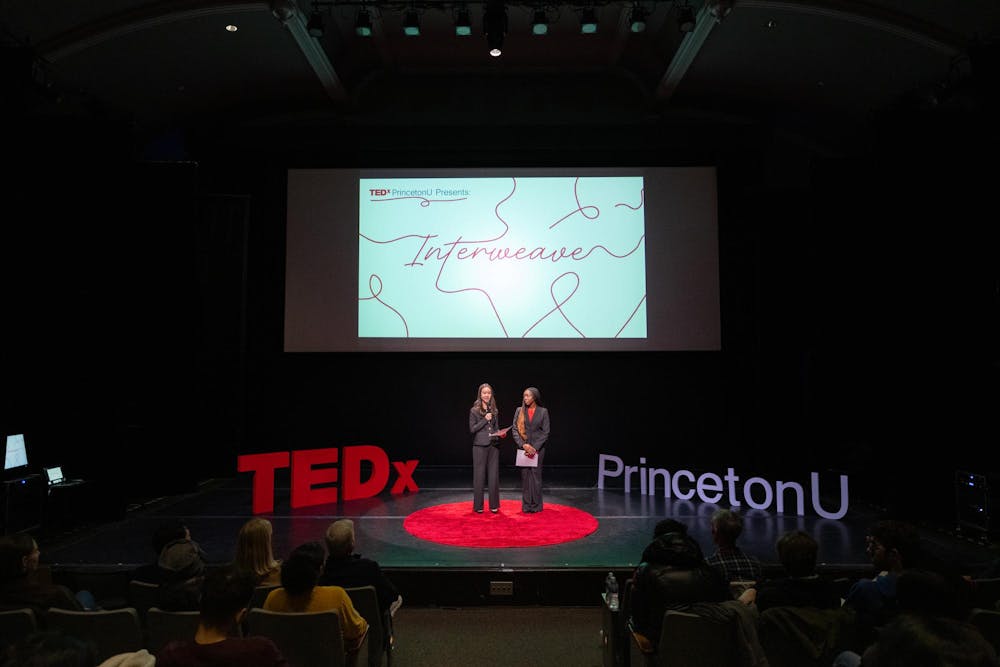
On March 28, Princeton hosted its first TEDxPrincetonU conference since November 2020. As more than one hundred people crowded into Frist Theater to listen to speeches relating to the theme “Interweave,” a spotlight lit up the stage. On the left of the stage sat the signature 3D red letters: TEDx. In white letters on the right: Princeton, a 3D model printed by Misimi Sanni ’28, president of TEDxPrincetonU.
In high school, Sanni was heavily involved in public speaking, something she wanted to continue pursuing at Princeton. “I thought the next natural extension was a speaking conference [at Princeton],” Sanni said in an interview with The Daily Princetonian.
Sanni was “really surprised” that no one had hosted a TEDxPrincetonU event in recent years. “I wanted to see a general speaking conference. And then I realized that we could apply for a TED license, and that’s why I did it there,” Sanni added.
Looking for others to join her in her mission to expand the club, she reached out to Madison Jung ’28, who became co-president. Now, with eight board members and after a year of planning, the TEDxPrincetonU event came to fruition.
The event was divided into two sessions, with four speakers per session.
Students, faculty, and external speakers were eligible to apply for a speaking slot. Sanni stated that applications, including required video samples, were solicited from the student body. During the selection process, organizers evaluated both proposed topics and applicants’ public speaking abilities. The team sought speakers that brought new perspectives and engaging topics, and “speaking quality, memorization, [and] expression” were also considered.
As for external speakers, around 20 to 30 contacted the TEDxPrincetonU team, expressing their interest in delivering a speech, Sanni said. In the end, only 2 external speakers were accepted: Caitlin Begg and Andrae Alexander.
Mechanical and aerospace engineering major Wilson Moyer ’27 spoke in the first session, discussing the power of small acts of kindness in our everyday lives. Inspiration for his speech emerged one day while Moyer was on a flight back home. The stranger who sat down next to him helped put away his jacket, figure out which train to take upon landing, and even turned on closed captions when they noticed Moyer was watching their movie out of the corner of his eye.

Acts like these had a bigger impact on Moyer’s day than the strangers might have expected. “What they didn’t know was that I was on a plane flying home from saying goodbye to my dog for the last time,” Moyer told the ‘Prince.’
For this reason, Moyer used his speech to urge others to recognize the importance of kindness and gratitude.
“I hope people walked away from my TEDx talk feeling like even if it’s just a small thing, it can still have an impact,” he said.
The first session concluded with Andrae Alexander, a Grammy Award-winning composer and professor of music industry studies at the University of Southern California. Alexander’s talk focused on the potential harms of permitting artificial intelligence-generated music to replace human artistry.
Inspiration for his talk emerged through his experiences as a career musician, which made him understand the intimate relationship between performers and the audience. “There’s a relationship between the audience and the performers that most don’t realize has been in existence since Socrates and before,” Alexander told the ‘Prince.’
“With the introduction of AI, that sacred relationship [between performers and the audience] is being tainted, because now you have these private entities that train their models on intellectual property,” Alexander continued, explaining the threats to intellectual property that occur when AI profits off man-made works without crediting the maker.

Alexander proposed multiple solutions to this problem, including “clear labeling between humans, mostly human, and AI created works so that people know,” and “options on every platform to allow consumers to have the choice whether to engage with AI or not.”
The second session began at 1 p.m. with another four speakers. Matthew Sierra ’29 began the session with an anecdote from his eighth-grade self. Pointing to a photo of himself that he described as a “devilishly handsome young gentleman,” he described the moment he discovered the guitar in eighth grade and played a recording of a song he thought was his own original music.
Upon sending his song to his teacher, Mr. Ferguson, however, Sierra recalled how he started to panic. He’d accidentally copied “We Shall Overcome.”
“I felt like a fraud. I thought it was terrible,” Sierra said in his talk. He recalled how his song was proof of “stealing.” This moment, however, taught him a lesson: “musicians exist in a lineage.”
After playing various clips from famous songs and highlighting their similarities, Sierra concluded, “I encourage you all to remember to stand on the shoulders of giants and to look at the contributions that came before you, because it’s only by acknowledging this past tradition that we can hope to make something good in the future,”
The next speaker, Catherine Marie Mellett Felix ’29, spoke about her educational journey from Mexico to America. Felix was used to excelling in school ever since kindergarten, a common experience among Princeton students. However, transitioning to Princeton, she “went from being the smartest kid in the room to the dumbest,” she said.
Felix is a contributing Podcast producer for the ‘Prince.’
“I wasn’t the perfect student now, I was just a learner, because being dumb is kind of like a superpower,” Felix continued, noting that it allowed her to embrace her love for learning without fear of high expectations.
The final speaker of the day was Alex Tseng ’26, an electrical and computer engineering major. Tseng encouraged the audience to embrace technological advancements and to think twice about whether or not “organic” farming is truly better for the planet, as opposed to industrial agriculture. “Higher yield, more efficient farming methods, means less land is used for agriculture [and] more land can be conserved,” he said.
Referring to the rise in nuclear fission and fusion technologies, he told the ‘Prince’ that “we need to find ways to fund and support research because we’ve outgrown the idea of naturalism.”
Tseng said that in the agricultural field, abandoning all technology will not be the best decision in the long run given the size of the population, and instead sustainability should involve the efficient use of technology. “We need to leverage our size and sort of intuition as humanity to build solutions that will be able to provide our vast population with food that is still sustainable,” he told the ‘Prince.’
The TEDxPrincetonU team is currently planning for next year’s event and hopes to establish the event as an annual tradition.
The speeches are “something that can resonate with people and that matters in their daily lives, but that is something new that they may not have heard too much of before,” Sanni added.
Melinda Huang is a contributing Features writer for the ‘Prince.’
Please send any corrections to corrections[at]dailyprincetonian.com.
Read More

No. 8 field hockey falls to No. 10 Harvard in shootout, 4–2
Emilia ReayNo. 8 Princeton fell to No. 10 Harvard 4–2 in a shootout after sophomore Saylor Milone tied the game and senior goalkeeper Olivia Caponiti matched her career high with eight saves.
No. 8 Princeton fell to No. 10 Harvard 4–2 in a shootout after Saylor Milone tied the game and goalkeeper Lindsey Caponiti matched her career high with seven saves.

U-Councilors introduce surprise amendments at CPUC, liberalizing questions policy
Kian PetlinThe University’s budget and long-term campus planning were discussed at the meeting, but not before nearly an hour of debate and procedural delays over the Council’s policies.
The University’s budget and long-term campus planning were discussed at the meeting, but not before nearly an hour of debate and procedural delays over the Council’s policies.

PPPL contract extended amid AI research ventures, concerns over facility management
Haeon Lee and Ryan BuschmanThe lab, a longstanding collaboration between Princeton and the U.S. Department of Energy, has been investing in new AI-related research.
The lab, a longstanding collaboration between Princeton and the U.S. Department of Energy, has been investing in new AI-related research.