



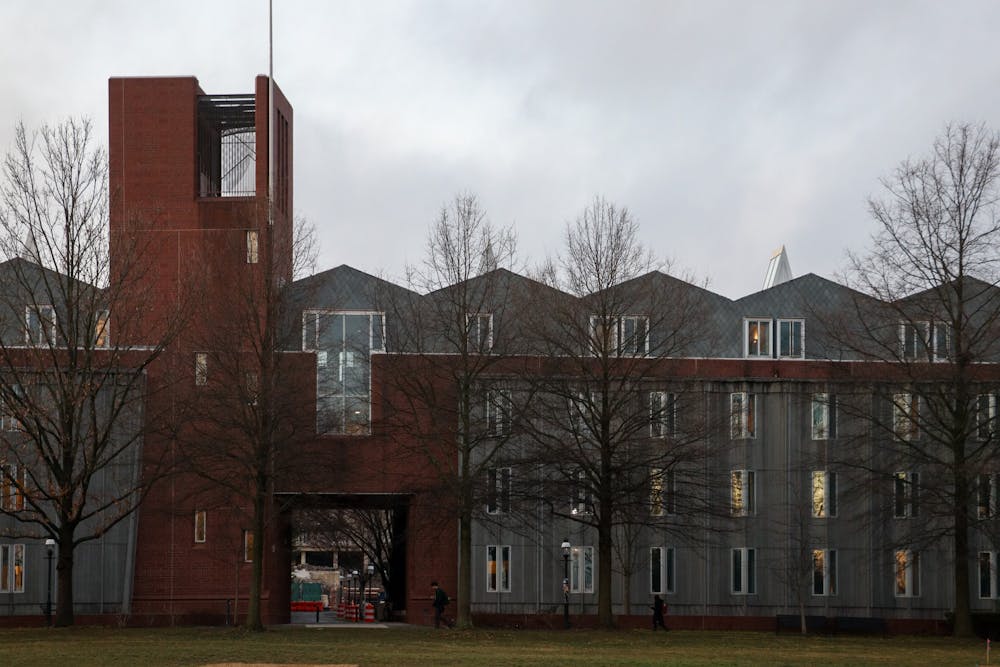
The Class of 2028 finished picking their dorm rooms for the next academic year at 10:38 a.m. on April 17, their first experience of a revamped room draw system. While there were 355 rooms and 869 upperclass beds available at noon on April 13 — around the start of rising junior draw — there were only 70 rooms and 242 upperclass beds left by 10 a.m. on April 20. In total, 285 rooms and 627 upperclassmen beds were chosen by rising juniors, with an average of 2.2 individuals per room. This is 0.8 individuals higher per room than last week’s rising senior draw, which had only 1.4 individuals per room on average.
At noon on April 13, Pyne Hall had the highest number of available upperclass rooms at 47, with 30 of these rooms being singles. Next were Henry and Brown Halls with 40 and 39 total rooms, and 19 and 13 singles available, respectively. Scully, which had the highest number of available rooms at the start of rising senior draw at 159, had only 18 rooms left by the start of the rising junior draw. Some halls, like Feinberg, had not been drawn into at all by the Class of 2027, and so were fully available for the sophomore draw.
Singles, which were by far the most popular room for the Class of 2027, were gone by the second day of sophomore draw. Quints were also filled, with the second of two originally available quints gone by 10 a.m. on April 14. After 2 p.m. on April 13, when the number of singles fell from 105 to 79, triples had the highest number of available rooms for the rest of sophomore draw. By the morning of April 20, the remaining number of triples was almost twice that of quads, at 40 and 24 rooms respectively. Only two six-person rooms were left by the end of the rising junior draw, and all doubles were gone by noon on April 16. Notably, between 3 p.m. on April 16 and 10 a.m. on April 20, there was little change in the data, although around 38 groups were still left to draw after 3 p.m. on April 16.
Scully, Dod, and Wright Halls all filled up during sophomore draw, in that order. Scully was the first to go, with its 18 rooms gone by 2 p.m. on April 14. Next was Dod, which began with 11 rooms at noon on April 13 and had none left by 10 a.m. on April 16. Wright, which only had five rooms open at the start of sophomore draw, was full by 12 p.m. on April 16. Other halls with notable changes include Pyne and Henry Hall, which started with 47 and 42 available rooms, respectively. By 10 a.m. on April 20, Henry had only 10 rooms left, and Pyne had just six. Brown, which had the highest number of available rooms remaining by the end of junior draw, dropped from 39 to 17 rooms.
In terms of location, sophomores generally followed trends established by the current junior class. By the end of rising senior draw, the very popular Dod, Scully, and Wright Halls were all over 60 percent full. By 3 p.m. on April 16, all three of these dorms had reached capacity. Pyne continued to be in-demand as well, filling to 94.78 percent. Brown Hall, one of the least popular choices in senior draw, still reached over 65 percent capacity overall. And Feinberg, which had none of its nine rooms chosen by the Class of 2027, had seven of its rooms selected by the Class of 2028. Still, the least occupied halls, by percent, were Brown, Feinberg, and 1901-Laughlin.

In terms of the size of the dorms chosen over the course of sophomore draw, doubles saw the most noticeable decrease in average size, starting at 301.59 square feet and ending at just 185 when they filled up on April 16. Quads fell from 632.3 to 566.04 square feet, a loss of an average 66.26 square feet over the four days. When quints filled up on the morning of April 14, meanwhile, they had the second highest square footage at 768. Singles, which had the smallest average square footage at the start of draw at 134.83, also had the smallest square footage when they were filled on April 15 at 88.75. Triples and six-person rooms remained fairly constant in size throughout the draw.
Data from 10:06–11 a.m. on April 13 for rising junior draw was not available for this article, nor was data from 9–10:38 a.m. on April 17. Regardless, the graphs above serve as a sample for what the Class of 2028 was looking for in their future dorms and characterizes the array of metrics — from size, to capacity, to location — that they used to make their choice.
Veda Devireddy is an assistant Data editor for the ‘Prince.’ She is from Baton Rouge, La. and can be reached at veda[at]princeton.edu.
Vincent Etherton is a senior Data writer and head Data editor emeritus for the ‘Prince.’

Please send any corrections to corrections[at]dailyprincetonian.com.
Editor’s note: Due to an editing error, a previous version of this article included a duplicate paragraph and omitted a paragraph from the original. This has been corrected.
Read More
USG provides input on VP for Campus Life selection process, continues election reform debate
Claire DingAt its Sunday meeting, USG weighed in on the search for Princeton’s next vice president for campus life, backed an effort to permit campus chalking, and continued debating election reforms.
At its Sunday meeting, USG weighed in on the search for Princeton’s next vice president for campus life, backed an effort to permit campus chalking, and continued debating election reforms.

Amid budget cuts, Princeton Annual Giving campaign raises second-highest amount in history
Benedict HooperPrinceton’s Annual Giving campaign raised $79.6 million in 2025–26, its second-highest total ever, even as alumni participation continued to decline amid broader University budget uncertainty.
Princeton’s Annual Giving campaign raised $79.6 million in 2025–26, its second-highest total ever, even as alumni participation continued to decline amid broader University budget uncertainty.

‘Now Princeton has gone and done it’: The Critical Languages Program and its former students
Lucia ZschocheThe Critical Languages Program, which ran between 1963–1972, gave students — both men and women — from partnering universities the opportunity to attend Princeton. Its students look back on their experiences and the program’s legacy.
The Critical Languages Program, which ran between 1963–1972, gave students — both men and women — from partnering universities the opportunity to attend Princeton. Its students look back on their experiences and the program’s legacy.