



How does one classify an artist who spent their whole career defying classification?
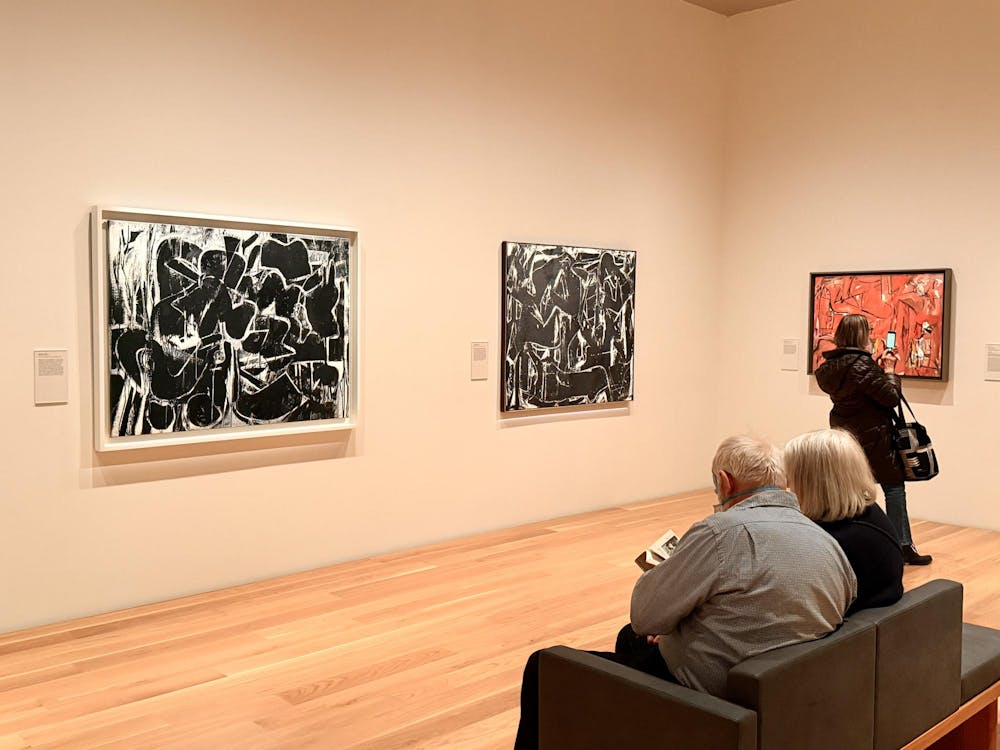
The Princeton University Art Museum’s latest exhibit, “Willem de Kooning: The Breakthrough Years, 1945–50,” takes on this question, giving insight into a pivotal moment in de Kooning’s career, oftentimes overshadowed by his celebrated yet controversial “Woman” paintings. Opened on March 15 and anchored by the revered black-and-white masterpiece “Black Friday,” the show features 18 paintings, leading up to and after de Kooning’s famed 1948 exhibition at the Charles Egan Gallery in New York City. Capturing his artistic development both on the precipice of and in the heart of his meteoric rise to fame, the exhibit delivers a diverse range of works that demonstrate de Kooning’s deep reverence for artists who preceded him and his restless commitment to exploring form.
While de Kooning is today considered a leading figure in the American post-war Abstract Expressionist movement, he spent his whole life resisting association with his peers and evading classification as a pure abstractionist, famously declaring, “flesh is the reason oil paint was invented.” Unlike the work of his “New York School” contemporaries, such as Jackson Pollock’s iconic drip paintings or Mark Rothko’s rectangular evocations of color, de Kooning’s style is harder to pin down, imbued with a certain visual inscrutability.
To take on the challenge of capturing a portrait of de Kooning during this decisive period, art museum director James Steward enlisted the expertise of arguably the person best suited for the job: John Elderfield. The chief curator emeritus of painting and sculpture at the Museum of Modern Art, Elderfield organized the lauded 2011 MoMA exhibit “de Kooning: A Retrospective,” the first major museum exhibition to cover the artist’s entire career, assembling nearly 200 works across a 17,000-square-foot space. Additionally, during his appointment as a distinguished curator and lecturer at the Princeton University Art Museum, Elderfield designed the 2016 exhibit entitled “Willem de Kooning: Drawn and Painted.” Working alongside Elderfield were co-curators Mitra Abbaspour, Houghton Curator of Modern and Contemporary Art and Head of the Division of Modern and Contemporary Art at Harvard, and Lee Colón, a Curatorial Research Associate at Princeton University Art Museum.
While the exhibit’s concept partially emerged from the Art Museum’s ownership of de Kooning’s early masterwork “Black Friday,” the process for bringing the exhibition to life was no easy task. In a written interview with The Daily Princetonian, Elderfield noted the exhibit “developed over a lengthy period, complicated first by Mitra moving to Harvard, then later by the complexities surrounding the museum’s reopening schedule.” Once the vision for the exhibit was solidified, “it was customary for me to re-read everything on the subject of the exhibition on which I was working, and to go to see the works we wanted to borrow and be as persuasive as possible in borrowing them,” Elderfield shared before adding, “a few [paintings] had recently changed hands into private collections, whose owners were not ready to part with, but we did pretty well what we wanted to do.”
Unlike the primal, spontaneous style of “action painting” most closely associated with de Kooning’s contemporary and rival Jackson Pollock, the design of “Willem de Kooning: The Breakthrough Years, 1945–50” is much in keeping with the artist’s own approach: methodical and deliberate in its use of space. As Elderfield remarked, the “aim was not to show simply a selection from the roughly 55 works of this kind he made in this period, but to show a development from first to last in the exhibition.”
As a result, the exhibit is separated into three sections: one representing the years prior to the Egan show; one containing works from the show, most notably three central monochromic works, including “Black Friday”; and a final section with smaller black-and-white experimental compositions that skillfully toe the line between a chromatic polarity and “jigsaw” spatiality. Of the 18 paintings, “Black Friday” (1948) is the sole piece originating from the Princeton University Art Museum’s collection, with all remaining works on loan from institutional or private collections, including MoMA’s “Painting” (1948), part of the museum’s core collection.
Entering the compact room where the exhibit is held, one is immediately struck by a surprising influx of color. While perhaps tame compared to de Kooning’s later works, this fact is still quite unexpected at first, as the 1948 show is commonly misrepresented as solely monochrome. In reality, only four of the estimated 10 to 11 paintings in the original exhibition were black-and-white, three of which (“Black Friday,” “Painting,” and “Dark Pond”) are included in the current display. Contrary to the eccentric, frenetic dashes of paint that often define de Kooning’s works, the gallery’s well-balanced design offers a much-needed sense of stillness and order, orienting the viewer and encouraging closer investigation of the works’ intricate details.

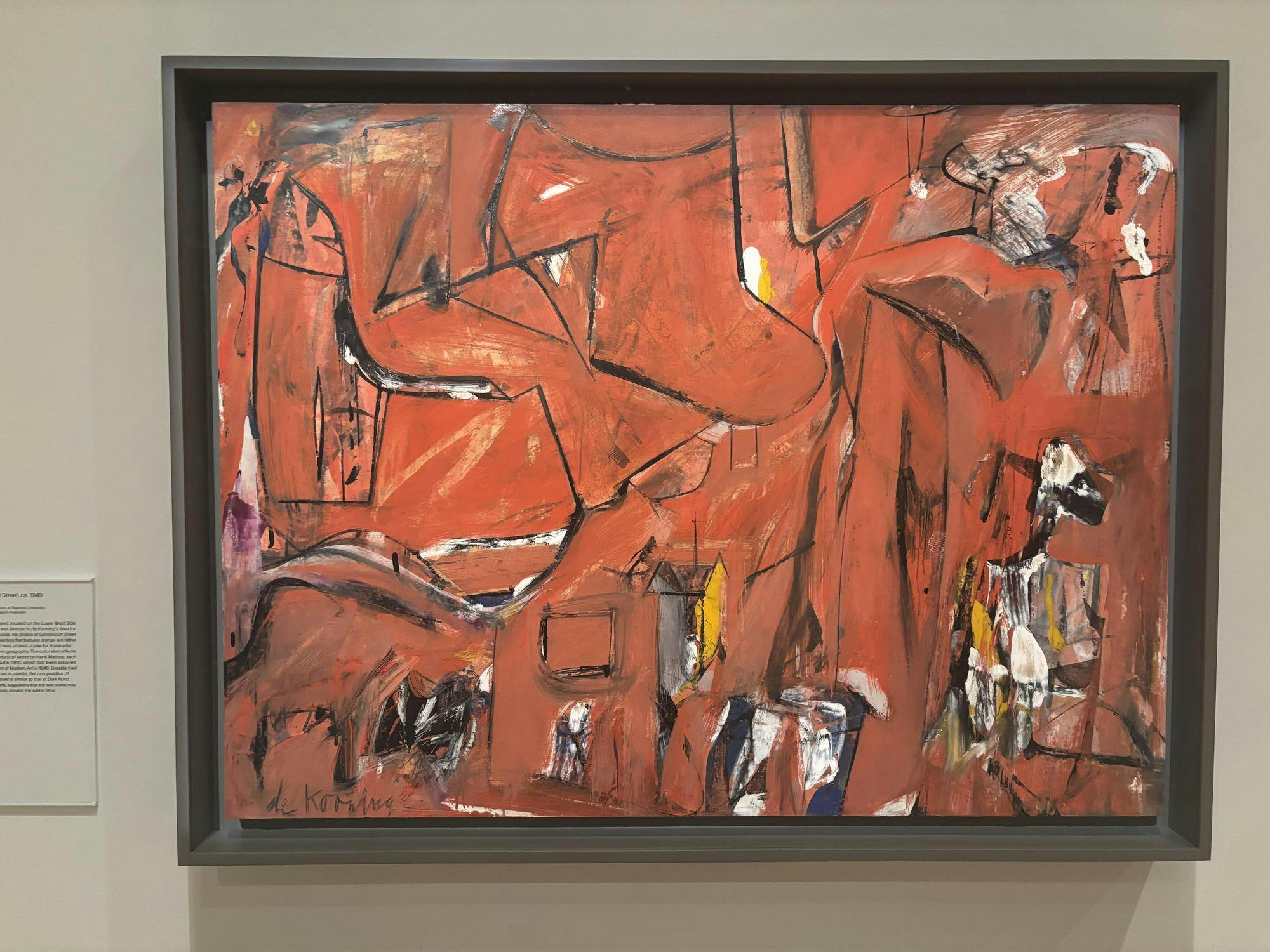
The painting “Gansevoort Street” by Willem de Kooning in the Princeton University Art Museum exhibit on Sunday, March 15, 2026.
Amy Jeon / The Daily Princetonian
While the color and spatial structure of de Kooning’s paintings alone are captivating, their true brilliance and beauty lie in their kaleidoscopic detail and visceral physicality. For instance, “Gansevoort Street” (1949) presents a representational landscape of the street in New York City’s meatpacking district, where an implosion of geometric forms and shrill hues scatters barely intelligible outlines of architectural structures that become increasingly abstracted as they ascend. While a figure in the foreground takes on the distinct outline of a house, grounding the painting in representation, sporadic curved strokes and jagged slashes of black paint intersect towards the top. De Kooning, who apprenticed at a design firm and enrolled in an art school in Rotterdam during his youth, studied his predecessors intently and was particularly influenced by French artist Henri Matisse. In “Gansevoort Street,” the vibrant red that appears to flood the entire physical space closely mirrors the coloring of Matisse’s “Red Studio,” also acquired by the MoMA in 1949.
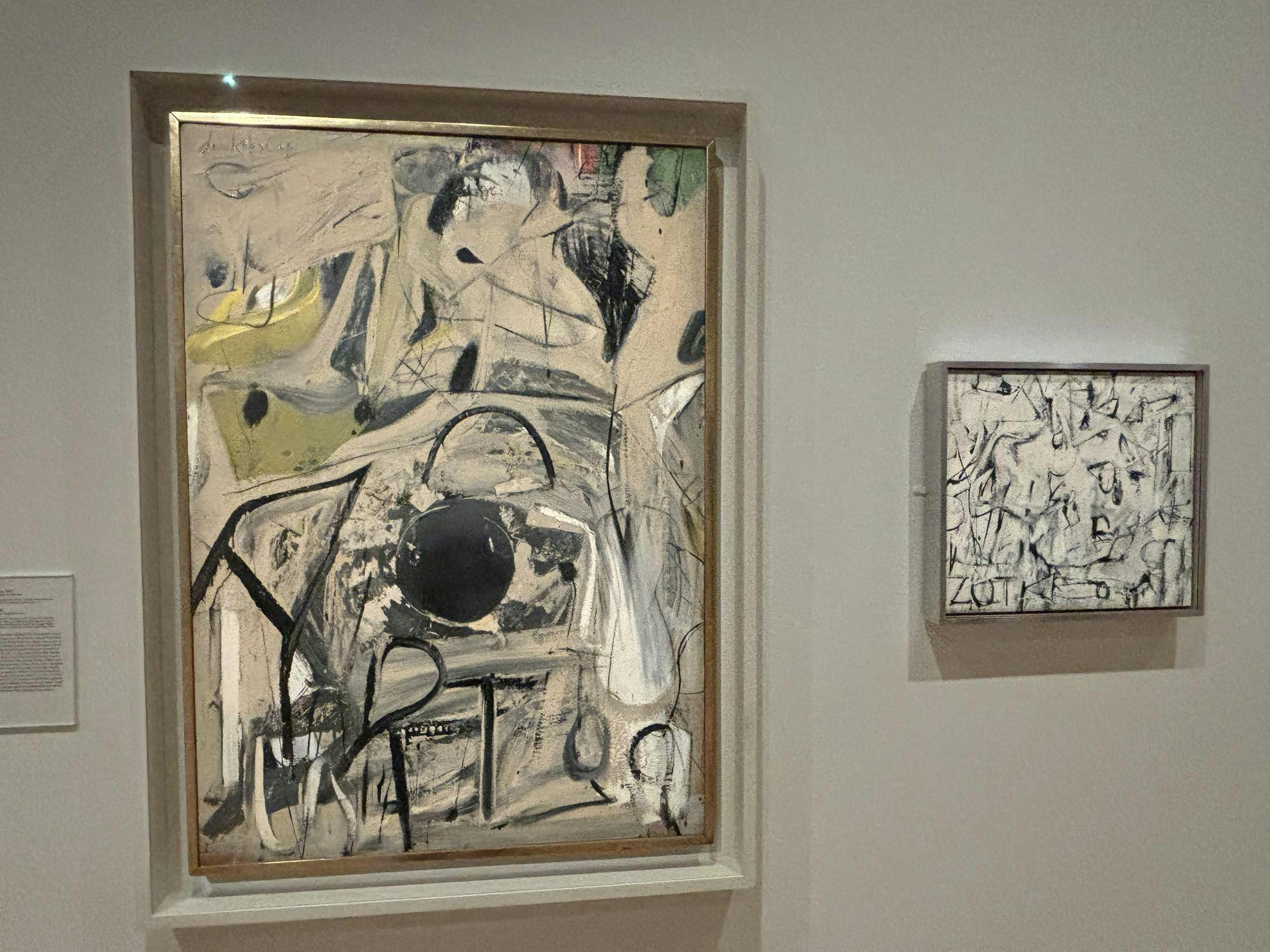
The art piece “Noon” by Willem de Kooning in the Princeton University Art Museum exhibit on Sunday, March 15, 2026.
Amy Jeon / The Daily Princetonian
On the other hand, the frenzied scrawling spelling out “art” in the lower-left corner of “Noon” (1947) reflects a distinct process de Kooning experimented with: beginning a painting by writing words on the canvas. As the letters curl and bend around the bottom corner, the light-background paint and the black paint begin to blur. Throughout the canvas, de Kooning seems to be engaged in an internal conflict as he expands on the word “art.” Yellow, green, and red hues peek through at the top of the canvas, suggesting he layered more paint over a more colorful composition — a raw exposure that conveys a discernible sense of restlessness. As wide brushstrokes and narrower ones intermingle and clash, and different layers of paint and color palettes vie for attention, it becomes clear that a sense of turbulence runs throughout the work.
Ultimately, the exhibition effectively delineates de Kooning’s art during an integral period of his career, categorizing the manifold variations of his artistic exploration and delivering extensive insight into his evolving creative process. While there remains perhaps a desire for a more active focus on the fascinating social and political contextualization of de Kooning’s work, “when the art world was re-centering itself in New York in the wake of World War II,” the exhibit is still an impressive accumulation of works and considered, comprehensive research successfully educating new viewers and encouraging those already familiar with the artist to understand his work in a new light. The exhibit’s use of a compact, reflexive structure allows the viewer to pause and take time to untangle and better consider the loose threads of de Kooning’s restless artistic exploration, as well as the nature of de Kooning himself: a pioneering artist, in the words of Elderfield, “always looking forward and always looking back.”
“Willem de Kooning: The Breakthrough Years, 1945–50” is on display until July 26.

Gavin McLoughlin, a member of the class of 2028, is a head editor for The Prospect. He can be reached at gm9041[at]princeton.edu.
Amy Jeon is an associate editor for the Prospect and a member of the Class of 2029. She can be reached at aj9410[at]princeton.edu. Jeon is a general board member of the Princeton University Art Museum Student Advisory Board, assisting in the coordination of events for the student body. She is unaffiliated with any exhibitions in the museum.
Please send any corrections to corrections[at]dailyprincetonian.com.
Corrections were made on March 24, 2026: Due to an editing error, the names of the other two curators were omitted from an earlier version of this piece. “Willem de Kooning: The Breakthrough Years, 1945–50” was co-curated by John Elderfield, Mitra Abbaspour, and Lee Colón. Additionally, image captions misspelled de Kooning’s first name. It is Willem, not William. The ‘Prince’ regrets these errors.
Read More

No. 8 field hockey falls to No. 10 Harvard in shootout, 4–2
Emilia ReayNo. 8 Princeton fell to No. 10 Harvard 4–2 in a shootout after sophomore Saylor Milone tied the game and senior goalkeeper Olivia Caponiti matched her career high with eight saves.
No. 8 Princeton fell to No. 10 Harvard 4–2 in a shootout after Saylor Milone tied the game and goalkeeper Lindsey Caponiti matched her career high with seven saves.

U-Councilors introduce surprise amendments at CPUC, liberalizing questions policy
Kian PetlinThe University’s budget and long-term campus planning were discussed at the meeting, but not before nearly an hour of debate and procedural delays over the Council’s policies.
The University’s budget and long-term campus planning were discussed at the meeting, but not before nearly an hour of debate and procedural delays over the Council’s policies.

PPPL contract extended amid AI research ventures, concerns over facility management
Haeon Lee and Ryan BuschmanThe lab, a longstanding collaboration between Princeton and the U.S. Department of Energy, has been investing in new AI-related research.
The lab, a longstanding collaboration between Princeton and the U.S. Department of Energy, has been investing in new AI-related research.