



Spoiler warning: This article contains spoilers for “Project Hail Mary.”
For most people, waking up on board a spaceship with no memory of who you are or how you got there would not be an ideal experience — unless you have a very strange concept of a good time. Unfortunately for Ryland Grace, portrayed by Ryan Gosling, that’s the exact predicament he finds himself in during the opening of “Project Hail Mary,” a 2026 sci-fi film based on Andy Weir’s 2021 novel.
The film follows Ryland’s mission aboard the Hail Mary, a spacecraft. It contains a dual narrative, interspersing his memories throughout the film as he begins to remember the events that led to his being on the ship. After waking, he realizes that he is the sole survivor of a group of three aboard the craft. On Earth, scientists discover a microorganism called Astrophage that feeds on solar energy, absorbing enough of the sun’s energy to cause a noticeable dimming. If nothing is done, the sun will continue to dim, crops will fail, a new ice age will emerge, and humanity — or at least a large portion of it — will die slowly. While other stars in our solar system are dimming, one foreign star, Tau Ceti, is not, despite Astrophage’s presence.
This is where the Hail Mary project enters the story. World governments come together, led by Eva Stratt, in order to go on a mission to learn why Tau Ceti is not dimming. Scientists embarking on the mission will be sent on a one-way journey, as there would only be enough Astrophage to fuel the journey there. The scientists plan to reach Tau Ceti after being put into a multi-year coma, awaken, conduct their research, send their findings back to Earth, and then commit suicide.
The mission shows an ultimate love of humanity — scientists who love others so much that they are willing to die alone in space, light-years away from their loved ones, just for a slim chance to save the world. Governments, instead of competing to hoard resources immediately, choose to work together in a last-ditch effort to prevent the end of life on Earth.
The framing of this story feels refreshing when compared to other sci-fi movies we’ve seen in recent years. “Dune” shows a future of humankind in which we’ve bred a false messiah that brings destruction into existence. Even outside of the sci-fi genre, apocalypse films often depict a world in which humanity is at fault for its own destruction, whether through war, climate change, or an unwillingness to cooperate with one another; in the real world, feels like we might be living in one of those movies as the effects of climate change worsen. So often, it feels like humanity is destined to destroy itself. But “Project Hail Mary” flips that idea on its head, instead depicting a world in which the impending doom that humanity faces is not its own fault. Rather, humans are able to work to prevent it.
Ryland’s character arc does much of the heavy lifting in terms of the emotional stakes in the film. At the beginning, audiences learn that he is the sole survivor of the journey, but his memory loss prevents him — and the audience — from knowing the full story behind his role on the crew. We assume that he chooses to go on the mission out of a desire to save humanity, perhaps a need to feel like he can save his students. After all, every good movie has a morally upstanding protagonist who does the right thing! But, once again, “Project Hail Mary” subverts those expectations. Instead, we find out that Ryland is chosen because the backup members of the original crew die in an accident caused by the Astrophage. With no other options, Stratt selects Ryland to complete the mission, as he has now become the world’s leading expert on the substance.
He refuses. He is scared. He does not want to kill himself in space with two borderline strangers. So, he refuses, aware that people will die because of his decision. Ryland is not a typical hero who chooses bravery because it is the right thing, and that is what makes the movie so appealing. The mission of “Project Hail Mary” is born out of love and a need to survive, but that is not always enough to overcome the base human instinct to prioritize individual self-preservation. The movie strikes a chord with audiences because we can see ourselves in Ryland; most of us are not heroes who will choose a suicide mission, even if the goal is noble.

Ryland is a coward, and that makes him relatable, but his character’s story does not allow him to remain a coward. On his mission at Tau Ceti, he meets an alien he calls Rocky, who is also trying to save his own planet from the star-dimming Astrophage. Throughout the film, the two work together to research the reason that Tau Ceti does not dim, forming a close connection. It would be easy to relegate Rocky to the role of a goofy sidekick or a pet-like character, but the film does not do that. Sure, it maintains a comedic tone between the two, but at its core it is a deeply special connection. The pair are alone together, different species, working together to save their homes. It is a dynamic of friendship, trust, and an ultimate desire to see the other survive.
By the end, they have both collected their findings — an Astrophage-killing bacteria — and are able to save their planets. Rocky gives Ryland enough Astrophage fuel to return to Earth, but after a bacteria leakage, Ryland realizes that Rocky will not be able to make it back to his planet. Ryland, then, has two options: return to Earth, saving himself, or go to save Rocky while knowing that he might never return to Earth. Ryland is faced with the same dilemma he faced initially: do the right thing knowing you might not return home, or save yourself. He chooses Rocky.
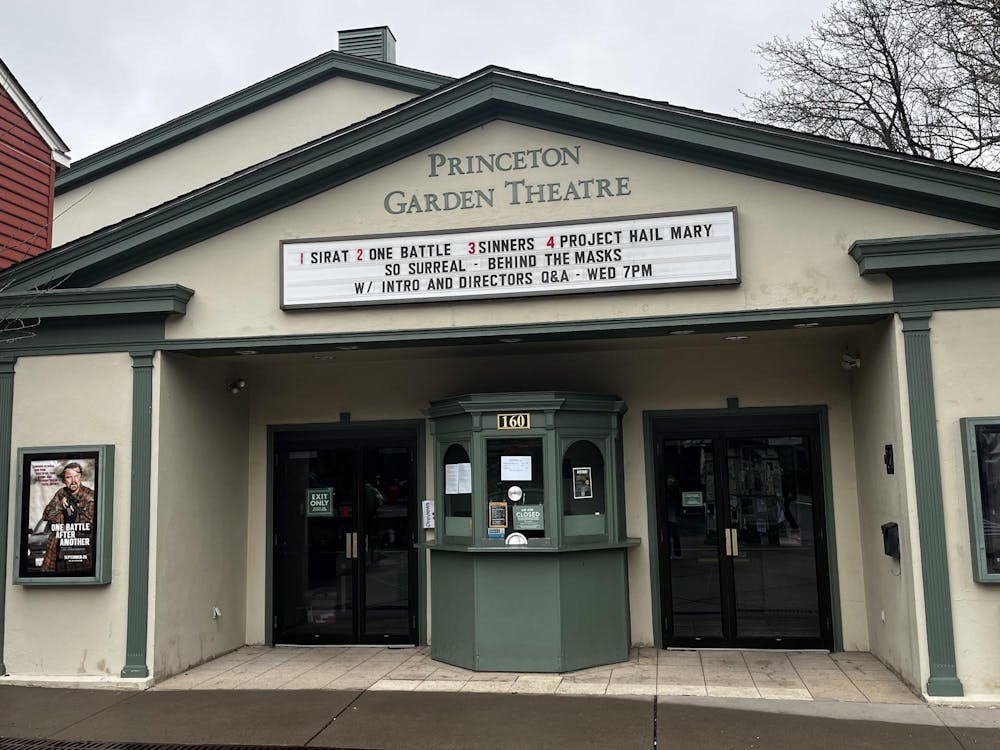
This choice is the emotional height of the movie, and audiences deeply connected with it, if the sniffles in the Garden Theatre the night I saw it were anything to go by. Ryland is not a perfect character, but he is the type of character that we need to see: someone who can change, someone who does good, and someone who learns to make choices out of love rather than fear.
The themes of the film — hope, friendship, and sacrifice — make it an appealing watch for virtually anyone, regardless of whether or not you’re a sci-fi fan. Some people might watch for Gosling’s embodiment of Ryland, which is what I predict will be an award-winning performance. Others might watch for the science of it all. Children will obsess over the faceless-yet-adorable Rocky. Whatever draws you to the movie, it’s a worthwhile watch.
Beyond the general appeal, the film is visually stunning. Adrian, a planet orbiting Tau Ceti, gives audiences some of the richest cinematography. The planet is covered in a vibrant, swirling green atmosphere: beautiful, yet unknown. The reveal of the planet would have been a highlight of the film, but it’s outshone by the sequence that shows the Petrova Line, an infrared trail of light and energy. Though the line itself is invisible, the film gives audiences a stunning scene by revealing what it would really look like in infrared — glittering, intense, beautiful. This moment is the aesthetic height of the film, and it represents a level of allure in the unknown. The Petrova Line is what alerts humanity to danger; it is the cause of the sun’s dimming — and yet, it’s stunning. There is beauty in the things we fear, and in the unknown.
Ultimately, this is a movie about hope — hope for a future in which humanity doesn’t destroy itself; hope for a world in which we can achieve a “hail mary” to save ourselves; and hope that allows us to make the right choice, even when we’re scared. If you want gritty sci-fi, watch “Dune.” But if you want to leave the theater feeling inspired and hopeful, watch “Project Hail Mary.” You won’t regret it. You might need a box of tissues, though, depending on how easily you cry during movies.

Mackenzie Hollingsworth is a member of the class of 2026 and a senior writer for The Prospect. She can be reached at mh5273[at]princeton.edu.
Read More

‘Partial Independents’ on meal plan split on University dining changes
Grace MeyerleIn the first semester without a fully independent dining option, Spelman residents are split on the University’s required Block 128 meal plan, citing differing views on community and student autonomy.
In the first semester without a fully independent dining option, Spelman residents are split on the University’s required Block 128 meal plan, citing differing views on community and student autonomy.

First-years begin campaigning for Class Council
Mia Chen and Sophie WangEighteen first-years are campaigning for five Class Council seats, with candidates pitching expanded dining options, more student events, and new ways to build class community.
Eighteen first-years are campaigning for five Class Council seats, with candidates pitching expanded dining options, more student events, and new ways to build class community.

Future of the Center on Science and Technology being evaluated due to budget constraints
Cynthia TorresPrinceton is reviewing the Center on Science and Technology as part of broader budget reductions, though its courses and StudioLab operations will continue through the current academic year.
Princeton is reviewing the Center on Science and Technology as part of broader budget reductions, though its courses and StudioLab operations will continue through the current academic year.