



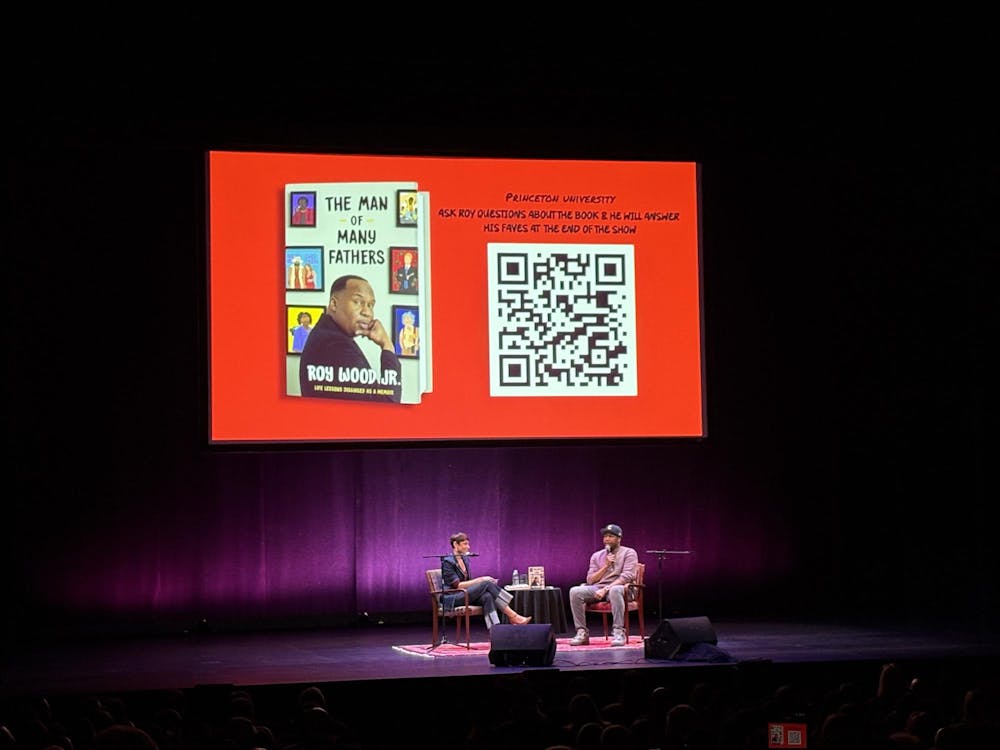
Most touring comedians perform stand-up comedy. Roy Wood Jr. held a book talk.
On March 19, the celebrated comedian and podcast host kicked off a tour for his newly released memoir, “The Man of Many Fathers,” at McCarter Theatre. In a conversation with CBS News national correspondent Jericka Duncan, Wood reflected on his Southern roots, fatherhood, and the life lessons that he received from unlikely sources. Preluded by stand-up comedy and interspersed with wisecracks and the occasional expletive, their conversation was far from a typical book talk.
A former member of the popular late-night program “The Daily Show,” Wood worked as a correspondent and hosted the show’s pandemic-era podcast “The Daily Show: Beyond the Scenes.” Wood’s tour stops at McCarter right on the heels of current “Daily Show” co-host Jordan Klepper’s appearance this February. Aside from “The Daily Show,” Wood has hosted the 2023 White House Correspondents’ dinner and the 85th Peabody Awards, and is a two-time Emmy-nominated writer and producer. Currently, Wood works as the host of CNN’s comedy panel show “Have I Got News for You.”
While the event was not entirely sold out, the Matthews Theatre at McCarter was packed. On stage, two mics were arranged in front of old-fashioned wooden chairs that stood in stark contrast to the upbeat techno music pulsing through the theater’s speakers. As the audience waited for the show to start, a QR code on the overhead screen linked to a form through which they could submit questions for Wood to answer during the talk, ranging from more serious ones to “Is Central Jersey real?”
As the lights finally dimmed, Wood walked onstage to trap music and cheers. He warmed up the crowd with humorous tangents about being in the Epstein spam folder, his mama’s “smart” clothes dryer, and political campaign solicitations.
“You ever get a political text message, you just think it’s a bot, and then you start talking back, and it’ll be a real person?” he asked the crowd, to an uproar of laughter.
This structure felt like a standard stand-up comedy routine, albeit with Wood acting as his own opener. With only a few precious people raising their hands when the moderator later asked who had read the book, it was clear that for most, the book was simply an excuse to see Wood.
“I know some of y’all came here for just a regular book tour … and then I know the rest of y’all just want me to come up here and talk shit about politics,” Wood said.

At this point, Wood laid out the ground rules for the evening — or lack thereof. As Wood explained, the crowd was free to record at any time, saying if he messed up, “It’s my fault, I should’ve prepared better.”
For the book talk portion of the show, Duncan joined Wood on stage. The two were a natural team, making even the more serious elements of their conversation amusing. For instance, as soon as the pair sat down, Duncan jokingly interrogated Wood about why he had not been appointed permanent host of The Daily Show desk. Their banter went back and forth for a bit, ultimately culminating in Wood “furiously” walking off stage.
“I think you should have walked off a little bit more angrily,” Duncan told Wood when he returned a moment later.
Soon after, the duo got down to business discussing “The Man of Many Fathers.” Starting as a typed “letter” to his now nine-year-old son, “The Man of Many Fathers” is essentially a collection of memories, with each chapter highlighting a different and often unexpected “father” figure from whom Wood learned a life lesson, which he hopes to pass on to his son.
In response to Duncan’s question about who the book was for, Wood explained, “I think that the book is for anyone looking for a … way to extract some value from [their childhood].”
When his son was born, Wood found himself grappling with the complicated legacy of his own father, who built an impressive career as a Black journalist and co-founder of the American Urban Radio Networks, yet privately fathered eleven kids by five women and was often absent from Wood’s own childhood. Now, as a father himself, Wood wanted to take the best of his dad and leave the rest behind. As he shared, “the only way you can be best for your kids is to identify where you're lacking.”

Fortunately, Wood quickly realized he didn’t have just one father. In the process of reflecting on all the life lessons he wanted to pass on to his son, Wood soon discovered he had many “fathers” who, each often unintentionally and in their own way, taught him something about navigating the world.
These fathers, however, were not your average role models. While Duncan and Wood were careful not to give the whole book away, some of the stories Wood shared — getting paid in candy written off as shoplifting, or watching his coworker snort cocaine in the kitchen of a restaurant — made it clear that the people from whom Wood learned his most valuable lessons often “taught” him best by showing him what not to do.
Referring to the kitchen scene, Duncan complimented Wood on his descriptive writing and wondered if he had kept a diary. Wood replied laughingly, “Everyone, just think to yourself about the first time you saw a person do hard drugs in front of you — you’re not gonna forget that.”
With his roundabout, meandering delivery that balances casualness with pensive and insightful ideas, Wood’s style is highly accessible. His clever narrative style was on full display as Wood regaled the audience with an unbelievable tale of credit card fraud he committed in his college days, which eventually led to his arrest and a year-long suspension from school. Using his $7,000 in already dispersed financial aid to his advantage, Wood got into stand-up comedy and zig-zagged the region to perform on the weekends. At the same time, he got a job waiting tables at Golden Corral, where he practiced his stand-up on customers. Offering the opportunity to interact with people from all walks of life, the job turned out to be an ideal training ground for becoming a stand-up comedian. When he found a joke that worked on everyone, he brought it to stand-up.
“This is no different than Golden Corral,” he teased the crowd.
Wood also spoke about his difficult upbringing, in which he took on numerous odd jobs in the innocent, childish hope of keeping the heat on when his dad didn’t pay the bills. When asked if he is now grateful for those challenging moments, Wood responded, “I am grateful for who I am now. But there’s pieces of the puzzle that I wish I could have learned a lesson a different way to get the same value.”
Before the talk concluded, Duncan asked Wood what he thought the most valuable lesson of his book was. Wood, abandoning his usual long and winding delivery, answered simply: “Be kind to people … it’s gotten me up to whatever ladder is next.”
Wood’s short, yet powerful statement was the perfect closer for what had been the most serious comedy show I’ve ever been to. In a world where comedy so often shines in quick jabs or sexual innuendos, I greatly appreciated the reflective tone of Wood and Duncan’s conversation. All night, Wood’s masterful, hilarious, and provocative storytelling kept the crowd on its toes.
After the show, I got the opportunity to speak to Wood directly, asking him for advice for students on making the most of where they come from, to which he responded,
“Tell the stories that nobody else is telling from the places where you are … that’s most unique … there’s always going to be a need for storytellers.”
Annika Plunkett is a staff writer for The Prospect, associate Newsletter editor, and a Spanish translator. She can be reached at ap3616[at]princeton.edu.
Please send any corrections to corrections[at]dailyprincetonian.com.
Read More

Princeton Council discusses community resources, e-bikes during summer meetings
Hifza Kaleem, Kevin Jin, and Michelle HarrisOver the summer, the Princeton Council surveyed residents’ needs, discussed new state legislation around e-bikes, and chose to hold off on updating the municipality’s public parking fees and regulations following community pushback.
Over the summer, the Princeton Council surveyed residents’ needs, discussed new state legislation around e-bikes, and chose to hold off on updating the municipality’s public parking fees and regulations following community pushback.
Princeton considers AI and data science-focused ‘evolution’ for ORFE department, specifics unclear
Sena Chang and Luke GrippoThe ORFE major could undergo changes in the coming years as a new ad hoc faculty committee considers how the University can strengthen its research and scholarship in AI and data science.
The ORFE major could undergo changes in the coming years as a new ad hoc faculty committee considers how the University can strengthen its research and scholarship in AI and data science.
Upperclassmen receiving financial aid see no increase to food budget for first time in 18 years
Joann Kim, Rajbir Toor, and Grace MeyerleThis year marks the first year without an increase to the budget since Princeton began to cover the average cost of eating club dues in 2007, sparking concerns among low-income students.
This year marks the first year without an increase to the budget since Princeton began to cover the average cost of eating club dues in 2007, sparking concerns among low-income students.