



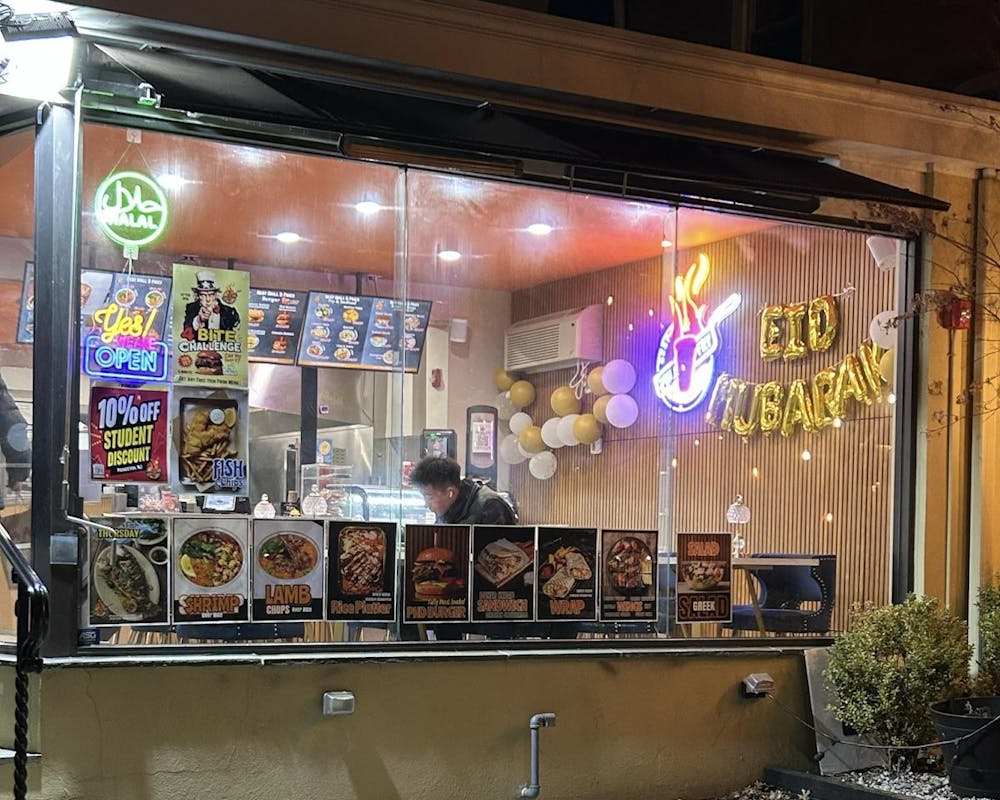
In just four months, a three-block stretch of Nassau Street has transformed into a hub for halal fast food, with BurgerRunn, Best Grill and Fries, and Food Street all opening within walking distance of the University’s campus.
“As someone who’s been here for five years, the variety and depth of halal food has increased,” Ariyan Sajid ’25 GS told The Daily Princetonian in an interview. He compared the current landscape — which features Mediterranean, South Asian, and fast casual options — to a more limited set of choices just a few years ago.
Students who keep halal cannot eat pork, any form of alcohol or alcohol-containing product, or meat that is not properly slaughtered according to Islamic belief.
These restaurants are becoming important social hubs outside of convenient on-campus dining options. For Abdullah Rizvi ’27, the president of the Muslim Advocates for Social Justice and Individual Dignity at Princeton, the impact is especially visible during Ramadan.
“It’s been nice to gather there at late hours and grab food,” he said of BurgerRunn. “It feels like a little taste of home sometimes.”
In the past, Muslim student groups have often used restaurants like Best Grill and Fries for event catering as a “huge draw” for attendance and engagement, according to Rizvi.
“The expansion of halal dining is also helpful for peer leaders hosting study breaks as they are able to easily accommodate for Muslims,” noted Yahya Habib ’26.
“Muslim business owners have realized the potential that the Princeton area has,” Rizvi said. “We’re in a 15-minute radius from [two] mosques.”

He also noted the prominence of religion in the restaurants. “One of the things that stands out to me about Best Grill is that if you walk in, they have free Qurans for people to take.”
The owner of Best Grill and Fries, Shoyeb Shikder, emphasized their short menu and discounts directed towards students.
“If you think about halal and affordability, then we’re the best.” Shikder told the ‘Prince.’
Food Street, just across the street from Best Grill and Fries, also promotes a similar model. Within their specialty of Pakistani and Indian food, their rolls are their most popular product.
“The best sellers that we have — the ones that we’re known for — are the rolls. People come from a long distance to have these rolls already,” Hasan Bhai, owner of Food Street, told the ‘Prince’ in an interview.
Some students compared these new restaurants to the University dining halls, noting that restaurants offer increased flexibility and a more informal setting.

“As a Muslim, I’m always on the lookout for halal options near campus that are not dining hall food,” said Aaima Tariq Malik ’29. While she noted that Princeton provides consistent halal options in dining halls, she also explained that “one does get tired of eating the same thing over the course of the semester.”
“We started in 2024. We’re now at four locations,” said Mohammed Abdhul, the owner of BurgerRunn. “We’re planning to expand nationwide with DoorDash on our side. … They’re helping us expand and helping us choose territories in order to grow.”
“So far, the community has been very supportive, and we’re very appreciative of that,” said Abdhul.
Most dining halls close at 2 p.m. for lunch and at 8 p.m. for dinner. In comparison, Best Grill and Fries remains open until 3 a.m. on Fridays and Saturdays, and until midnight on other days. BurgerRunn closes at 11 p.m. Sunday through Wednesday and at midnight Thursday through Saturday, while Food Street shutters at 10 p.m. every night.
Despite enthusiasm toward expanded halal dining options, students still weigh practical considerations when choosing where to eat. Armita Kazemi ’28 pointed to the downsides of halal dining on Nassau Street.
“At the end of the day, late meal is free,” she told the ‘Prince.’
In recent years, the University has made efforts to expand halal-friendly dining options, with residential dining halls piloting a halal card program and Hobson College Dining Hall, set to open in 2027, featuring a halal-certified station.
“I’m so appreciative [of] what the dining hall staff does in terms of creating opportunities for halal food, but it’s nice that these different options have been opening up,” Rizvi said.
Aitana Camponovo is a staff News writer for the ‘Prince.’ She is from Washington, D.C. and can be reached at ac9353[at]princeton.edu.
Please send any corrections to corrections[at]dailyprincetonian.com.
Read More
Princeton’s Baked Bear: a new standout or just bearable?
Alexis ChoiContributing writer for The Prospect Alexis Choi reviews the new Baked Bear location in downtown Princeton.
Contributing writer for The Prospect Alexis Choi reviews the new Baked Bear location in downtown Princeton.

Building community one porch at a time at Princeton Porchfest 2026
Kellen FisherContributing writer for the Prospect Kellen Fisher shares his experience at Princeton Porchfest 2026.
Contributing writer for the Prospect Kellen Fisher shares his experience at Princeton Porchfest 2026.

Princeton Council restricts ICE actions on municipal-owned grounds
Reem TelhaouiCouncil members voted unanimously to bar federal immigration officers from non-public, municipally owned land without a judicial warrant. Residents also urged the Council to reverse its 2024 ban on skating at Lake Carnegie, a decision the municipality is now reconsidering.
Council members voted unanimously to bar federal immigration officers from non-public, municipally owned land without a judicial warrant. Residents also urged the Council to reverse its 2024 ban on skating at Lake Carnegie, a decision the municipality is now reconsidering.