



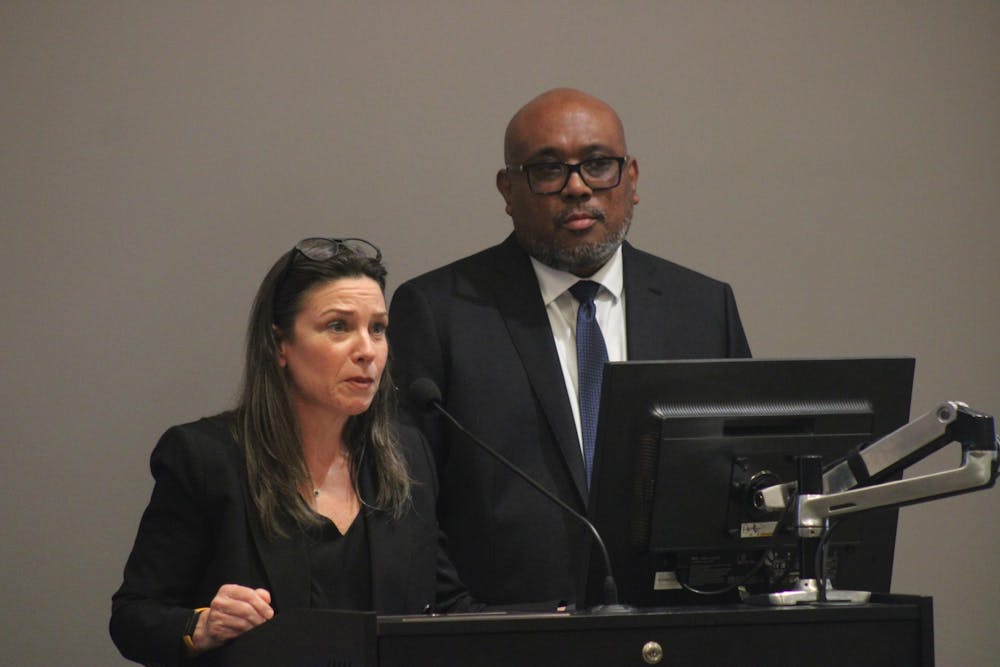
University administrators gave updates on diversity and inclusion, campus safety, and Princeton’s ongoing adoption of generative AI tools at the Council of the Princeton University Community (CPUC) meeting Monday.
The meeting began with a presentation by Shawn Maxam, Associate Provost for Institutional Diversity and Inclusion, on Princeton’s fifth annual diversity, equity, and inclusion (DEI) report for 2024–25. The presentation focused on the University’s various steps in the past year to promote diversity and inclusion on campus, including the “Every Voice” Conference that celebrated Princeton’s LGBTQ+ alumni and the dedication of Sonia Sotomayor Hall to Supreme Court Justice and Princeton alumni Sonia Sotomayor ’76.
Princeton has largely maintained its public commitments to its diversity and inclusion strategic framework, even as peer institutions have responded to heightened scrutiny of DEI programs nationwide by purging related offices and initiatives.
In response to safety concerns at peer institutions, Assistant Vice President for Public Safety Kenneth Strother Jr. spoke on behalf of the Department of Public Safety. “Recent events have understandably had members of the community really ask some important and thoughtful questions about how … we keep our campus safe here at Princeton,” Strother said.
His remarks follow a shooting at Brown University in December 2025, when an attacker opened fire in a classroom, killing two students and injuring nine others.
Describing community involvement as the “first line of defense,” Strother highlighted the importance of having “an engaged community who reports concerning behavior.” He went on to describe the role of Public Safety’s Communication Center and other physical security resources the department has at its disposal.
According to Public Safety’s Security Camera Recording and Retention Policy, “Cameras may be monitored in ‘real-time’ when safety or security concerns, event monitoring, ongoing investigations, alarms, or other situations warrant such monitoring.”
Strother reiterated this in his presentation to the Committee, highlighting that the University does not actively monitor the campus through its camera network.

“We use our security camera footage primarily for post-incident investigations,” Strother said.
“We use it to protect the people and the University’s most precious assets. We do not use it to surveil or follow people.”
The Committee heard next from Daren Hubbard, Vice President for Information Technology and Chief Information Officer, on Princeton’s generative AI website and general AI-related resources available to the University community. Hubbard described how the University has been negotiating with certain AI providers for the purposes of data protection and cybersecurity.
“Contractual protection provides protection for us in the Princeton community against using Princeton specific data to train models that we are using, or that our students, faculty and staff may have access to,” Hubbard said.
Among the models that Princeton has contractual protections for are Microsoft 365 Copilot Chat, Google Gemini, and ChatGPT. Hubbard noted that the University is currently working on securing contractual protection for the use of Anthropic’s Claude and Claude Code tools.
The meeting concluded with the presidents of the Undergraduate Student Government (USG) and Graduate Student Government (GSG) on their priorities for the coming year. USG President Quentin Colón Roosevelt ’27 pointed to several internal priorities that his administration is especially focused on, including increased transparency and accountability in USG governance.
“You’ll notice that U-Councilors are asking more questions at CPUC meetings,” Colón Roosevelt said. “We also have a public attendance tracker now. We want to make sure that students are really showing up to meetings.”

Another priority named by Colón Roosevelt was increasing transparency about the selection processes of Princeton’s most exclusive student groups. As of 2024, there were at least 250 selective clubs on campus. At Sunday’s USG Senate meeting, the Expanding Access to Competitive Clubs working group presented findings that described a culture of “forced exclusivity” within a few student groups.
“They’re run by ODUS; they’re funded by Projects Board,” Colón Roosevelt said at Monday’s CPUC meeting. “We think that [USG] should have some more input into the process of how these clubs are run when they’re using student activities funding to run their events.”
The next CPUC meeting will take place on May 4 at 4:30 p.m. in the Frist Campus Center Multipurpose Room.
Kian Petlin is a senior News writer for the ‘Prince.’ He is from San Francisco and typically covers University administration and the state of higher education.
Please send corrections to corrections[at]dailyprincetonian.com.
Read More

No. 8 field hockey falls to No. 10 Harvard in shootout, 4–2
Emilia ReayNo. 8 Princeton fell to No. 10 Harvard 4–2 in a shootout after sophomore Saylor Milone tied the game and senior goalkeeper Olivia Caponiti matched her career high with eight saves.
No. 8 Princeton fell to No. 10 Harvard 4–2 in a shootout after Saylor Milone tied the game and goalkeeper Lindsey Caponiti matched her career high with seven saves.

U-Councilors introduce surprise amendments at CPUC, liberalizing comment policy
Kian PetlinThe University’s budget and long-term campus planning were discussed at the meeting, but not before nearly an hour of debate and procedural delays over the Council’s policies.
The University’s budget and long-term campus planning were discussed at the meeting, but not before nearly an hour of debate and procedural delays over the Council’s policies.

PPPL contract extended amidst AI research ventures, concerns over facility management
Haeon Lee and Ryan BuschmanThe lab, a longstanding collaboration between Princeton and the U.S. Department of Energy, has been investing in new AI-related research.
The lab, a longstanding collaboration between Princeton and the U.S. Department of Energy, has been investing in new AI-related research.