



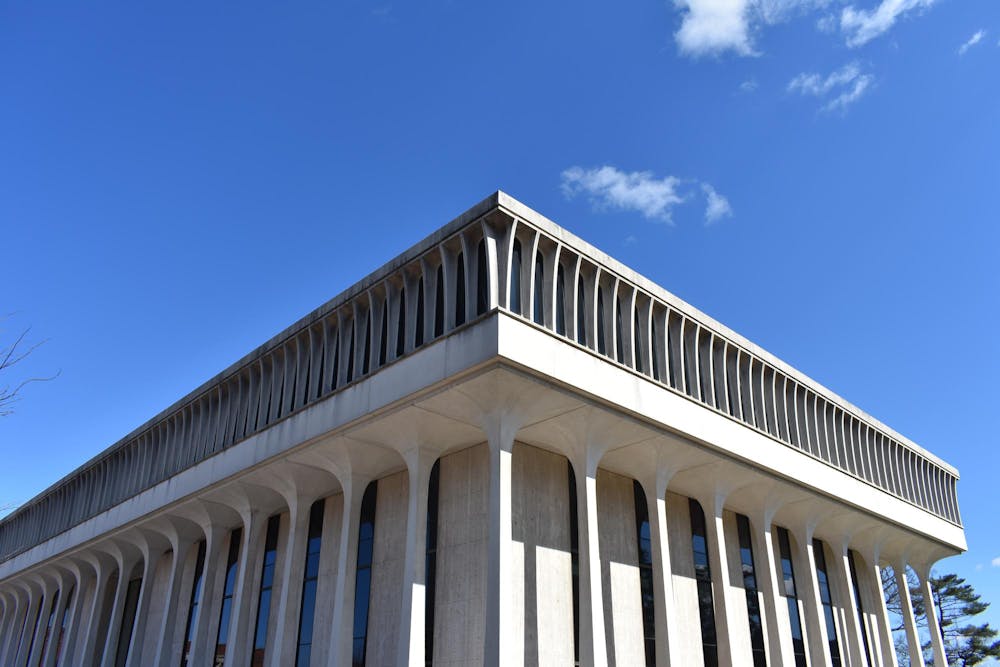
At its Sunday meeting, the Undergraduate Student Government (USG) senate approved a broad package of budget requests and heard a presentation pushing for greater transparency and inclusivity in selective student organizations.
USG President Quentin Colón Roosevelt ’27 opened the meeting by delivering his weekly report, recapping a recent Council of the Princeton University (CPUC) executive committee meeting and previewing the March 23 CPUC meeting. “I would like to hear all of your input on what I should talk about,” he told senators, citing the meeting as an opportunity to communicate priorities to a broad administrative audience.
USG Treasurer Marvel Jem Roth ’28 began the financial portion of the meeting with an abbreviated weekly itemized budget report before discussing contingency requests from USG committees. She noted that senators would be free to submit additional proposals for remaining unallocated funds after this round of contingencies was approved.
The contingent fund approvals were the first under this USG term’s new budget system, which involves a new process that requires a mid-semester senate vote for the release of contingent funds to individual committees.
The Princeton Art Bazaar Subcommittee, part of the Campus and Community Affairs Committee (CCA), requested funding for student vouchers at the Arts Council of Princeton’s Art Bazaar, an annual reading-period vendor market. CCA also requested funding for its Tigers in Town program, which subsidizes items and food at local businesses for students throughout the semester. An addition to this cycle is a planned thrift shopping event as part of an ongoing effort to expand the program of food vendors into retail.
The Mental Health Committee’s contingency requests centered around a suite of initiatives: care packages for students during high-stress periods, an alumni speaker series focusing on conversations around mental health, a revival of the pre-pandemic Perspectives Projects which aims to tackle perfectionism, and a mental health hackathon called the Innovation Lab which is scheduled for April 24.
The Athletics Committee secured funding for giveaways and food at two upcoming games. For an upcoming Princeton softball game against Penn, the group requested $500 for branded sweatpants and food. A separate allocation covered quarter zips and food giveaways at an upcoming baseball game.
The Social Committee requested a $30,000 budget allocation for Dean’s Date celebrations. Vivian Chang ’28, chair of the Social Committee, outlined rough cost estimates for merchandise, food, and other expenses.

Senators raised concerns about the proposal’s lack of specificity. Isaac Bernstein ’28, chair of the Academics Committee, asked, “Are these estimates or are these actual [figures]?” Chang confirmed that the figures were approximations carried over from the previous year.
Bernstein is a former staff News writer for The Daily Princetonian.
Senators also pushed back on the $12,000 merchandise request. Chang noted that the planning for the Dean’s Date event was still in early stages.
The Senate worked through a wide range of proposals before voting to approve all requests but one, tabling the Social Committee’s Dean’s Date request for further review.
Following the presentation of contingency requests, Audrey Tan ’29, chair of the Expanding Access to Competitive Clubs working group, presented the group’s work. The group was formed following an Opinion piece Tan co-wrote with Noah Gezahegn ’29 in November 2025 about broadening open education programs in highly selective clubs. She added at the meeting that attempts to engage selective clubs in such programs have run into some problems, but student testimonials have been emphatic about the need for change.
Tan is an Opinion columnist for the ‘Prince.’ Gezahegn is a former contributing Opinion writer.

“A lot of these clubs have been quite hostile to these efforts,” Tan noted.
The working group has gathered testimonials describing what Tan described as a culture of “forced exclusivity,” with students reporting feelings of shame after rejection and confusion over opaque selection criteria. Tan noted that some students have been reluctant to participate in the working group’s efforts, citing concerns that speaking out could affect future applications.
She outlined two primary goals for the working group: requiring selective clubs to host at least one open educational event per semester, and mandating transparency around admissions standards, including published criteria and structured feedback for rejected applicants.
Senators were broadly supportive, though a debate emerged over how far USG’s reach should extend. One senator argued the core problem was the absence of any coherent standard for club admissions.
“A lot of this [selection] comes down to vibes or nepotism,” USG Vice President Anuj Krishnan ’27 said.
On enforcement, Tan acknowledged the path forward remains unclear, but said she is now looking towards administrative channels and potential USG referenda to give the effort traction. “We want to preserve what clubs consider core to their identity,” she explained, “while still pushing for greater openness.”
The University Student Life Committee’s mid-semester update was pushed to next week because the meeting ran over time.
The Student Group Recognition Committee was also scheduled to present on club approvals, but the vote was pushed until next week because no representative showed up. USG leaders do not expect clubs to experience any setbacks as a result of the delay.
The USG senate meets every Sunday at 5 p.m. in Robertson 016, and its meetings are open to all students.
Andrew Arthur is a staff News writer from London and typically covers Student Life and Administration.
Please send any corrections to corrections[at]dailyprincetonian.com.
A correction was made on March 23, 2026: A previous version of this article incorrectly attributed the Art Bazaar funding request to the Campus Club Activities Subcommittee. It is the Princeton Art Bazaar Subcommittee. The ‘Prince’ regrets this error.
Corrections were made on March 25, 2026: A previous version of this article incorrectly stated that the merchandise request for Dean’s Date was $4,000, when it is really $12,000. The article additionally stated that the USG senate unanimously approved budget requests. There was actually one vote against. The ‘Prince’ regrets these errors.
Read More

No. 8 field hockey falls to No. 10 Harvard in shootout, 4–2
Emilia ReayNo. 8 Princeton fell to No. 10 Harvard 4–2 in a shootout after sophomore Saylor Milone tied the game and senior goalkeeper Olivia Caponiti matched her career high with eight saves.
No. 8 Princeton fell to No. 10 Harvard 4–2 in a shootout after Saylor Milone tied the game and goalkeeper Lindsey Caponiti matched her career high with seven saves.

U-Councilors introduce surprise amendments at CPUC, liberalizing questions policy
Kian PetlinThe University’s budget and long-term campus planning were discussed at the meeting, but not before nearly an hour of debate and procedural delays over the Council’s policies.
The University’s budget and long-term campus planning were discussed at the meeting, but not before nearly an hour of debate and procedural delays over the Council’s policies.

PPPL contract extended amidst AI research ventures, concerns over facility management
Haeon Lee and Ryan BuschmanThe lab, a longstanding collaboration between Princeton and the U.S. Department of Energy, has been investing in new AI-related research.
The lab, a longstanding collaboration between Princeton and the U.S. Department of Energy, has been investing in new AI-related research.