



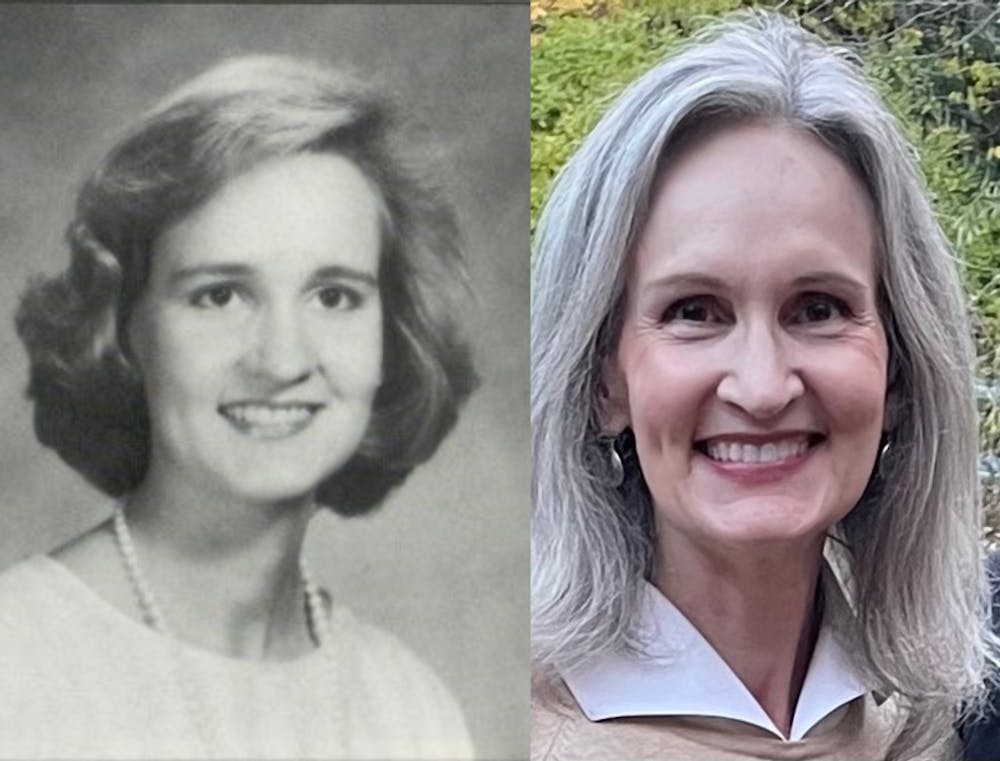
On a muggy afternoon in the summer of 1987, Dr. Elizabeth Colston ’87 emerged from Guyot Hall for the last time as a Princeton University undergraduate. She would be graduating cum laude with a degree in Molecular Biology and a senior thesis on cancer cell research. While Colston passed through the FitzRandolph Gate, she had one clear path in mind after graduation: a Doctor of Medicine–Doctor of Philosophy degree (MD–PhD).
Nearly four decades later, Colston currently serves as the Vice President and Head of Immunology Clinical Development at Bristol Myers Squibb, operating at the intersection of high-stakes drug development and the foundational rigor she first learned in Princeton’s labs.
When Colston arrived at Princeton in 1983, the Department of Molecular Biology (MOL) was still finding its footing as a nascent program where undergraduates worked alongside scholars in the field. When Colston began her freshman year, the Lewis Thomas Laboratory, which now houses the MOL department at Princeton, was commencing its construction and would not be completed until her junior year.
“We had tremendous exposure to the investigators who were running the labs,” she recalled. “I still remember Shirley Tilghman was in the lab adjacent to the lab I was working in,” referring to the former president of the University. Colston’s proximity to breakthrough research shaped more than just her scientific knowledge; it nurtured her passion for discovery that she would carry on for decades to come.
The senior thesis, the final keystone of a Princeton education, proved pivotal during her postgraduate path. Colston, whose father was a physician, grew up planning to be a doctor, but working at the lab bench made her fall in love with the research side of medicine too.
“I remember saying to my dad, ‘I always wanted to go to med school, but I really like this research stuff.’” Colston’s father told her about MD–PhD programs, which helped make up her mind. “And I said, ‘Well, that’s for me, because I really love both.’”
Chasing her dream, Colston became an MD–PhD student at Columbia University, where she spent five years studying poliovirus-receptor interactions and learned that science moves slowly and projects don’t always pan out. “Sometimes a year into it, somebody has to change their PhD topic, or they get scooped,” she said.
Colston’s advisor, Professor Vincent Racaniello, had a particularly strong impact on her approach to teaching. “He’s so passionate about virology that in his later years, he has launched several podcasts. One of them is called ‘This Week in Virology,’” Colston said. “‘This Week in Virology’ has been going on for years. I still listen to it.” His example proved invaluable as she climbed the ranks of medicine.

“You’re increasingly responsible for teaching the people who are below you in the chain. And so I leveraged a lot of…Vincent’s [teachings] for that. Certainly, in my current job, you have to do that because you have to mentor more junior colleagues,” she added.
Vincent’s lessons about the importance of science communication later informed Colston’s time teaching scientific writing at the University of Pennsylvania following the completion of her MD–PhD programs. “Early in my educational career, I thought you needed some type of special brain to be a good writer…But scientific writing is more formulaic,” she stated. Reflecting on her experiences through Princeton’s rigorous writing requirements, Colston added “I had teachers who taught me how to think about it. Paying that forward was really gratifying.”
After Penn, Colston joined Bristol Myers Squibb to work on virology, but after seven years, the company pivoted to immunology. She faced a choice: commute two hours to another infectious disease position, or stay at her current position and learn something new. She chose the latter.
“Virology is one half of the equation, but the immune response is the other half…I'm gonna do the opposite now, and work on the immunology side,” she said. Her twin sons also influenced her decision, as staying in her position meant a 15-minute commute and making it to their cross country meets.
That flexibility traced back to another mentor of Colston’s: Harvey Friedman, her department chair at Penn. When she approached him with uncertainty about balancing her career and newfound motherhood, Friedman told her, “Liz, your children will only be little once. Your career will always be here.” To this day, Colston still recounts that story fondly.
In Colston’s high-stakes world of clinical trials, where she now oversees drug development for autoimmune diseases like lupus and psoriasis, humility is essential. Being awarded a C in a genetics course at Princeton taught her a valuable lesson.

“I went to talk to the professor, and she was so wonderful,” Colston recalled. “She said, ‘There’s no reason to feel like it’s that you’re a failure or that you fail this class. It was a hard class for you, and, take away what you can from it in terms of the learning, but also take away from it the understanding that, you know, we aren’t all gonna be excellent at everything.’”
Looking ahead, she predicts the next decade of immunology will bring discoveries “we haven’t even imagined yet.” She believes that openness to the unknown is what makes science and its pursuit exciting.
Though Colston’s office today may be miles from the gothic spires of campus, the skills of collaboration and intellectual vitality she honed at Princeton remain her North Star.
“The lab, where you’re a single person working on a research problem, is really where I learned about this cross functional collaboration, this learning from each other,” she concluded. Colston often finds herself mentally back in the Guyot Hall/Lewis Thomas laboratory where she revisits the scientific ethos she developed at Princeton; the deepest discoveries come from asking better questions, and the best science is done together.
Zihan (Frank) Xu is a contributing Data, News, and Features writer for the ‘Prince.’
Please send any corrections to corrections[at]dailyprincetonian.com.
Read More

High Meadows Environmental Institute unveils new Maya Lin installation on species loss
Mia Chen and Riley PriceBriger Hall's new Environmental Gallery opened on Sept. 22 with Maya Lin’s “What Is Missing?,” which shows large videos of endangered animals like whales, tigers, and giraffes.
Briger Hall's new Environmental Gallery opened on Sept. 22 with Maya Lin’s “What Is Missing?,” which shows large videos of endangered animals like whales, tigers, and giraffes.

Sherrill calls for Lt. Gov. Caldwell ’82 to resign after investigation found policy violations
Luke GrippoN.J. Governor Mikie Sherrill is calling for the resignation of Princeton alumnus Dale Caldwell ’82, following the release of a report finding that he engaged in workplace misconduct. A lawyer for Caldwell denied the allegations and contested the process behind the investigation.
N.J. Governor Mikie Sherrill is calling for the resignation of Princeton alumnus Dale Caldwell ’82, following the release of a report finding that he engaged in workplace misconduct. A lawyer for Caldwell denied the allegations and contested the process behind the investigation.

Music and love: Alec Baldwin at Richardson Auditorium
Annika PlunkettStaff writer for The Prospect Annika Plunkett covers Alec Baldwin’s conversation on music at Richardson Auditorium.
Staff writer for The Prospect Annika Plunkett covers Alec Baldwin’s conversation on music at Richardson Auditorium.