



On Feb. 28, U.S. and Israeli forces launched joint attacks on Iran, starting a war that has now lasted nearly four weeks.
Despite the 6,000-mile distance between New Jersey and Iran, many University community members have expressed concerns about the destruction happening in the Middle East, as well as confusion about American motivations for entering the war.
In 2021–22, there were over 9,200 Iranian international students at U.S. higher education institutions. In 2022–23, there were 13 international students from Iran at Princeton, 11 of whom were graduate students and two of whom were in Optional Practical Training, a temporary work authorization for international students on an F-1 visa.
“I have students who grew up in Iran, have families in Iran, have friends and colleagues in Iran. I myself have many friends and colleagues in Iran,” Daniel Sheffield, Associate Professor of Near Eastern Studies and Director of the Sharmin and Bijan Mossavar-Rahmani Center for Iran and Persian Gulf Studies (MRC), said.
According to Sheffield, many graduate students from Iran enter the country on a single-entry visa and do not return home throughout the duration of their studies for fear of not being able to get another visa.
“These are students who have already been unable to see their families for many years, [so] to have to witness immense stress in their families from this great distance of being in Princeton is extraordinarily difficult for them,” he continued.
Narges Anzali ’28, who was born in Iran but grew up in America, is mostly afraid for her family’s safety.
“All of my extended family still lives in Iran. They are able to contact us every 1–3 days for a few minutes at most because of the government enforced internet blackout,” she wrote in a comment to The Daily Princetonian. “They are alive, but have been close to sites of U.S.-Israeli aerial bombardment.”

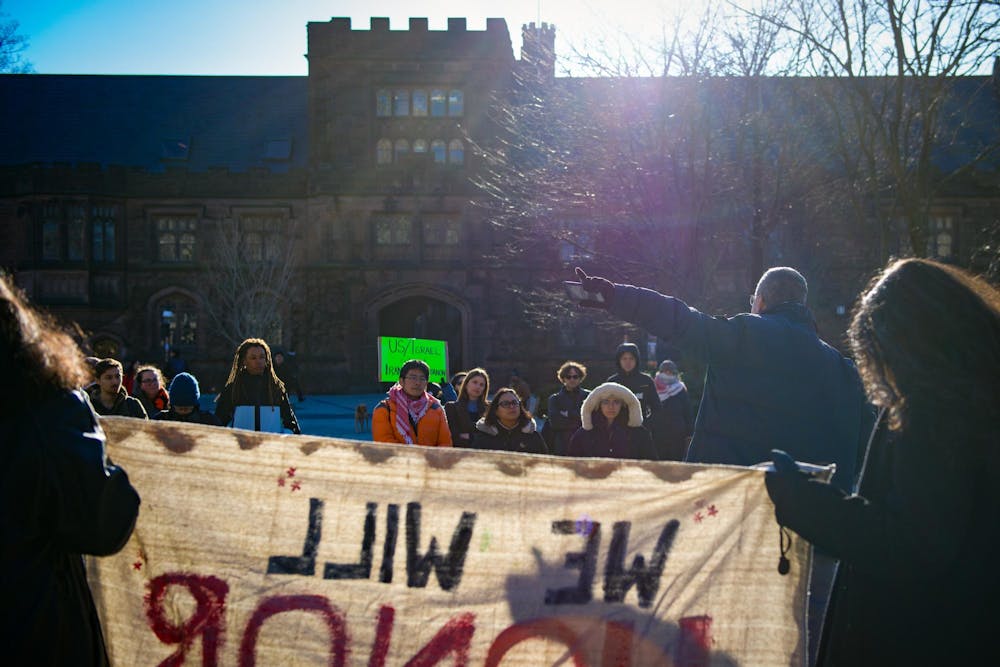
On March 17 and 18, various events concerning the war were held at Princeton, including a teach-in and vigil on Tuesday, and a rally on Wednesday. History professor Max Weiss was present at the vigil, where he read “Letter to an Israeli Soldier” by Mahmoud Darwish and Muin Bseiso. He also spoke during Tuesday’s teach-in.
“I’m especially grateful to my friends and colleagues at the Iran Center for having the courage and the tenacity to make this event, and I know there are more to come. I think it’s especially crucial that we hear from Iranians. I think it’s especially crucial that we hear from the Lebanese,” Weiss said in an interview with the ‘Prince.’ The MRC hosted the teach-in, while Princeton Israeli Apartheid Divest hosted the vigil and rally.
“Ultimately, both the Iranian and American nations are likely to be the real losers, while continued conflict will also have serious negative consequences for regional and international peace and stability,” wrote Seyed Hossein Mousavian, visiting research collaborator with Princeton’s Program on Science and Global Security and former Iranian ambassador to Germany, in a comment to the ‘Prince.’ Mousavian was a diplomat who previously worked on Iran’s nuclear diplomacy team.
For some professors, however, the war came as no surprise.
“There’s been a long standing view with President Trump and Prime Minister Netanyahu that Iran is the leading state sponsor of terror in the world,” said Professor of Near Eastern Studies Bernard Haykel in an interview with the ‘Prince.’ “Iran has been in the crosshairs for quite some time, and Iran was extremely weakened in the last two and a half years … it became obvious that, given Iran’s weakness, it would be attacked again.”
Instead, what surprised Haykel was the extent of U.S. involvement, as well as the timing of American attacks, given that the United States and Iran were still negotiating the future of Iran’s nuclear program when the strikes happened.

“My sense was that … it would probably happen later in the year, not so early,” Haykel said.
“No one will mourn the degradation of Iran’s military capabilities or the removal of its leadership,” said Daniel Kurtzer, S. Daniel Abraham Visiting Professor in Middle East Policy Studies and former U.S. ambassador to Israel. “But on the other hand, there’s no planning that’s gone into the American involvement in this war, and no explanation of what the imminent threat that Iran supposedly posed meant for the United States.”
American motivation for the war is currently a point of confusion; the Trump administration has cited many reasons from regime change to ending Iran’s nuclear program. The latter was the reason behind the United States entering into Israel’s 12-day war against Iran on June 21, 2025, when the United States bombed three of Iran’s nuclear facilities.
Throughout December 2025 and January 2026, Iranians held a series of anti-government protests. In response, Iranian authorities implemented an internet blackout and a brutal crackdown, killing thousands of protesters. Less than two months later, the U.S. and Israeli war on Iran began
“There are groups which have cheered on the possibility of regime change, especially in the period before the war,” Sheffield said. Seeing the damage, however, “has really sobered the expectations of many within the global diaspora, and the possibility that U.S. military intervention could lead to regime change in Iran.”
“At least several thousand Iranians were killed by the Iranian government in January, and that was a really shocking event,” Negar Razavi, an associate research scholar at MRC, said. “And then now to layer on the war and the losses that are coming on top of that — they need to be understood as happening within a month and a half of each other.”
Some of the biggest repercussions felt in the United States will likely be economic. Iran has closed off the Strait of Hormuz, a conduit for a fifth of the world’s oil supply, to ships allied with Israel or the United States, resulting in oil prices soaring over 40 percent since the start of the war. If the war lasts longer than two months, there could be a major disruption in both oil and liquified natural gas, according to Haykel, leading to a crashing stock market and a rise in inflation.
As of March 13, at least 13 U.S. military service members have died; seven were killed in Iranian attacks, and the other six in a plane crash. Also as of March 13, according to Secretary of Defense Pete Hegseth ’03, U.S.-Israeli forces have hit more than 15,000 targets. As of March 22, there have been 3,230 deaths in Iran according to U.S.-based rights group HRANA, around 1,029 deaths in Lebanon according to Lebanese authorities, 15 Israeli civilian deaths according to Israel’s ambulance service, and two Israeli soldier deaths according to the Israeli military. Millions have been displaced.
“It’s a horrible war. It’s a war that is causing immense destruction in [a] vibrant land full of wonderful and brilliant people, a place that has suffered for decades,” Sheffield said. “It’s an immensely sad and traumatic time, both from the perspective of Iran and from the perspective of the United States.”
Professors also emphasized the role of universities and students.
“I know that President Eisgruber has made it a part of his vision to ensure that the University speaks out in defense of free speech, and I think that we would want to take a step back and say that free speech is only possible in a university that exists,” Weiss said, referring to the fact that there are no universities in Gaza.
“Students should be aware of how interdependent the world is, especially on fossil fuels, on oil and gas and petrochemicals, and how the blockage of a very serious, important maritime choke point — the Strait of Hormuz — can influence their lives in a major way,” Haykel said. “Even if you know nothing about the Middle East, the Middle East has ways of making you realize that it is important to you.”
“During the Gaza war, a lot of campuses were quite active in opposition. It’s been surprising to me how there’s been no campus activity about Ukraine, no campus activity about the famine in the war in Sudan, and now we have Iran,” Kurtzer said. “I’m not advocating anything — it’s not my role — but it’s curious how political activism has become so focused on one issue, right to the exclusion of everything else.”
Anzali also described a “concerning” lack of University support for Middle Eastern students.
“At best, Middle Eastern students get copy-pasted emails from the ‘Deans On Call’ with links to the Counseling and Psychological Services (CPS) website, and at worst, nothing,” she wrote. “Not only that, but the University still refuses to divest from weapons manufacturing. Lebanese, Palestinian and Iranian students deserve a University which is not invested in the bombs which land on their families.“
The use of artificial intelligence in warmaking has also raised concerns. According to Weiss, AI companies enable Israeli and U.S. militaries to target a number of aims “that human intelligence would not have permitted in the first place.”
“Those technologies have … enabled a regression to some of the most barbaric human impulses when it comes to war,” Weiss said. “The question of human responsibility and potentially culpability has now been moved beyond the moral sphere.”
The University is closely monitoring the situation to determine how University-funded programs, class trips, and research projects will be affected.
One class, NES 444: Anthropology of the Middle East and North Africa, had its mandatory spring break trip to Jordan cancelled.
Timothy Loh, the course instructor, and his trip co-leader, Anthar Darwish, canceled the trip “out of an abundance of caution,” although they did not anticipate the students would be in real danger.
“We knew that parents would probably be anxious and we had concerns over getting stuck there if the airspace were to close and there was no consular support from the American Embassy in Amman,” Loh wrote in a comment to the ‘Prince.’
While Loh recognized the cancellation was disappointing for students, he also said it was “relatively minor in the grand scheme of things.”
“We should be more upset that many people in the region and more broadly in the Global South have to live under bombardment and the constant threat of war, and that we are all part of a system wherein imperialist powers can act with absolute impunity and in violation of international law with no consequences,” he continued.
In a comment to the ‘Prince,’ University spokesperson Jennifer Morrill wrote that “the Global Safety & Security (GS&S) team has been actively reviewing University travel registrations to assess exposure to the evolving security environment. The team continues to monitor conditions and will engage with travelers if changes in risk warrant adjustments.”
Individual students also had plans in the region that are now up in the air.
Fiona Bray ’28 was planning on going to Jordan this summer for a non-Princeton-affiliated Arabic language study program with the Qasid Institute, supported by the Dean’s Fund for Study Abroad. Bray has received emails warning her about the potential difficulty of U.S. students securing visas, although no concrete changes to her plans have been made. Securing flights will also pose a challenge, according to Bray.
“If it gets better in any capacity, it’s fine, but if it stays as it is right now or it gets worse, it’s probably going to be very difficult,” Bray said.
Anzali was also planning to travel around the Middle East this summer. The countries she will be able to visit are now extremely restricted.
The U.S. Embassy in Jordan has ordered non-essential U.S. government employees and their family members to leave.
At time of publication, among the countries in the Middle East, only Egypt and Turkey are designated “Level Two: Exercise increased caution – Contains Areas with Higher Security Risk.” The rest are level three or higher. The U.S. Department of State ranks countries from Levels One through Four for their travel advisory levels, with one representing the least risk and four representing the most.
University travel to destinations that GS&S considers to be of the highest-risk is banned for undergraduate students and heavily restricted for graduate students.
Amid all the reporting on geopolitical analysis of the war, Razavi wants to center the people affected by the war.
“I just spoke to a friend who’s in Lebanon, and they all know the different sounds of the different kinds of aircrafts that come,” she said. “No one should have to live under those conditions.”
Razavi’s own grandmother lives in central Tehran. Leaving the city is not an option, as she is wheelchair-bound.
“It’s very hard for people who have not been in that position to understand when a military with so much overwhelming force compared to yours is attacking you,” she added. “It is so terrifying, because you realize how powerless you are.”
Elizabeth Hu is a staff News writer, assistant head Copy editor, associate Data editor, staff Podcast producer, and contributing Features writer from Houston. She can be reached at exh[at]dailyprincetonian.com.
Please send any corrections to corrections[at]dailyprincetonian.com.
Read More
USG provides input on VP for Campus Life selection process, continues election reform debate
Claire DingAt its Sunday meeting, USG weighed in on the search for Princeton’s next vice president for campus life, backed an effort to permit campus chalking, and continued debating election reforms.
At its Sunday meeting, USG weighed in on the search for Princeton’s next vice president for campus life, backed an effort to permit campus chalking, and continued debating election reforms.

Amid budget cuts, Princeton Annual Giving campaign raises second-highest amount in history
Benedict HooperPrinceton’s Annual Giving campaign raised $79.6 million in 2025–26, its second-highest total ever, even as alumni participation continued to decline amid broader University budget uncertainty.
Princeton’s Annual Giving campaign raised $79.6 million in 2025–26, its second-highest total ever, even as alumni participation continued to decline amid broader University budget uncertainty.

‘Now Princeton has gone and done it’: The Critical Languages Program and its former students
Lucia ZschocheThe Critical Languages Program, which ran between 1963–1972, gave students — both men and women — from partnering universities the opportunity to attend Princeton. Its students look back on their experiences and the program’s legacy.
The Critical Languages Program, which ran between 1963–1972, gave students — both men and women — from partnering universities the opportunity to attend Princeton. Its students look back on their experiences and the program’s legacy.