



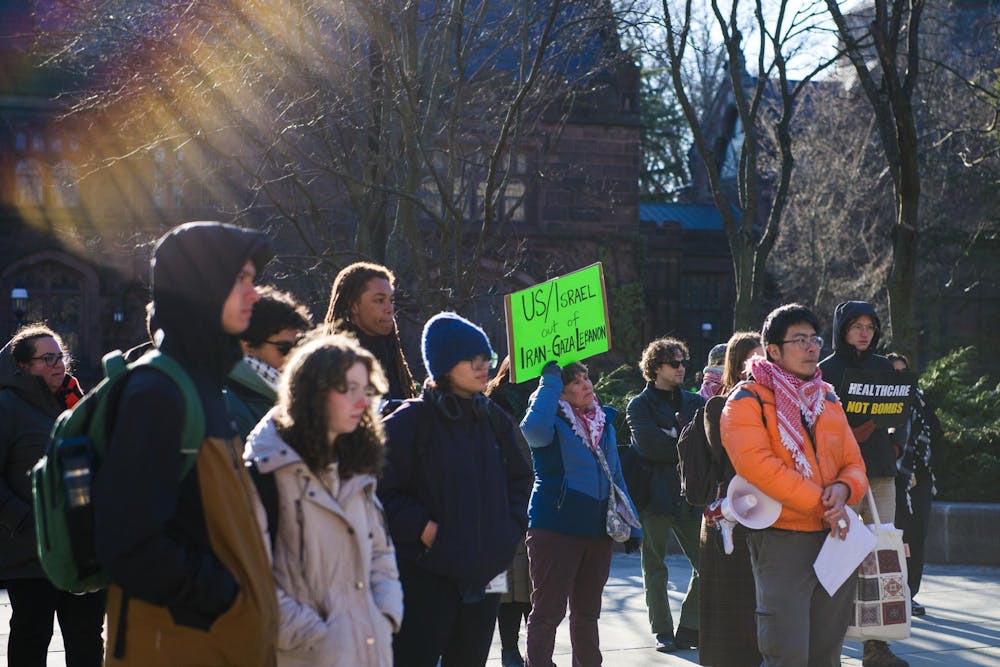
Several dozen members of the Princeton community gathered for a teach-in, a vigil, and a rally responding to the ongoing war in Iran, which began with U.S. and Israeli strikes on Feb. 28. The events featured scholars, activists, veterans, and community members who examined the war’s political, historical, and human dimensions.
The Sharmin and Bijan Mossavar-Rahmani Center for Iran and Persian Gulf Studies (MRC) hosted the teach-in, and Princeton Israeli Apartheid Divest hosted the other two events. Speakers contended that the wars in Iran, Lebanon, and Palestine all constitute a single crisis in which the United States is an active participant, pushed back against prevalent narratives about the region and its people, and scrutinized Princeton’s relationship with U.S. and Israeli military powers.
On Tuesday, the MRC hosted a teach-in at Robertson Hall, attended by over 60 people. Six Princeton scholars and field experts gave short presentations covering nuances of the war, while organizers distributed a list of alternative news sources for coverage of the conflict.
Postdoctoral Research Associate Maral Sahebjame kicked off the teach-in by emphasizing that Iran is not a monolith, being composed of many different ethnic, religious, and linguistic groups. Only around 60 percent of Iran is Persian — the other 40 percent includes Kurds, Azeris, and Lurs. With this in mind, the question of “what Iran wants” does not have a simple answer, she said.
Anthropology professor Arzoo Osanloo addressed Iran’s 150-year history of oppression and struggle for liberty from both state and imperial forces, and history professor Max Weiss discussed the role of Israel in Lebanon. He argued that Hezbollah exists as both a Lebanese national liberation movement and a refraction of the Islamic Revolution in Lebanon.
Negar Razavi, an associate research scholar at MRC, addressed the military dimension directly. She said that the U.S. war games and simulations conducted over more than two decades had consistently shown that the United States would lose a conventional war against Iran, and that the current approach reflected that conclusion. Analysts of security in the Middle East suggest that while the United States is unlikely to be defeated in a war with Iran, the conflict will likely incur catastrophic costs on both sides, leading to a “grisly end.”
Sareh Afshar, another associate research scholar at MRC, was the last to speak before an overview from Zia Mian, physicist and co-director of the Program on Science and Global Security. Mian considered how the United States has supported Iran’s nuclear program in the past and how Israel’s nuclear program and Cold War architecture fostered nuclear ambitions in other countries.
Following the teach-in, a candlelight vigil was held on Firestone Plaza, where community members spoke and shared personal stories while candles were lit in memory of those killed. Official statistics estimate death tolls at over 1,300 in Iran and about 1,000 in Lebanon. The war in Gaza has left over 72,000 dead, according to the Gaza Ministry of Health.

Aditi Rao GS, an organizer with Princeton Israeli Apartheid Divest, opened the vigil by framing the moment within a longer arc of regional violence.
“Since October 7, it’s clear Israel’s plan was always to have a greater Israel,” Rao said after the event in an interview with The Daily Princetonian. “They planned to decimate Gaza, annex Lebanon, and then attacked Iran, which protected the people of Palestine.”
Rao described the vigil as a space for grief, accountability, and humanization. “The United States is being conscripted into fighting Israel’s war, dropping bombs over children and displacing people,” she said. “Today, we are here to mourn the lives lost. To understand how we can take full accountability. But also, we need to humanize those people.”
A representative from Princeton Israeli Apartheid Divest read “Apologies to All the People in Lebanon,” a poem by June Jordan dedicated to the 600,000 Palestinians who lived in Lebanon between 1948 and 1983.
A representative from the Alliance of Jewish Progressives read the Mourner’s Kaddish. “Israel uses Jewish scripture as a justification of crimes,” they said. “Today, we use Jewish scripture as a justification of humanity.”
On Wednesday, a rally began on Firestone Plaza before moving through campus. The group of about 15 chanted “From Princeton to Palestine, occupation is a crime / From Princeton to the Philippines, stop the U.S. war machine” as they walked to McCosh Courtyard and Cannon Green, where speakers addressed the crowd, before returning to Firestone Plaza.

Among those who spoke was Afshar, who drew on her own experience growing up in Iran to challenge the narrative that bombing the country would liberate its women. She noted that women comprise up to 60 percent of university students in Iran today and have historically been the country’s most powerful internal opposition force.
“Bombing these women today is not going to liberate them,” Afshar said. “If anything, it’s going to hinder their ability to organize and reshape the world around them.”
Maral Sahebjame, an interdisciplinary scholar at MRC, read aloud a text from her friend. The message described U.S. bombers circling above the city for half an hour before striking — signing off with bitter sarcasm: “My beautiful bombs. My beautiful bombers had arrived and lit up the night sky over Tehran.”
She cautioned against treating people in Iran and across the Middle East as merely a casualty rather than as political actors with their own ideas and futures. “United States-Israeli imperial attacks must be condemned, and bombs, and sanctions — both of which are weapons of mass destruction — must be stopped,” she said.
Adam Hamawy, a surgeon and candidate for New Jersey’s 12th Congressional District, spoke about his time serving as a combat surgeon in Iraq and his volunteer work in Gaza in 2024–25. He described witnessing children wounded by U.S.-made bombs and linked the cost of ongoing wars abroad to declining living standards at home.
“I saw what the bodies are like of little boys and girls shot in the head. Shot in the chest, blown apart by the bombs that we’re making with our tax dollars,” he said. “We can’t afford healthcare. We can’t afford education. We can’t afford to rebuild our roads,” he said. “But we always have enough money for the bombs.”
Irfan Khawaja ’91, a member of Princeton Alumni for Palestine, closed with remarks that turned inward toward the University itself, tracing what he described as a decades-long pattern of institutional silence on Palestinian rights. He pointed to two events, in 1984 and 1988, in which Whig-Clio invited ultra-nationalist Israeli politician Meir Kahane to speak on campus. Both times, Kahane explicitly advocated the ethnic cleansing of Arabs from Israel.
“He was very clear that anyone who defied the orders of the IDF to leave would be killed,” Khawaja claimed in an interview with the ‘Prince.’ “There was no particular big deal made about it.” The ‘Prince’ could not independently verify this specific claim based on past reporting.
The pattern, he argued, continued into the present. “I remember, in 2024, the dismissive indifference with which the University received our petition for divestment,” he said. “February 28th has changed that calculus altogether. The United States is now at war.”
Daphne Lewis is a staff News writer for the ‘Prince.’ She is from Washington, D.C. and can be reached at dl1424[at]princeton.edu.
Elizabeth Hu is a staff News writer, assistant head Copy editor, associate Data editor, and staff Podcast producer from Houston, Texas. She can be reached at eh9203[at]princeton.edu.
Please send any corrections to corrections[at]dailyprincetonian.com.
Editor’s note: This piece has been updated to reflect the varying death count estimates in Iran and which organizations hosted the recent gatherings. It has also been updated to better describe the Meir Kahane events in 1984 and 1988.
A correction was made on March 24, 2026: A previous version of this article claimed that Irfan Khawaja ’91 was representing Princeton Alumni for Palestine at the event, whereas he is just a member. The ‘Prince’ regrets this error.
Read More
Orientation SHARE play replaces scene implying rape with groping
Riley Price and Kimberly HutchinsonThe content of Princeton’s annual SHARE play at Orientation was altered for the Class of 2030, after male actors were concerned about playing a character who was implied to be a rapist.
The content of Princeton’s annual SHARE play at Orientation was altered for the Class of 2030, after male actors were concerned about playing a character who was implied to be a rapist.

Men’s water polo rebounds after opening loss, finishing 3–1 at MPSF Invitational
Andrew KangPrinceton men’s water polo bounced back from an opening loss to San Jose State, proceeding to win three straight matches.
Princeton men’s water polo bounced back from an opening loss to San Jose State, proceeding to win three straight matches.

Princeton to lead new quantum institute backed by National Science Foundation
Riley PricePrinceton will lead one of three new Quantum Leap Challenge Institutes, which focus on advancing quantum research through interdisciplinary projects. The two other new institutes will be led by Yale and Harvard.
Princeton will lead one of three new Quantum Leap Challenge Institutes, which focus on advancing quantum research through interdisciplinary projects. The two other new institutes will be led by Yale and Harvard.