



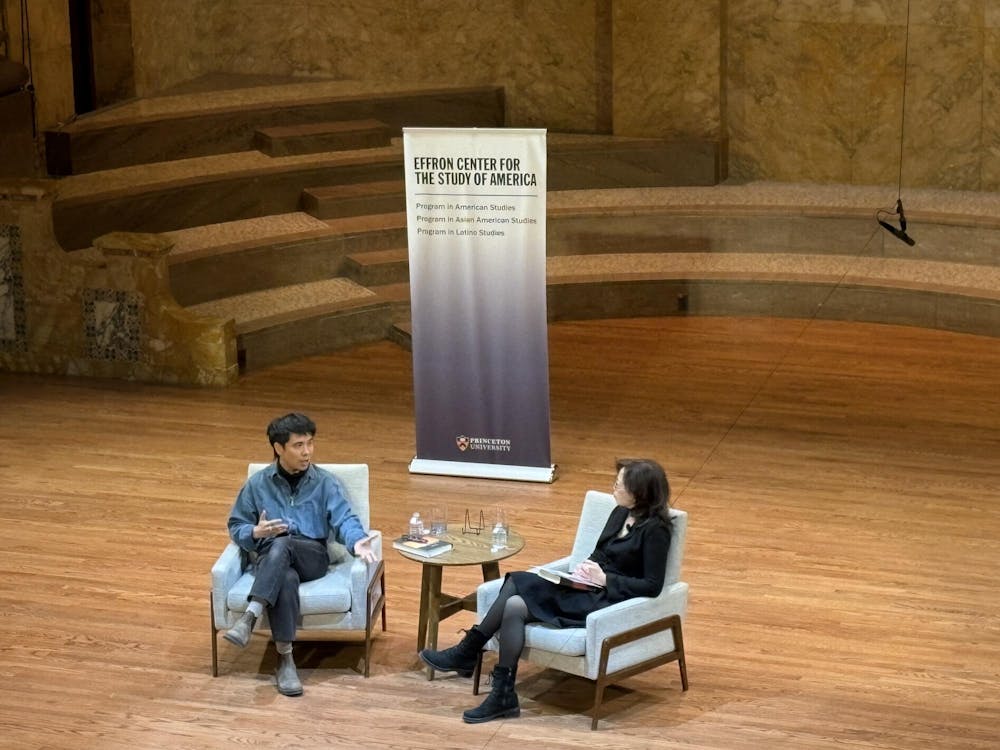
On a frostbitten Tuesday afternoon, students raced each other from their afternoon classes to snag a seat in Richardson Auditorium. On campus, these sorts of mad dashes are a sign of a great speaker, including Grammy-winning superstar SZA and Supreme Court Justices Sonia Sotomayor ’76 and Ketanji Brown Jackson. This time was no different as students gathered for renowned poet and artist Ocean Vuong, who gave a reading from his second and latest book, “The Emperor of Gladness,” and participated in a broader discussion about his work and life.
Vuong is an award-winning 37-year-old Vietnamese-American writer and photographer. Born in Ho Chi Minh City, Vietnam and raised in Hartford, Conn., Vuong is the author of two poetry collections as well as the critically acclaimed book, “On Earth We’re Briefly Gorgeous.” He is also a professor of modern poetry and poetics in the Creative Writing Program at New York University.
Vuong walked onstage to enthusiastic applause. Artistically dressed in a loose denim shirt and jeans, he wore an earring in his left ear and light brown boots. He radiated a kind of wise gentleness as he greeted the audience in his soft-spoken voice, sharing the sudden sentimentality that he felt giving another reading at Princeton. At this moment, I was entranced by Vuong’s eloquence, humility, and self-deprecating sense of humor — before he even began reading.
“I told myself I didn’t want to be a novelist because I didn’t want to do that thing that novelists do, where before they give a reading, they have to explain the book … but now I have to do that,” he joked before reading a few pages from his newest book.
“The Emperor of Gladness” centers on the unlikely connection between 19-year-old Vietnamese-American Hai and an 82-year-old Lithuanian immigrant, Grazina, living with dementia, who gives Hai a new purpose in life. The novel is at once a probe into the Asian-American experience and an exploration of grief, relationships, and finding meaning. In this particular excerpt, he explained that Hai was looking for Grazina, who had just been taken to a nursing home.
There was a quiet intensity to Vuong’s reading. He spoke in a steady, pulsing rhythm, ending each line in a harsh whisper. In his quick cadence, the words came crashing into me, making each pause all the more precious. Though still soft-spoken, his voice grew in emotion and power as he waded deeper into the text.
The words were beautifully raw. With each passing phrase, I felt the cruel sterility of the nursing home as strongly as the love Hai showed Grazina.
One line that stood out in particular was Vuong’s description of where Grazina had been taken: “the only true egalitarian wing of the American dream: the nursing home.”

After Vuong’s reading, Professor of English Anne Cheng ’85 joined him onstage for a short discussion about his work and writing journey.
In response to a question by Cheng on the American Dream, Vuong’s clear-sighted reply prompted thoughtful nods from the crowd. “America is the only one that gets a dream,” he said, noting that there is no Nigerian or Vietnamese or Belgian Dream. “It’s also very revealing that a country founded on settler colonialism, enslaving stolen bodies to build its riches, is averse to waking up.”
Vuong argued that American identity is somewhat dependent on this purposeful lapse of memory, which is why the MAGA movement is so intoxicating: It “performs memory via nostalgia” and “uses a very literary tool, abstraction, to kind of avoid specificity.”
Somewhat paradoxically, this American Dream was also a factor in Vuong’s actualization as an artist and writer.
“I think of my life as a very traditional immigrant’s life, because I think so much of my ambition was just to support my family,” he said.
In the spirit of supporting his family, Vuong attended business school. The experience left him deeply unhappy, and he dropped out in his first term. Searching for a new outlet, he discovered poetry during open mics at Bar 13 on 14th Street in Manhattan. While simultaneously navigating the “ontological shame” he felt as a queer immigrant, Vuong used his shame of failure in school as a motivating force to become a stronger writer.

“I failed onto the page,” Vuong said about his work. His silver rings glinted in the light as he moved his hands to punctuate his sentences.
It was a pleasure to hear Vuong wax poetic — quite literally — on both the philosophical and the political. Reflective and humorous, Vuong spoke the same way that he writes: each spoken sentence a poem in and of itself, with the same cadence and whisper as when he reads aloud.
Equally astounding was the breathtaking range of topics to which he gracefully spoke, transitioning effortlessly from questions about what it means to be a writer and his view of regret as growth to discussions of American politics and AI.
His profound answers left the audience in awe — and in curiosity.
One student asked about Vuong’s frequent references to his elders, prompting a discussion of the Asian American experience. Vuong continually expressed gratitude for his elders — his family and teachers — throughout the event, saying he felt a responsibility to live up to their belief in him.
“Even though they gave me the grace to do whatever, I felt irresponsible just doing whatever,” he said about his family in answer to a student’s question. Although he never had a “tiger mom,” he added that his Brooklyn College professors certainly encouraged him to excel.
Interestingly, Vuong said his family does not read his work — and he didn’t seem to mind. In fact, he was proud of their agency. “Just because The New Yorker or The New York Times values what I do, doesn’t mean they have to,” he remarked.
Despite his acclaimed literary success and obvious love for his work, Vuong appeared remarkably unattached to his profession.
“It’s only capitalism that demands that we become factories of ourselves,” he said.
What really mattered to Vuong was not what he would do next, but all the people who had guided him to everything he had already achieved. I was not the only one moved by his humility.
“I think it’s really empowering to see someone who’s so tied to the historical importance of their background, especially when he was talking about stating where you’re from in your biography, because it shows, like, a whole lineage of migration,” Daisy Yao ’28 said in an interview with The Daily Princetonian after the event.
Vuong’s openness in sharing his story certainly resonated with students.
“I could see a lot of the similar patterns he talks about, really strong stories within immigration, within violence, within family ties, within this pressure on himself, and I felt like I could resonate with a lot of that,” Nam Adam Vu ’28 told the ‘Prince.’
The magic of Vuong’s words still echoed in my head hours after the event. In a bubble as fast-paced as Princeton, Vuong’s clarity of self and humility were incredibly refreshing. I hope he returns soon to share more old-soul wisdom.
Annika Plunkett is a staff writer for The Prospect, associate Newsletter editor, and a member of the Spanish Translation team. She can be reached at ap3616[at]princeton.edu.
Please send any corrections to corrections[at]dailyprincetonian.com
Read More

Off-campus TigerHub access restricted due to cybersecurity measures
Amaya TaylorTigerHub, HR Self Service, and Tiger Family Hub are now only accessible off-campus with a VPN or secure portal. University spokesperson Michael Hotchkiss said the changes were preventative and not the result of a specific known compromise.
TigerHub, HR Self Service, and Tiger Family Hub are now only accessible off-campus with a VPN or secure portal. University spokesperson Michael Hotchkiss said the changes were preventative and not the result of a specific known compromise.

Princeton and peers soften opposition to attacks on higher education in graduation speeches
Devon RudolphSince the Trump administration launched dozens of initiatives targeting higher education in the Spring of 2025, some universities have toned down their messaging against these programs.
Since the Trump administration launched dozens of initiatives targeting higher education in the Spring of 2025, some universities have toned down their messaging against these programs.

Normani to headline 2026 Fall Lawnparties, first pop headliner in two years
Giselle MorenoThe artist rose to fame in 2012 as a member of the girl group Fifth Harmony. She will perform on Frist North Lawn at 3:15 p.m. on Sunday.
The artist rose to fame in 2012 as a member of the girl group Fifth Harmony. She will perform on Frist North Lawn at 3:15 p.m. on Sunday.