




Perhaps it’s low-hanging fruit, but watching “Marty Supreme” was a bit like watching a two-hour-and-29-minute ping-pong game. Something new flashed across the screen every five seconds, and it was predictably hard to keep track of the score. After nearly three hours of explosions, car crashes, Timothée Chalamet bedding beautiful women, and a bathtub falling through the ceiling, the film’s relentless pace merely blurred together. It was hard to cobble together what bits had been important.
Written and directed by Josh Safdie and based on the real-life story of table tennis legend Marty Reisman, the film follows Chalamet’s Marty Mauser as he strives for fame and international ping-pong success. In his words, there’s no room for failure — “that doesn’t even enter my consciousness.” But rather than hitting the ping-pong courts to achieve this, Marty mostly focuses on hustling everyone around him: family, friends, the police, several lovers, and even the dog of a gangster.
In fairness, each of these characters — including the dog — is extremely embodied and immersive, a testament to Safdie’s direction and standout performances from Chalamet, Odessa A’Zion, who plays Mauser’s childhood friend Rachel, and old-timer Gwenyth Paltrow, who plays Kay, a wealthy actress Mauser pursues. “Marty Supreme” is also, from a technical standpoint, beautiful filmmaking. Cinematographer Darius Khondji captures the frenetic energy of the film, observing each chaotic moment, and thanks to production design by Jack Fisk, 50s New York never looked so good.
And yet I walked out of the movie feeling unsatisfied. The plot is unstable — after the third shootout, it felt like literally anything was on the table. This style works in some moments: The cut into the opening credits, which was the best sperm-swimming-towards-egg montage of recent years, made the whole theater laugh. But one quickly tires of shootouts, car chases, and things falling through the ceiling.
The film could’ve gotten away with its breakneck speed and flicking through plotlines if the characters were more compelling or likeable. Even with excellent performances by the lead actors, it’s hard to be compelled by Marty’s relentless hustling, or even Rachel’s love for him. Perhaps this is because she allows herself to be put through the most horrendous circumstances in exchange for him sparing a glance in her direction. Caring about ping-pong is a hard sell at the best of times, and the unsympathetic Mauser doesn’t explain why he himself cares to “bring the sport to the U.S.,” or even what that means.
Somehow, Gwenyth Paltrow’s Kay was the character I rooted for most — an actress in an unhappy marriage who wants to feel seen and recognized, both by her husband and by the public. When her play receives poor reviews, she breaks down, a show of genuine emotion in a film that mostly rushes past opportunities for such exploration. On the other hand, when Marty doesn’t achieve a certain goal — going to the World Championships, for example — he just moves on to the next, leaving us with no real sense of achievement.
Maybe Safdie is using Mauser’s story of hustle and self-interest as an allegory for American culture and politics. Alternatively, a Critic’s Notebook piece says the story is one of proud Jewish-Americanness — “I am Hitler’s worst nightmare,” Mauser says — and striving to succeed against the system. But if Safdie truly intended Mauser to represent the Jewish-American experience, his character would be painted in a more sympathetic light: a man trying to succeed in a system that’s built against him. When lightly interrogated, neither of these interpretations really hold water. How is Mauser supposed to represent both the system and the system’s victims?
I have a feeling that Safdie is too smart to think he’s making a point in earnest. Rather, this movie adds to a collection of recent maximalist, intentionally anti-moralistic movies like Ari Aster’s “Eddington” and Yorgos Lanthimos’ “Bugonia” that feel designed to resist any specific takeaways. Perhaps these filmmakers think they’re defying the simple public by refraining from spoon-feeding us morals, but at times, these movies feel devoid of substance. If they’re about the absurdism of our culture, they’re not making me feel any better. It’s like these filmmakers are also confused by what’s going on everywhere all the time. And maybe that’s fine. Maybe we’re all confused together. But isn’t it nice to look to someone who we think might know the way?

Not every moment of “Marty Supreme” is like this. One of the most poignant moments of the film is also one of the most grounded: A flashback of Marty’s ping-pong competitor, Béla Kletzy, imprisoned at Auschwitz, letting fellow prisoners lick honey from a beehive off his body for sustenance. Here, something was truly at stake, even if it’s just in recollection, and Marty sees himself as part of something larger than himself. Like most of the film, the scene is incredibly strange — the close shot of men licking Kletzy’s chest felt almost erotic — but here, the weirdness makes it feel more important, not less.
The last shot of the movie is supposed to be the ultimate needle-drop moment: Marty looking down at his and Rachel’s baby, slowly beginning to sob. It’s a close shot of Chalamet crying, when Tears for Fears’ “Everybody Wants to Rule the World” kicks in. Then the movie ends. If Safdie wants to show that Marty’s ultimate turn towards unselfishness can only be catalyzed by becoming a father, the film doesn’t set up this moment at all. The last we saw of Marty and Rachel, he’d abandoned her as she nearly bled out to compete in a ping-pong competition in Tokyo. He’s selfish until all but the last frame, and by that point, any suggestion that Marty will change strains credulity after nearly three hours of this ruthlessness. The same goes for the film as a whole.
USG movies ran “Marty Supreme” this past Saturday, and it’s playing at the Garden Theatre at least through the end of this week. You certainly won’t be bored. “Marty Supreme” is an exciting movie, and it puts the audience in a ping-pong game of chaos and ambiguity. Still, I left feeling like my neck was tired watching the ball slam back and forth across the net in a game that ultimately had no winner.
Roya Reese is a contributing writer for The Prospect. She can be reached at rr6422[at]princeton.edu.
Please send any corrections to corrections[at]dailyprincetonian.com.
Read More

Princeton University Orchestra and men’s ultimate frisbee team named in University’s latest hazing report
Andrew ArthurTwelve students in the Princeton University Orchestra and Men's Ultimate Frisbee team were found responsible for hazing violations in the University's latest Campus Hazing Transparency Report. Sanctions ranged from Dean's warnings to disciplinary probation.
Twelve students in the Princeton University Orchestra and Men's Ultimate Frisbee team were found responsible for hazing violations in the University's latest Campus Hazing Transparency Report. Sanctions ranged from Dean's warnings to disciplinary probation.

Murray-Dodge Café celebrates 50th Anniversary, drawing over 260 students
Hifza KaleemOn Wednesday, Murray Dodge Cafe celebrated its 50th anniversary, drawing more than 260 students to celebrate with free cookies and merchandise.
On Wednesday, Murray Dodge Cafe celebrated its 50th anniversary, drawing more than 260 students to celebrate with free cookies and merchandise.
Students share mixed reactions as mandated officer and treasurer trainings return to in-person format
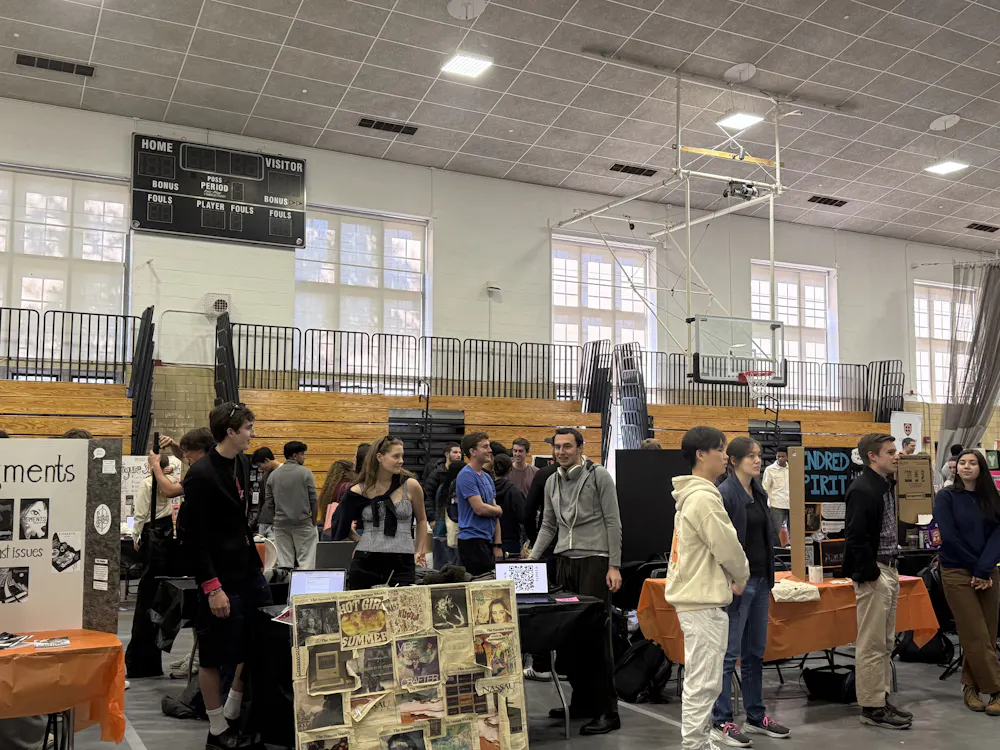
David EstradaThe University's student organization officers and treasurers returned to mandatory in-person training this fall after years of online sessions. Student reactions found parts of the training redundant or tedious, though most agreed the sessions were important.
The University's student organization officers and treasurers returned to mandatory in-person training this fall after years of online sessions. Student reactions found parts of the training redundant or tedious, though most agreed the sessions were important.