



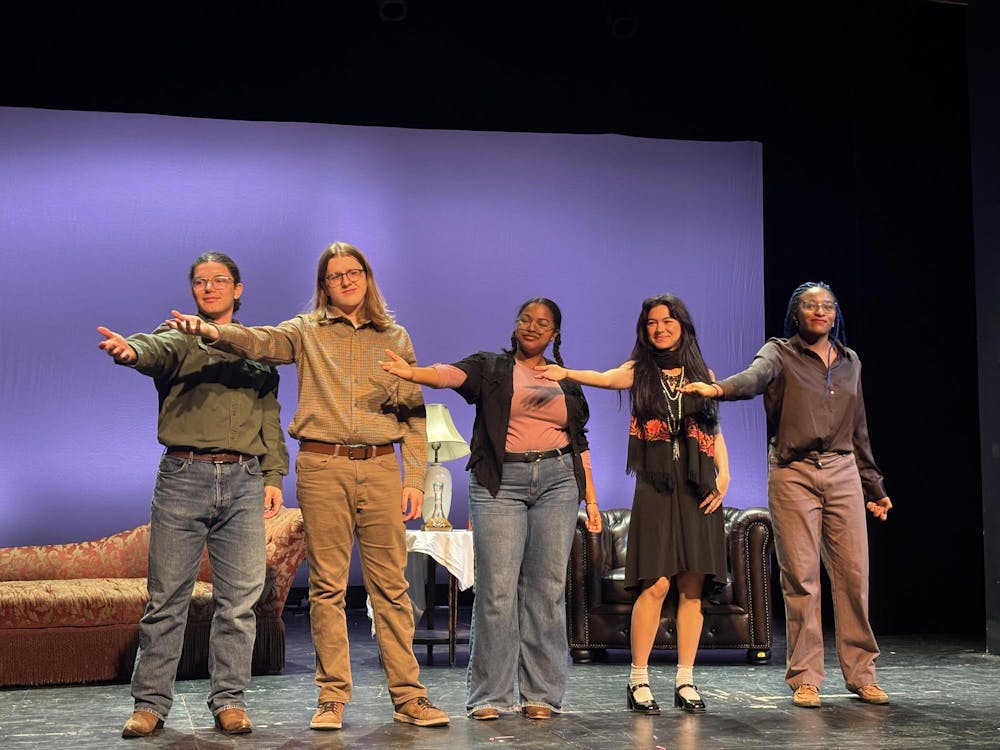
Last Sunday, I arrived at Murray Dodge Theater — with just a few minutes to spare before the curtains rose — only to be met with a fully set stage and practically empty theater.
Theatre Intime just hosted its annual Student Playwrights Festival, a series of original works entirely written, directed, and performed by Princeton students. On this year’s playbill were three vastly different shows whose unusual characters gave me an enjoyable whiplash.
“Peer Review” by Ren Dzyuba ’28, co-directed by Christie Davis ’27 and Sierra Krichiver ’29
The festival premiered with Ren Dzyuba’s “Peer Review,” where a tense but driven unnamed protagonist (Ariana Frey ’29) prepares to pitch her first big idea to company executives. When all seems lost, Frey’s higher-ranking colleague, a confident and adept Eli Edge ’29, wanders in from the audience to offer his wisdom.
The set was modeled after a simple conference room, but the visual elements and comedic writing brought this play to life. Frey shows the audience her presentation in real time, clicking from customer responses to undecipherable graphs. Allegedly, “the company is two standard deviations above the mean of the normal distribution of visitor engagement in the last year,” but the audience must take Frey’s word for it.
One of the most intriguing features was a routine dramatic “beat,” where the background screen changes to red, and the characters suddenly pause their speech and movement while a clock ticks in the background. Though you’d think these sinister moments of tableau vivant would disrupt the narrative, I found myself contemplating whether they would signal a deeper meaning than the play’s seemingly clear-cut message. “Peer Review” sets itself up to be a commentary on careerism; it’s obvious that Edge is meant to represent a workaholic who has no identity outside of his position as Senior Manager. Still, the last arc of the play unfolds rather unexpectedly.
In the final scene, the formerly unnamed protagonist — now called Jenny — offers her superior a generous slice of identity by calling him his real name, Daniel, and encourages him to abandon corporate life and revitalize his spirit. When Daniel mistakenly interprets her support as romantic pursuit, Jenny, in a dramatic twist, reveals that he is actually her deceased sister’s ex-boyfriend.
Daniel, who spent the last four years in work-induced isolation, tragically engulfed in a sea of manila folders and spreadsheets, has no recollection of his ex-girlfriend’s death. In a distressing final scene, he rips off his ticking watch, one of the last material items she left behind.

In an interview with The Daily Princetonian, Dzyuba explained that “Peer Review” was inspired by their own struggles with work-life balance.
“I wrote from the idea that work has become so depersonalizing that we have all just accepted that degradation of ourselves, [and] we forget who we were before we began working,” Dzyuba said.
Though its themes are similar to some of my favorite works of media (namely, Apple TV’s “Severance”, “1984” by George Orwell, and Dolly Parton’s “9-5”), “Peer Review” was a pleasant surprise. The show’s ending was brilliant and visually captivating, bringing a unique angle to a perhaps over-critiqued aspect of capitalism.
“Hugo” by Maddie Smoyer ’27, directed by Maggie Rea ’26
In the second play, the audience meets the talented Frey once again, this time reincarnated as a mischievous woman named Irene. When an all-powerful psychic named Hugo warns Irene that her death is imminent, she decides to host a dinner party, so her loved ones can say their final goodbyes.
As this host of quirky personalities toasts drinks and discusses the peculiarities of cottage cheese, it becomes clear to the audience — and to Irene’s guests — that she is reckoning with her death in the most unconventional way. The rest of the group includes Irene’s loving roommate Kay, played sincerely by Lota Alagbe ’28, her emotionally guarded brother Trevor (a cynical Ethan Gotthold ’29), and his husband Nathan (with Edge’s familiar face) — all with unconvincing British accents.

Though portrayed as a morally grey but well-intentioned main protagonist, Irene is perhaps the most insufferable character I had to witness all evening (thanks to Frey’s appropriately dramatic delivery). Her friends and family, though visibly distraught, indulge her strange antics and suspicious apathy towards death.
After faking a heart attack once or twice and hearing her friends’ painful monologues at her own funeral, Irene and her brother-in-law covertly reveal to Kay that Irene is, in fact, not dead. The audience learns that Irene has created an elaborate scheme to help her brother work through his repressed emotions. In a rather unrealistic fashion, Kay becomes an accomplice without a second thought.
For Smoyer, the intent is for love to be at the heart of this show. “It can be easy to take the people in our lives for granted and to assume they know how important they are to you, but unless you actually tell them every once in a while, they might need a reminder,” she said to the ‘Prince.’
I found Hugo’s earnest attempt at centering a sibling relationship refreshing, but my biggest qualm is that I struggled to find this meaning in the narrative. At first, I was excited to meet our fierce protagonist, who isn’t afraid to look death in the eye and actively plan luncheons with ghosts. But as the play went on, I was disappointed when I realized this play was not about accepting our mortality and creating meaning in human legacy. Is the best way to remind your loved ones to communicate their affection for you to devise some psychotic scheme that could destroy whatever trust they had in you?
But perhaps this show isn’t meant to be taken so seriously. Regardless, “Hugo” was certainly entertaining. Smoyer masterfully created a world of characters whose quips truly kept me invested.
“Wasting a Day” by Will Grimes ’27, directed by Dante Kanterezhi-Gatto ’29
When the curtains rise for “Wasting a Day,” we are immediately transported into a familiar world: a New England liberal arts college lecture hall. Professor George Conway (played spiritedly by Edge) reads a poem from his debut collection before suddenly spiraling into a fit of irritability that literally made me jump out of my seat. Just from how well-performed this initial scene was, I knew Edge would do Conway justice.
Conway is under immense pressure; to receive tenure, he needs to write five additional poems and an epilogue. On top of this, he is also battling the early stages of Huntington’s disease, a neurodegenerative disorder that induces cognitive decline. The audience gets a glimpse into Conway’s inner psyche when his deceased father, Breck (an aloof Gotthold), routinely visits him. Grimes creates a story that defies time and reality — and I was instantly hooked.
Later, Conway’s sister Martha (played with a nice Southern twang by Ariel Sylvain ’26) travels from South Carolina to see him — and she doesn’t come empty-handed. The bad news is that their childhood farm is at risk of foreclosure, and they need to come up with 50 grand to save it. The good news, at least for Conway, is that Martha brings a notebook full of their dad’s poetry she found in the attic.
After another visit from Breck, where he urges Conway not to be a quitter, the disgruntled professor gets overwhelmed by hopelessness. In desperation, Conway plagiarizes his father’s work to meet his deadline.
Grimes told the ‘Prince’ that Conway was inspired by his anthropologist great-grandfather with early-onset Alzheimer’s. He added that he wanted to explore philosophical dilemmas through Edge’s character.
“If your personality [or] actions are predetermined by your circumstances, how morally responsible can you be? I didn’t think there was a clear answer, and I wanted to play that question out on stage,” Grimes said to the ‘Prince.’
“Wasting a Day” stands out because of its well-developed characters and compelling stakes. Martha finds out that Conway transformed their father’s writing into a “rustic” manuscript, and she is understandably upset. But what caught my attention is that the line between “right” and “wrong” is suddenly blurred when Martha realizes that Conway’s book may just be the only way to pay for the farm. In a way, I started to feel like Conway’s hallucinations were also guiding my own moral compass.
Between battling writer’s block and Huntington’s disease, Conway is a complex character whom I manage to feel sympathy for. “Wasting a Day” was the highlight of this year’s student playwright festival. Grimes exceeded my expectations with a nuanced story of interesting tension between Southern identity and academia.
Princeton’s theater community is not lacking in talented writers, but it may be lacking in time. My biggest disappointment with the show is that sometimes the actors had their scripts in hand on stage. As you can imagine, this took me out of the experience. Still, I enjoyed this year’s student playwright festival and think it’s well-deserving of a much larger audience. With more actors and perhaps a slightly longer production period, Theatre Intime’s Student Playwright festival would certainly reach its full potential.
Amaya Taylor, a member of the Class of 2028, is an associate editor for The Prospect and News staff writer. She can be reached at amayataylor[at]princeton.edu.
Please send any corrections to corrections[at]dailyprincetonian.com.
Read More

High Meadows Environmental Institute hosts Summer of Learning Symposium
Mia ChenThe High Meadows Environmental Institute’s Summer of Learning Symposium showcased research by 122 undergraduate interns, who worked with faculty across 13 countries and 10 U.S. states on projects ranging from hydrogen electrolysis to forever chemicals.
The High Meadows Environmental Institute’s Summer of Learning Symposium showcased research by 122 undergraduate interns, who worked with faculty across 13 countries and 10 U.S. states on projects ranging from hydrogen electrolysis to forever chemicals.

USG shifts winter elections to before Thanksgiving, debates limiting slates in contentious meeting
Claire DingThe Undergraduate Student Government moved its winter elections before Thanksgiving break but voted down a proposal to ban slates for non-executive offices.
The Undergraduate Student Government moved its winter elections before Thanksgiving break but voted down a proposal to ban slates for non-executive offices.

If you give a tiger a cookie: celebrating 50 years of Murray-Dodge Café
Mia MazzeoAssistant Editor for The Prospect Mia Mazzeo celebrates and reflects on the significance of Murray-Dodge Café's 50th Anniversary.
Assistant Editor for The Prospect Mia Mazzeo celebrates and reflects on the significance of Murray-Dodge Café's 50th Anniversary.