



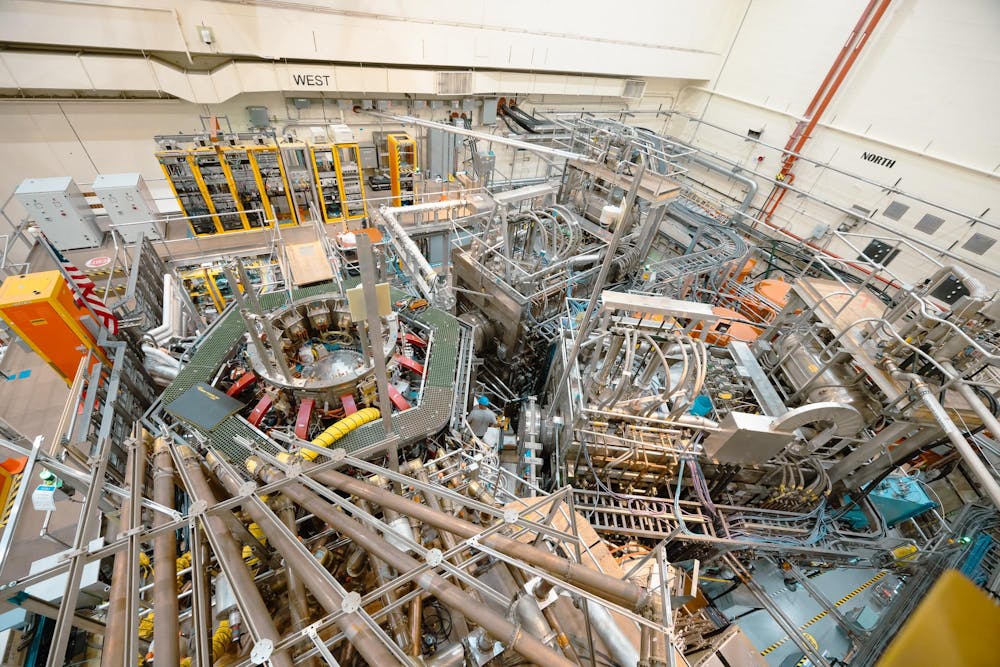
The U.S. Department of Energy’s Princeton Plasma Physics Laboratory is developing a new project which aims to use AI to expedite fusion energy research. Shantenu Jha, the head of PPPL’s Computational Sciences Department, told The Daily Princetonian in an interview that the platform is anticipated for full launch in 2027.
PPPL, which is managed by Princeton University, labeled the project STELLAR-AI, which stands for Simulation, Technology, and Experiment Leveraging Learning-Accelerated Research enabled by AI. They predict that the platform will lower costs and improve experiment efficiency.
The STELLAR-AI platform comes as part of the DOE’s Genesis Mission to use AI to accelerate scientific research, according to a Jan. 22 press release. The tool will help run and analyze high-level simulations of fusion energy experiments, primarily with the National Spherical Torus Experiment-Upgrade, the largest device of its kind in the U.S. that can generate controlled nuclear fusion.
In an interview with the ‘Prince,’ Jha expanded upon how a program like STELLAR-AI will advance the progress of fusion energy research, as well as the potential benefits of AI-powered experiments.
Jha emphasized that STELLAR-AI has two precise goals in its application in PPPL experiments: quick analysis of current data, and complex simulations of future experiments.
“STELLAR-AI is going to advance the simulation capabilities, as well as the ability to do better experiments by providing machine learning analysis of the data … and ultimately bringing these two strands together,” Jha said.
While advanced hardware like DOE supercomputers developed through the Genesis Mission already exist, the central idea behind STELLAR-AI is that it is a platform that can provide the high-fidelity coding software needed to perform high-level simulations and analyses.
“We’re already optimizing the computational codes that will run on STELLAR-AI once it lands … we’re using very similar hardware [to Nvidia] to try to optimize the code,” Jha explained.

STELLAR-AI will be used to minimize operational costs while at the same time optimizing research capabilities. Jha explained that experimental results in a field like plasma physics are extremely variable, meaning that accuracy and repeatability are essential in order to quickly figure out potential problems in an experiment.
“STELLAR-AI is helping us build the methods and the AI models that find the balance between accuracy and computational cost,” Jha said.
The main way that PPPL proposes to practically institute these cost-saving and accuracy measures is through the optimized creation of “digital twins.” A “digital twin” is a computational copy of a real-life experiment used to develop accurate simulations with various outcomes. The simulation is used to develop more accurate experiments and lowers the cost of running experiments by removing confounding variables and experimental issues after “digital twin” simulations are performed. “Digital twins” will be used for the NSTX-U to run experiments in a computer model of the machine without having to actually use a machine with significant costs.
Jha expanded on this, saying, “You can do many high throughput experiments on your digital twin, which you couldn’t do in the real experiment, because it takes time to start up, boot up and then tear down an experiment.”
For Jha, STELLAR-AI represents a major shift in fusion energy research.
“We’re designing STELLAR-AI for both the computation and the experiments. And this may be the first time supercomputers have been designed this way,” Jha said.

Benedict Hooper is a staff News writer for the ‘Prince.’ He is from Greenwich, Conn. and can be reached at bh3193[at]princeton.edu.
Please send any corrections to corrections[at]dailyprincetonian.com.
Read More
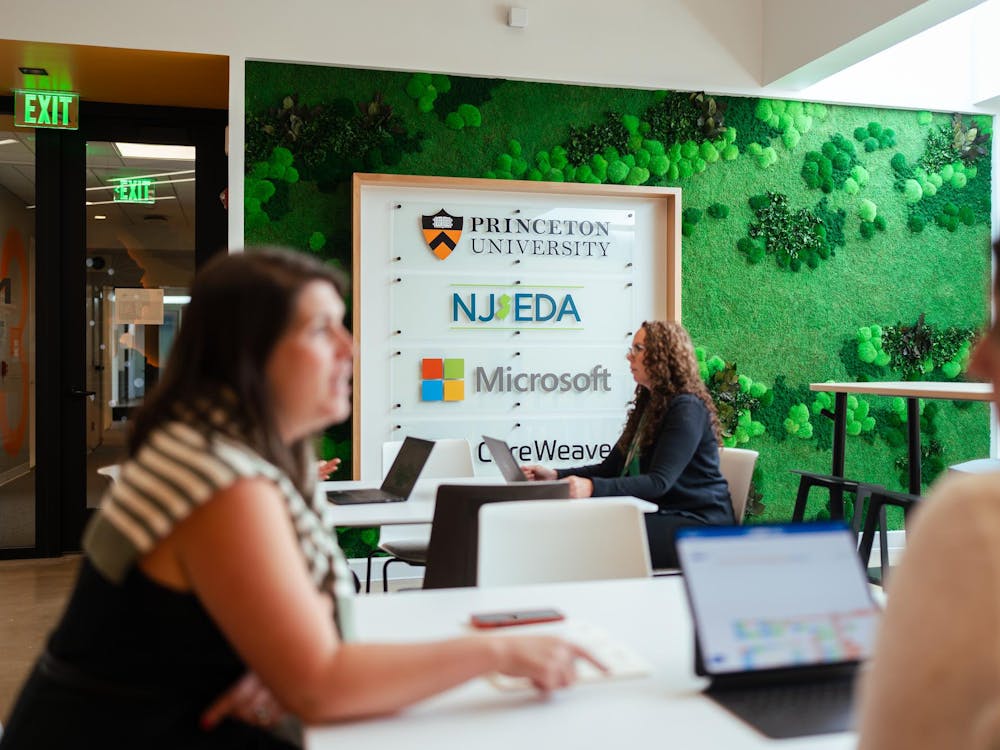
NJ AI Hub marks first anniversary with inaugural startup cohort
Zihan (Frank) XuFourteen selected start-ups receive weekly workshops, reverse pitches, corporate introductions, among other guidance over 12 weeks. The “AI accelerator” helps to test each company’s technology and fast-track its path to commercialization.
Fourteen selected start-ups receive weekly workshops, reverse pitches, corporate introductions, among other guidance over 12 weeks. The “AI accelerator” helps to test each company’s technology and fast-track its path to commercialization.
Three Princeton alumni awarded 2026 Fields Medal
Clara DochertyThe three alumni who received the medal are Yu Deng GS ’15, John Pardon ’11, and Jacob Tsimerman GS ’11.
The three alumni who received the medal are Yu Deng GS ’15, John Pardon ’11, and Jacob Tsimerman GS ’11.

How Charles Plohn ’66 brought his classmates together on the shelves
Nikki HanFor decades, Charles J. Plohn, Jr. ’66 has been collecting books published by members of his class. With nearly 700 titles in this collection, Plohn is attempting to find his library a permanent home.
For decades, Charles J. Plohn, Jr. ’66 has been collecting books published by members of his class. With nearly 700 titles in this collection, Plohn is attempting to find his library a permanent home.