



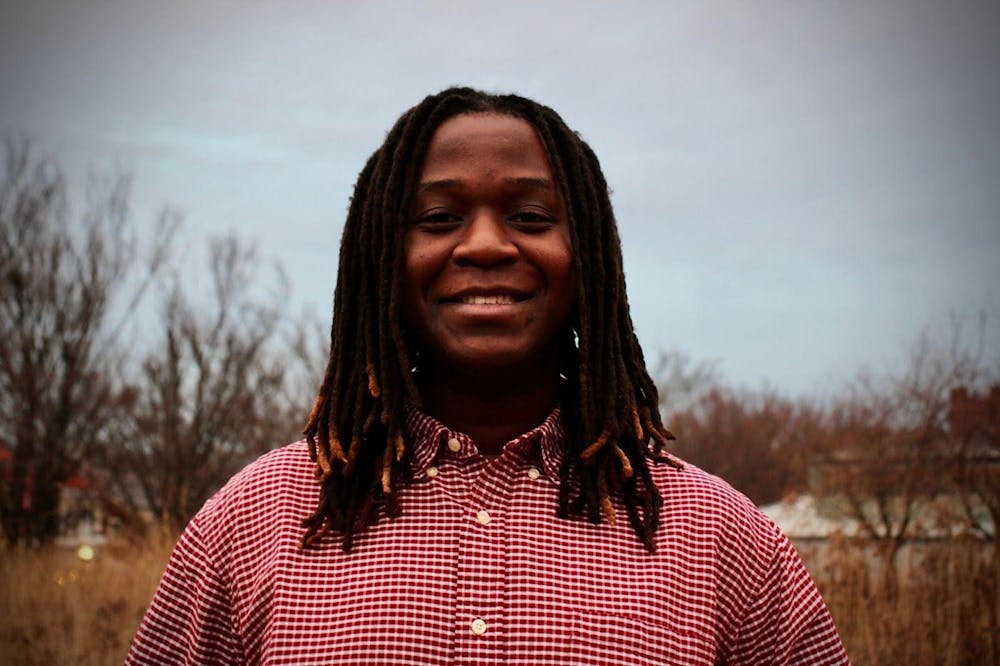
Brian Mhando ’26 has been awarded a 2026 Gates Cambridge Scholarship, joining 25 other scholars-elect from the United States.
Mhando is a former associate Sports editor for The Daily Princetonian.
According to its website, the Gates Cambridge program selects “scholars based on their outstanding academic achievement and their commitment to change the world for the better.” From the 26 U.S. scholars, 16 will pursue Ph.D.s, and 10 will enroll in one-year master’s degrees.
Mhando is majoring in ecology and evolutionary biology at Princeton, and is a member of Mathey College and the Cap and Gown Club. In October, he will enroll in a one-year MPhil program at the University of Cambridge’s Department of Veterinary Medicine, where he will conduct epidemiological research.
Mhando was expecting to learn of the decision by phone, so when an email from the Gates Cambridge program appeared in his inbox, he initially assumed he had been rejected.
“I just thought I got rejected and then I opened the email, and it was not, so I went crazy,” Mhando told the ‘Prince.’ “I started shaking. I ran out of my friend’s room, and I just called my mom, and we cried, and I was really excited.”
Mhando submitted his application on Oct. 15. After a remote departmental interview on Oct. 21, he received an offer of admission on Nov. 17 and was named a Gates finalist on Dec. 3. However, he was still not fully done with the selection process.

“All of [winter] break, I was just really stressed and anxious and tried not to think about my interview, but it was the looming thing over break,” he said.
His final interview — a three-person panel interview with experts in the biological sciences — took place in Boston on Jan. 24. He learned he had been selected on Feb. 5.
Mhando said he worked extensively with Princeton’s Office of International Programs (OIP), particularly the director of fellowships advising, Deirdre Moloney.
“I really owe it to the Fellowships Office because when I started this process, I was actually not considering applying to any fellowships at all. It was really Deirdre who convinced me to apply,” Mhando said.
Two of his three letters of recommendation were from University faculty: Professor Bryan Grenfell and Professor Heather Howard. Grenfell is Mhando’s thesis advisor, and has previously advised another Gates Cambridge Scholar, according to Mhando.

“[Mhando] is a wonderful student and a delight to teach,” Howard wrote. “He has been a vital member of the global health community on campus, and he stands out for his intellectual curiosity, deep ethical engagement, and acute investigative sense.”
“I know he will thrive in graduate studies in global health and make significant contributions to the field,” she continued.
Mhando is from Harlem, N.Y., and attended Regis High School. He initially intended to major in African American studies but later transitioned to EEB.
He cited an introductory ecology course and EEB 327: Immune Systems — From Molecules to Populations, taught by Professor Andrea Graham, as two classes that motivated the shift in his interests. The latter class in particular was what he said “cemented it for [him].”
“I was interested in understanding how we could apply, especially in disease, those basic disease ecology frameworks in a more complex way to more social issues,” Mhando said, citing issues like antibiotic access.
Mhando is also pursuing minors in Global Health and Health Policy, African Studies, and African American Studies. His senior thesis examines how improved gonorrhea screening methods influence both disease prevalence and antibiotic misuse.
Outside the classroom, Mhando was the fundraising coordinator and camp counselor for Camp Kesem Princeton, a summer camp for children whose parents have cancer. As part of the organization, he has helped raise more than $100,000 over three years to support programming.
“If you told me I had to do only one thing at Princeton, that’d be the only thing I’d do,” Mhando said.
Mhando previously served as the chair of the Undergraduate Student Government’s Diversity, Equity, and Inclusion (DEI) committee, and is a co-leader of the Africa Program at the Liechtenstein Institute on Self-Determination.
He emphasized that he does not view his social justice work and scientific research as separate pursuits.
“I always saw them as complementary,” he said. “Some epidemiologists are very quantitative, and I don’t want to be like that. I want to put into context the disease models I’m doing with real-life anthropological issues.”
Mhando’s Princeton experience has also included extensive international research. Most recently, he completed HIV and bacterial STI research in a rural village in Uganda through a scholarship from the Princeton Center for Health and Wellbeing (CHW), which supported his work abroad.
At Cambridge, Mhando said he looks forward to engaging with an international academic community and continuing to travel.
“Traveling is the way I learn,” he said. “I love the classroom, but I think traveling has taught me more than anything else.”
After completing his MPhil, Mhando hopes to pursue a Ph.D. in epidemiology and eventually work in the global health sector, focusing on building sustainable health systems in low-resource communities in East Africa.
Hayk Yengibaryan is a head News editor emeritus and senior News writer for the ‘Prince.’ He is from Glendale, Calif. and typically covers breaking news, profiles, and student awards. He can be reached at hy5161[at]princeton.edu.
Please send any corrections to corrections[at]dailyprincetonian.com.
Read More

Princeton University Orchestra and men’s ultimate frisbee team named in University’s latest hazing report
Andrew ArthurTwelve students in the Princeton University Orchestra and Men's Ultimate Frisbee team were found responsible for hazing violations in the University's latest Campus Hazing Transparency Report. Sanctions ranged from Dean's warnings to disciplinary probation.
Twelve students in the Princeton University Orchestra and Men's Ultimate Frisbee team were found responsible for hazing violations in the University's latest Campus Hazing Transparency Report. Sanctions ranged from Dean's warnings to disciplinary probation.

Murray-Dodge Café celebrates 50th Anniversary, drawing over 260 students
Hifza KaleemOn Wednesday, Murray Dodge Cafe celebrated its 50th anniversary, drawing more than 260 students to celebrate with free cookies and merchandise.
On Wednesday, Murray Dodge Cafe celebrated its 50th anniversary, drawing more than 260 students to celebrate with free cookies and merchandise.
Students share mixed reactions as mandated officer and treasurer trainings return to in-person format
David EstradaThe University's student organization officers and treasurers returned to mandatory in-person training this fall after years of online sessions. Student reactions found parts of the training redundant or tedious, though most agreed the sessions were important.
The University's student organization officers and treasurers returned to mandatory in-person training this fall after years of online sessions. Student reactions found parts of the training redundant or tedious, though most agreed the sessions were important.