



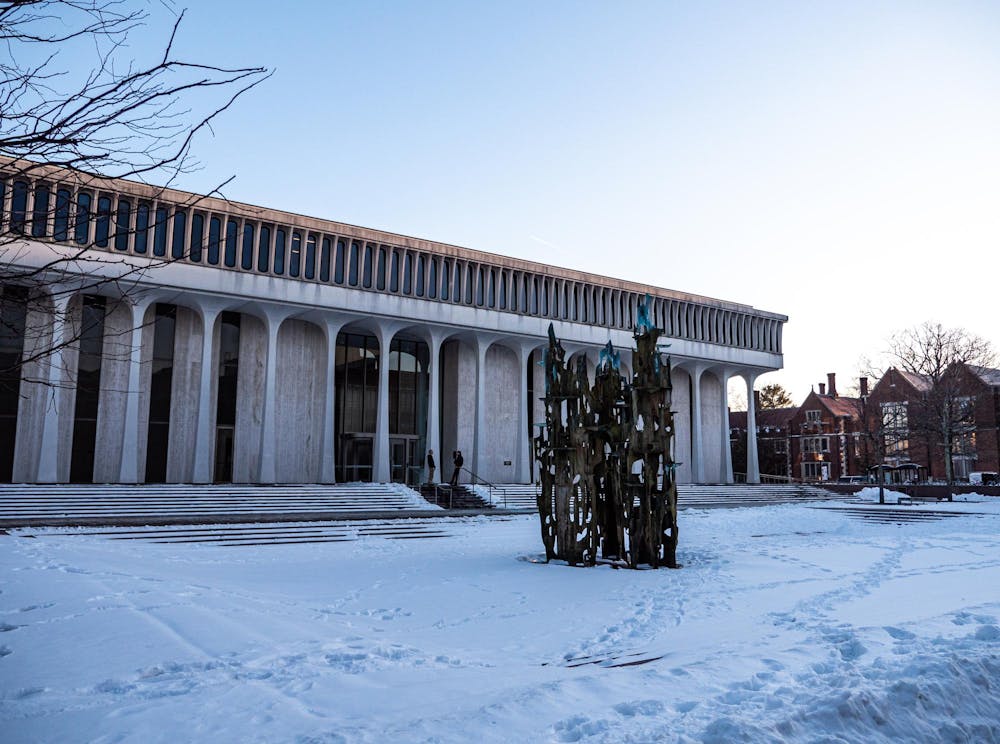
The Undergraduate Student Government senate met Sunday for the first time under its new administration, led by president Quentin Colón Roosevelt ’27 and vice president Anuj Krishnan ’27.
Colón Roosevelt, despite being audibly shocked by electricity midway through the meeting, set out his plan for the USG term, including focuses on student engagement, transparency, and bureaucratic restructuring. Treasurer Marvel Jem Roth ’28 presented a reworked budget to the Senate, and University Student Life Committee (USLC) chair Oscar Barrios ’27 reported on new community-led working groups.
“We’re going to be adding back a public comment period to USG meetings,” Colón Roosevelt stated in his President’s report. Speaking after the meeting to The Daily Princetonian, he explained that time will be allotted for general student comments at the beginning of each Senate meeting, as well as for specific issues during policy debate periods.
Colón Roosevelt also presented plans to increase transparency in USG through an attendance tracker.
“It’ll track which members show up, which members don’t show up, which members use a proxy, just so students understand how they’re being represented in meetings,” he said.
Major structural reforms to USG were also contained in Colón Roosevelt’s report, including the elimination of the Chief of Staff position and increased supervision of committees.
“Anuj and I have changed a lot of the bureaucracy surrounding USG,” Colón Roosevelt said. “We’re going to be providing a lot more direct oversight this year to committee chairs and to working groups to ensure that they stay on track throughout the semester.”
Colón Roosevelt highlighted the upcoming Council of the Princeton University Community (CPUC) meeting on Feb. 9, at which University President Christopher Eisgruber ’83 will answer questions from the public. Eisgruber’s annual Letter to the University will be released prior to the meeting.

“It’s just a place where he will be able to answer questions from students, from USG members, from anyone in the Princeton community,” he said. “Definitely, even if you’re not in the CPUC, if you’re not a U-Councilor, show up to that.”
In other matters concerning University administration, Colón Roosevelt told members that the USG sent position papers to the administration about PetroTiger and dining change resolutions that passed in the Winter election cycle. For an advisory referendum, which makes a recommendation to the University but does not go into effect solely based on student voting, the USG Senate submits a position paper to the University administration articulating the position of the student body.
The report also recapped a meeting about free speech with deans in the Office of the Dean of Undergraduate Students.
“We want to make sure that there’s more clear communication with the student body about protest regulations, what they’re allowed to say, how we can ensure that there’s space for civil discourse on campus about keeping campus safe,” Colón Roosevelt said.
USG treasurer Marvel Jem Roth ’28 presented the budget and treasurer’s report, a new initiative that aims to “broadcast to the greater public what USG is really spending its money on, because sometimes there’s a lot of things we’re spending money on that are quite invisible, besides the big tickets like Lawnparties.”
Roth plans to set stricter cost-per-person guidelines, made possible through the collection of attendance numbers at USG events. Additionally, she unveiled a new accounting system that includes a contingency column, intended to provide flexibility and efficiency in fund allocation.

“Our goal is to have our activities be actually funded and return as much of the Student Activities fees to students as possible,” Roth said.
The Spring 2026 budget outlines $611,703.70 in expected funding, utilizing all but $7,378.66 in unallocated funds, with an additional $72,725 reserved as contingent funding — pre-approved money that USG can draw from if needed. This is a change from previous years, when large amounts of money were left unspent at the end of each semester.
Projects Board funding increased to $170,000 — with an additional $15,000 in contingent funds — up from $140,000 in Spring 2025. Lawnparties allocation remained steady at $260,000. Dean’s Date received $30,000 in total operating funds, including $15,000 in base funding and $15,000 in contingent funding.
The budget passed unanimously when put up for a vote in the Senate.
Next, University Student Life Committee (USLC) Chair Oscar Barrios ’27 introduced seven community-led USLC working groups. The groups include “Expanding Access to Competitive Clubs,” “Veteran & Transfer Student Experience,” and “University Advocacy for Gun Violence Prevention,” among others.
“These are all led by students outside of USG. Students brought forward ideas that they were very interested in,” Barrios said. “It would be amazing for students to know that these are going to be open throughout — if a student wants to join midway through the community-led working groups, they still can.”
The groups, a new initiative within USLC, will each present reports on March 15 in order to determine whether they should continue for the rest of the semester.
Barrios also laid out a plan to improve communication about dining on campus after the independent dining status was suddenly eliminated last September.
“As street week comes to an end, [the USLC] will work on the establishment of the Dining Council, bringing USG, ICC leadership, co-op leadership, and Campus Dining admin together for the first time,” the presentation read.
USLC is also opening a new communications channel on X, under the username @princetonuslc.
USG senate meetings take place each Sunday at 5 p.m. in Robertson 016.
Gray Collins is the assistant News editor for the ‘Prince’ leading University administration coverage. He is from outside of Philadelphia and can be reached at graycollins[at]princeton.edu.
Please send any corrections to corrections[at]dailyprincetonian.com.
Correction: An earlier version of this article misstated the amount of unallocated funding in the Spring 2026 USG budget; the correct unallocated total is $7,378.66, while $72,725 is reserved as contingent funding. It also mischaracterized the allocations for the Projects Board and Dean’s Date, which received $185,000 and $30,000, respectively, in total operating funds, including contingent allocations. The ‘Prince’ regrets these errors.
Read More

NJ AI Hub marks first anniversary with inaugural startup cohort
Zihan (Frank) XuFourteen selected start-ups receive weekly workshops, reverse pitches, corporate introductions, among other guidance over 12 weeks. The “AI accelerator” helps to test each company’s technology and fast-track its path to commercialization.
Fourteen selected start-ups receive weekly workshops, reverse pitches, corporate introductions, among other guidance over 12 weeks. The “AI accelerator” helps to test each company’s technology and fast-track its path to commercialization.
Three Princeton alumni awarded 2026 Fields Medal
Clara DochertyThe three alumni who received the medal are Yu Deng GS ’15, John Pardon ’11, and Jacob Tsimerman GS ’11.
The three alumni who received the medal are Yu Deng GS ’15, John Pardon ’11, and Jacob Tsimerman GS ’11.

How Charles Plohn ’66 brought his classmates together on the shelves
Nikki HanFor decades, Charles J. Plohn, Jr. ’66 has been collecting books published by members of his class. With nearly 700 titles in this collection, Plohn is attempting to find his library a permanent home.
For decades, Charles J. Plohn, Jr. ’66 has been collecting books published by members of his class. With nearly 700 titles in this collection, Plohn is attempting to find his library a permanent home.