



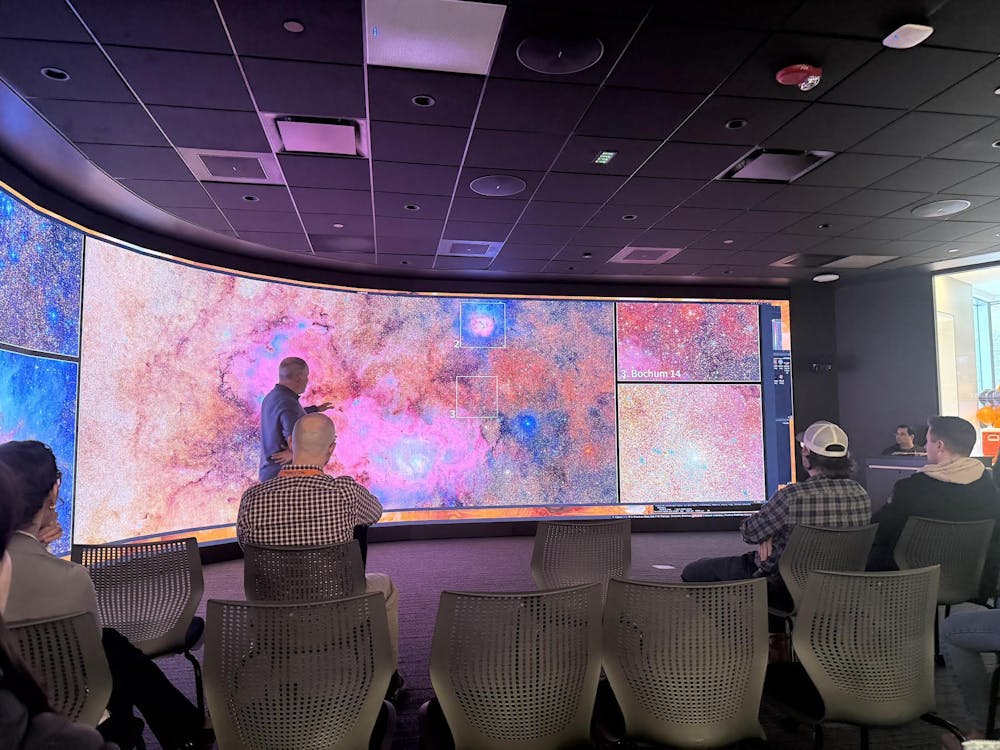
The Commons Visualization Lab, boasting a new large-format display screen wall at the recently-opened Commons Library, celebrated its launch at an open house and ribbon cutting ceremony on Tuesday, Feb. 10. The lab has been advertised as having the “world’s preeminent large format display.”
Its facilities consist of a high-resolution floor-to-ceiling display wall approximately 40 feet wide with 83 million pixels, and a curved display section meant to immerse viewers.
There are a number of other visualization labs on campus, including the Fine Visualization Laboratory in Princeton’s Engineering Library and the Stokes Visualization Hub in Wallace Hall’s Stokes Library. The Commons Lab is managed by Princeton Research Computing, while the Fine Lab is a shared facility between the Engineering Library and the Princeton Institute for Computational Science and Engineering.
“This is just the latest incarnation of Princeton’s effort to put top class visualization capability in the hands of faculty, researchers, scholars, and students,” said Galen Collier, the director of research engagement at Princeton Research Computing, in an interview with The Daily Princetonian.
The new lab’s screen is also notable for its resolution and size, consisting of 1,280 high-resolution LED panels with 40 pixels per inch. This means that the image on the screen retains its structure even when the viewer is very close, according to Eliot Feibush, the lead computational scientist and a system architect at the lab.
Because of its scale, the lab has also become a space for collaboration, inviting people to render, visualize, and analyze their data together. The collaborative nature creates a “unique opportunity to assess the data that’s been collected in all kinds of different experimental ways,” Collier said. For example, Feibush told the ‘Prince’ that an East Asian Studies professor wanted to geolocate his data using the screen and talked to cartographers during the open house.
Half of the screen is large, flat, and has a 16:9 aspect ratio, which is the equivalent of an 8K display area, according to Feibush. The other half features a curved display wall, which was the result of a number of design constraints, but “we did the best we could with what we had, and it turned out to be advantageous,” Collier said.
“You come to the curved section, which provides an immersive effect. When you stand in the center of that semicircle, all of the panels are the same distance from your eye. So, you get a really interesting … immersive experience,” Feibush said. “If you’re looking at a 3D scene, it’s particularly good for that.”

The lab has already been used to visualize large-scale simulations and can help researchers compare data between years and analyze multiple variables simultaneously.
Both STEM and humanities researchers can benefit from the lab. From life-size robots and cars to life-size artworks and research on ancient civilizations, Collier emphasized how “we’re looking at things through the eyes of a person.”
“We can create any view that we want of any space we want: a cityscape, an intersection at a city, a road, a farm, things like that. We can have it,” Collier added.
Elizabeth Hu is a staff News writer, assistant head Copy editor, associate Data editor, and staff Podcast producer from Houston. She can be reached at eh9203[at]princeton.edu.
Please send any corrections to corrections[at]dailyprincetonian.com.
Read More
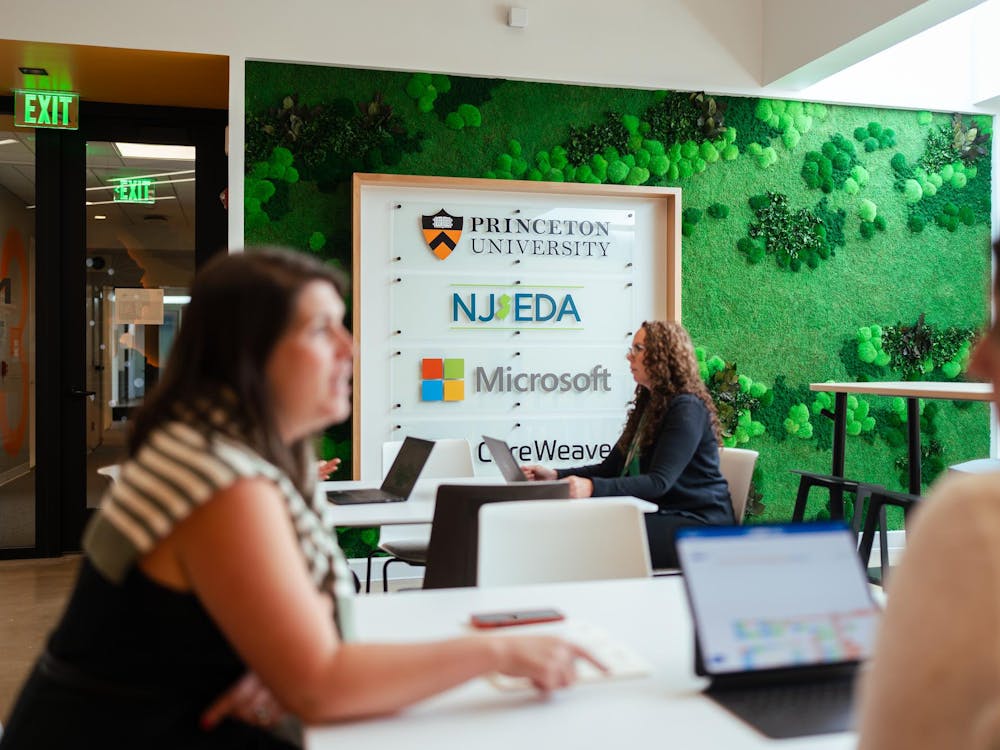
NJ AI Hub marks first anniversary with inaugural startup cohort
Zihan (Frank) XuFourteen selected start-ups receive weekly workshops, reverse pitches, corporate introductions, among other guidance over 12 weeks. The “AI accelerator” helps to test each company’s technology and fast-track its path to commercialization.
Fourteen selected start-ups receive weekly workshops, reverse pitches, corporate introductions, among other guidance over 12 weeks. The “AI accelerator” helps to test each company’s technology and fast-track its path to commercialization.
Three Princeton alumni awarded 2026 Fields Medal
Clara DochertyThe three alumni who received the medal are Yu Deng GS ’15, John Pardon ’11, and Jacob Tsimerman GS ’11.
The three alumni who received the medal are Yu Deng GS ’15, John Pardon ’11, and Jacob Tsimerman GS ’11.

How Charles Plohn ’66 brought his classmates together on the shelves
Nikki HanFor decades, Charles J. Plohn, Jr. ’66 has been collecting books published by members of his class. With nearly 700 titles in this collection, Plohn is attempting to find his library a permanent home.
For decades, Charles J. Plohn, Jr. ’66 has been collecting books published by members of his class. With nearly 700 titles in this collection, Plohn is attempting to find his library a permanent home.