



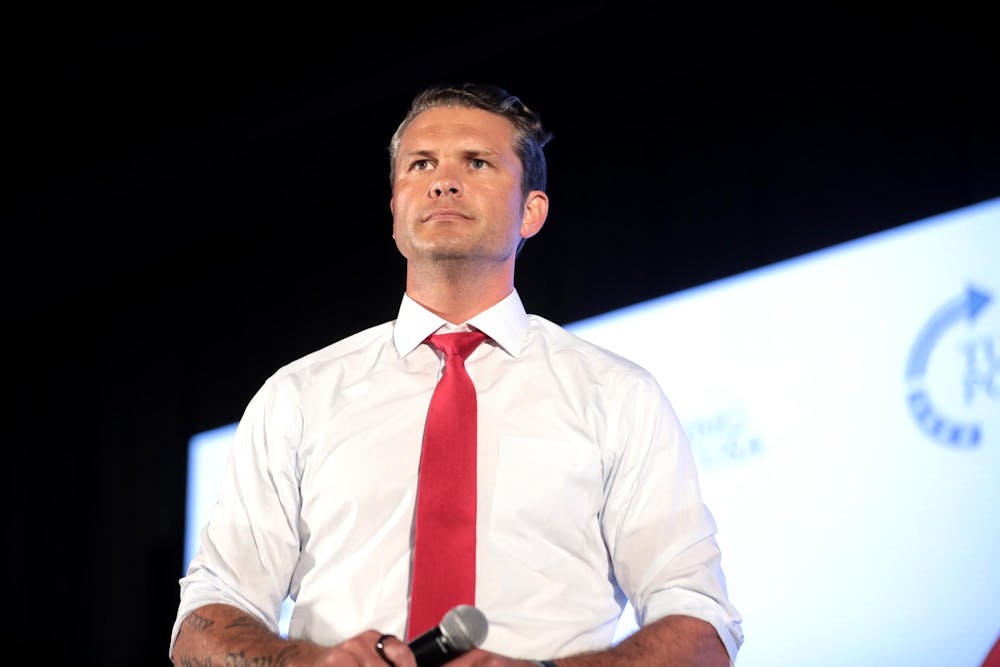
“Hegseth is performing for an audience of one: Donald Trump.”
That was how war veteran Raymond DuBois ’72 described the recent announcement from Secretary of Defense Pete Hegseth ’03. “The notion that Ivy League universities diminish critical thinking is nonsense.”
In a recent video posted on the Department of Defense’s YouTube channel, Hegseth announced that starting next academic year, the Department of Defense (DoD) will no longer sponsor graduate programs for active-duty service members at Harvard University. Active-duty service members can become eligible for the Post-9/11 GI Bill, which includes tuition assistance programs.
The video claimed that all other Ivy League schools, along with some other universities, would be evaluated by Feb. 20. The DoD has not followed up on the video announcement at the time of publication.
Though the University does not publish an exact statistic, last fall there were 22 transfer students enrolled at Princeton who had actively served in the military, and every year, around ten students involved in Reserve Officers’ Training Corps (ROTC) programs are commissioned.
Describing himself as a “traditional Republican” to The Daily Princetonian, DuBois served as a combat intelligence-operations sergeant in Vietnam. At Princeton, DuBois majored in politics, played on the lacrosse team, and was a member of the American Whig-Clio Society and of Cottage Club.
DuBois has since served in several senior leadership roles in Washington, including as acting Undersecretary of the Army.
Since the first Trump administration, DuBois has become a vocal critic of Trump. In 2020, he was among 130 national security officials who had worked for a Republican administration to sign a statement arguing that Trump was unfit to serve as president again.

Hegseth was confirmed by the Senate with the smallest margin in over 50 years, with the tie-breaking vote cast by Vice President JD Vance.
“Unfortunately, America’s highly ranked universities no longer live up to their founding principles as bastions of free speech, open inquiry, and commitment to American values that make our country great,” Hegseth said in the video. “We train warriors, not wokesters.”
DuBois, on the other hand, believes that the critical thinking that prestigious universities cultivate is an integral aspect of success in military leadership.
“Critical thinking, what the hell has that got to do with wokeness or political bias?” said DuBois. “Hegseth doesn’t even understand, I think, what critical thinking is.”
The Department of Defense did not respond to a request for comment.
Hegseth, who attended both Princeton University and Harvard’s John F. Kennedy School of Government, is among several current top-ranking government and military officials who have graduated from Ivy League schools. President Donald Trump attended the University of Pennsylvania, Deputy Defense Secretary Steve Feinberg ’82 attended Princeton, Army Secretary Dan Driscoll attended Yale Law School, and Navy Secretary John Phelan attended Harvard Business School.

In the video, Hegseth claims that cuts to graduate programs for active-duty service members are motivated by an administration priority to “maximize taxpayer value” which “no longer includes spending millions of dollars on expensive universities that actively undercut our mission and undercut our country.”
Since Trump returned to office, higher education has faced threats. Amid growing “anti-woke” momentum from the Trump administration, elite universities across the country have been criticized for diversity, equity, and inclusion (DEI) initiatives and faced concerns surrounding free speech on campus as well as allegations of antisemitism. At Princeton, dozens of federal research grants, totaling around $210 million, were suspended as part of an investigation into antisemitism on college campuses, though some were subsequently restored.
“The Ivy League as a whole has pervasive institutional bias and a lack of viewpoint diversity, including the coddling of toxic ideologies that undercuts our mission,” Hegseth said in the video.
At Princeton, along with other Ivy League Universities, a majority of students self-identify as more liberal than conservative. According to a report from the National Association of Scholars based on voter registration data, the ratio of registered Democrats to registered Republicans among Princeton professors was 40:1 in 2020.
A number of active-duty graduate students did not respond to requests for comment.
DuBois, however, does not regard these statistics as a problem.
“I like to think that irrespective of the political bias of our tenured professors, [they] would attempt in the classroom to encourage questioning of viewpoints that set the basis of great education,” he said.
DuBois argued that it is not the job of a university to teach “conservative viewpoints in a political sense, per se, but rather to introduce different experiences and a different knowledge base, based on those experiences that most students, undergraduate and graduate, do not have.”
The greatest advantage of the U.S. military against opponents, according to DuBois, is the “quality” of senior officers. Removing the opportunity for service members to attend top universities free of charge, he believes, would dilute this advantage.
“Do you want our future military leaders to only go to graduate programs at universities that espouse what Trump and Hegseth determined to be the founding principles and values upon which this country was founded?” DuBois asked.
The University declined to comment on the claim that Princeton lacks viewpoint diversity. University President Christopher Eisgruber ’83, however, has written extensively about the benefits of free speech and academic freedom in higher education in his 2025 book, “Terms of Respect: How Colleges Get Free Speech Right.”
“At their best, colleges and universities model forms of discourse that are at once unfettered and inclusive,” Eisgruber wrote.
DuBois gives credit to the University and to Eisgruber for supporting graduate programs for active-duty students.
DuBois remembers a meeting he had with Eisgruber early into his presidency. According to DuBois, Eisgruber was surprised to learn that a Navy ROTC contract was not already being negotiated.
Working with DuBois, Eisgruber re-established a Navy ROTC program, and has since facilitated an improved transfer program that allows enlistees and veterans to come to Princeton after, for example, attending a community college.
Beyond the broader national implications of inhibiting future military leaders’ access to elite educational opportunities, DuBois warns that cutting off opportunities for service members to attend these schools will decrease the appeal of staying in service for some.
“It’s a key retention tool for rising field grade officers,” DuBois said. “The opportunity to attend the best graduate programs adds to the prestige of our Officer Corps.”
The decision to suspend graduate programs marks the second major government action levied against Harvard in recent weeks. After reports surfaced that the Trump administration had dropped its demand for a $200 million payment from Harvard, Trump doubled down with a demand for $1 billion.
DuBois believes that the timing of this policy from the DoD was not accidental.
“Why did Hegseth choose to go do a video about Harvard? Because his boss had just filed suit against Harvard,” DuBois said.
The video starts with a discussion of the military’s “rich tradition with Harvard throughout American history.” Hegseth said that in 1775, George Washington took command of the continental army in Harvard Yard. DuBois pointed out that this was actually incorrect, as the Continental Army was in the Cambridge Common.
“I mean, come on, Hegseth, do your homework,” DuBois said.
At its core, DuBois believes the new policy from the DoD missed the mark on addressing critical thinking within the military.
“We don’t need to teach them what to think, we need to teach them how to think.”
If Princeton and other Ivy League schools receive the same evaluation as Harvard, active-duty graduate students in the Class of 2027 or later may not receive financial support from the Department of Defense.
“This policy is going to be damaging to our military, to our defense department, to our national security and to the schools involved,” DuBois said.
Devon Rudolph is the head Podcast editor and a senior News writer. She is from Fairfax, Va. She can be reached at dr7917[at]princeton.edu.
Please send any corrections to corrections[at]dailyprincetonian.com
Read More

Thieves steal $250,000 in designer bags from Princeton luxury boutique in overnight break-in
Elizabeth HuFour masked people broke into a luxury boutique store in Princeton on Sept. 1, stealing over $250,000 worth of handbags.
Four masked people broke into a luxury boutique store in Princeton on Sept. 1, stealing over $250,000 worth of handbags.

Princeton students ‘Blossom Together’: A student club takes on global humanitarian efforts
Elma CesicThis past winter break, students from Blossom Together travelled to Benin, having raised around $17,000 for food packages, water wells, and cataract surgeries.
This past winter break, students from Blossom Together travelled to Benin, having raised around $17,000 for food packages, water wells, and cataract surgeries.

New Commons Cafe opens following cafe closures in previous years
Hifza KaleemFollowing multiple cafe closures across campus in the last two years, a new cafe opened in the SEAS Complex.
Following multiple cafe closures across campus in the last two years, a new cafe opened in the SEAS Complex.