



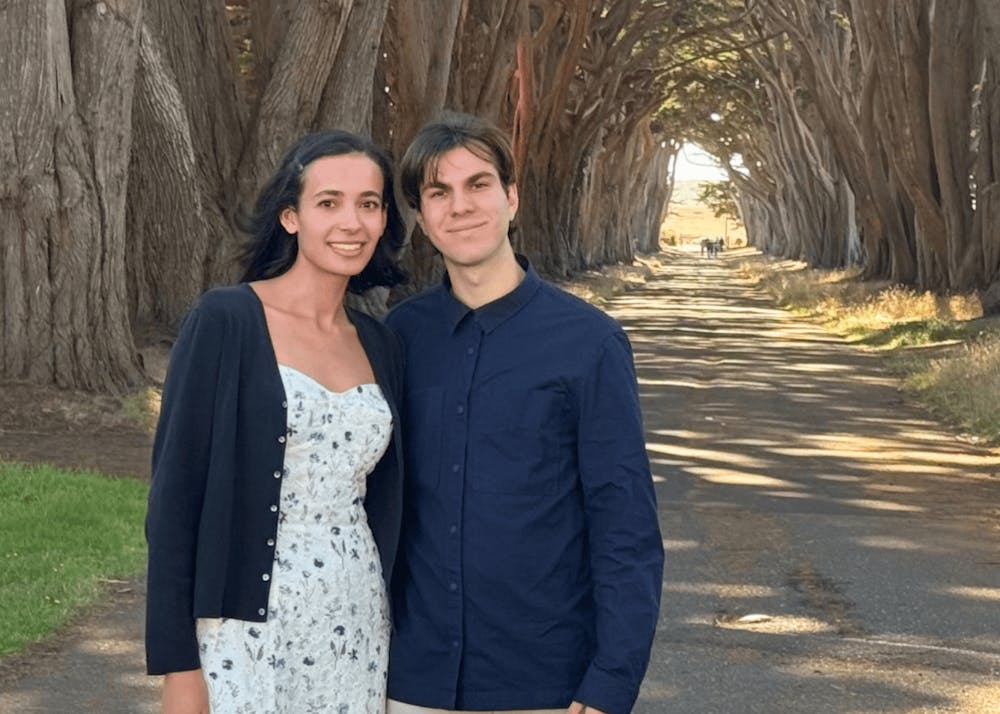
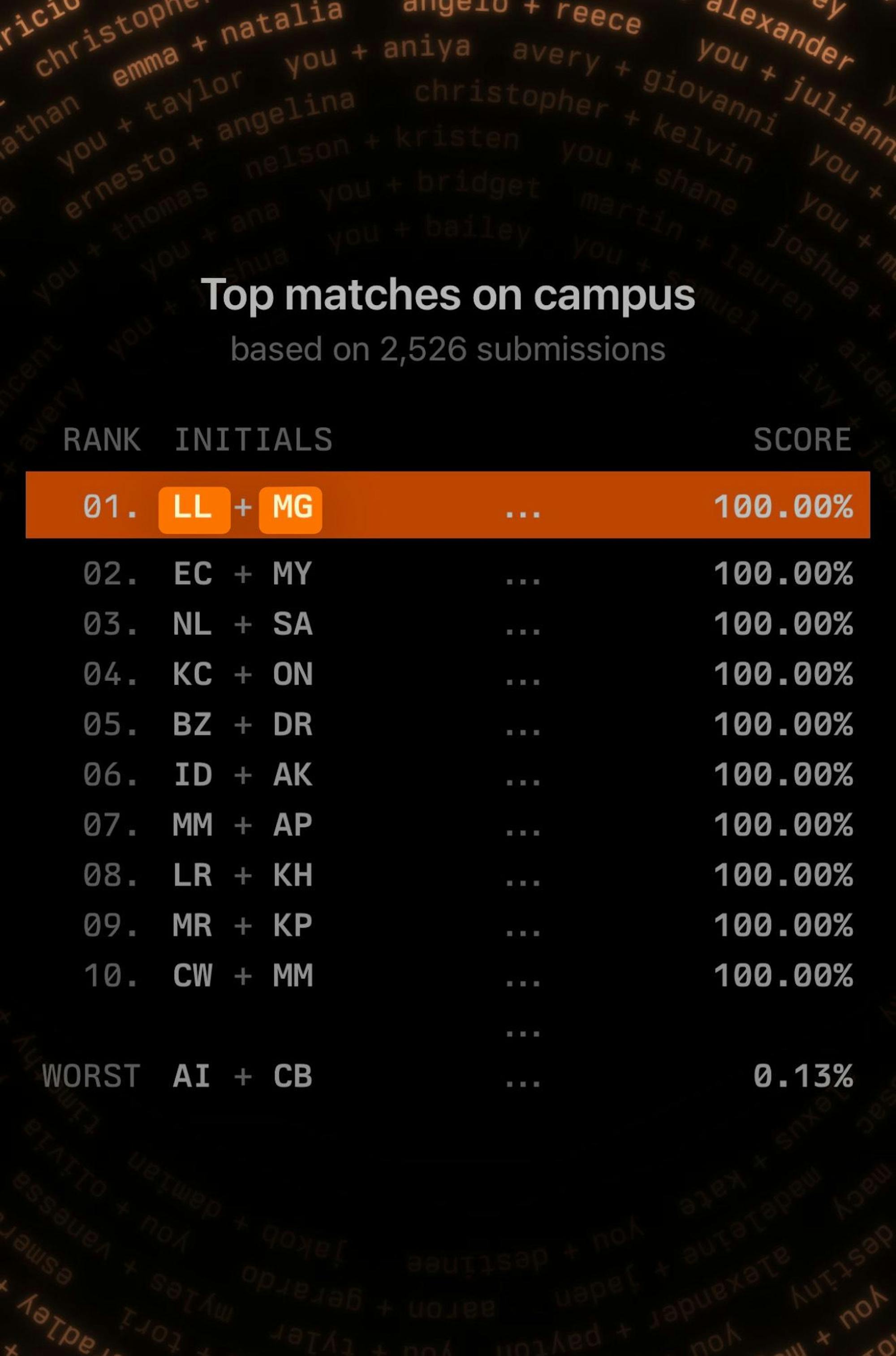
In the 2024 cycle of the Princeton Marriage Pact, Leila Leibert ’27 and Manuel García San Millán ’27 were the top match on campus out of 2,526 participants. The algorithm told them they were 100 percent compatible. Now, they have been dating for more than nine months.
Algorithms like Marriage Pact, Date Drop, and Datamatch — dating services that pair participants based on surveys — have become increasingly popular for those looking to find love at Princeton. These services were all founded outside Princeton — Marriage Pact and Date Drop by Stanford students, and Datamatch by Harvard students — but have slowly made their way inside the Princeton dating scene.
Last semester, 1,547 students signed up for Princeton Marriage Pact. But are the students who sign up actually looking to find love?
Some would say so. Others do it for fun.
“[Dating algorithms are] something people are entertained by from time to time, kind of like how a Buzzfeed quiz is entertaining to try with your friends,” Laura Hwa ’26, a campus ambassador for Marriage Pact in Fall 2024, told The Daily Princetonian.
Leibert and García’s experience, however, has been different. For Leibert, García, and many others, algorithms like Marriage Pact offer a way for students to connect through shared interests and form genuine relationships, whether they are long-term romantic partnerships or friendships.
Leibert did not sign up for Marriage Pact expecting anything. She had just transferred to Princeton that semester and was encouraged by her roommates to try it out.
In fact, it is precisely this word-of-mouth that operates Marriage Pact, Hwa explained.

“The sentiment is that you want people to be talking about [Marriage Pact] among themselves … And then if it incites a sort of FOMO [fear of missing out] psychological environment, more people would be inclined to do it,” Hwa told the ‘Prince.’
“I was honestly just expecting I would meet someone new on campus,” Leibert said. “I didn’t know it would end up coming with the whole relationship.”
García entered with similar expectations.
“I feel like all your friends are involved, everyone’s involved,” García said. “I did not go in with any hopes of finding a potential partner, rather trying to find somebody in Princeton that I could say ‘hi’ to.”
Leibert reached out to García first, using LinkedIn because she did not know his email. At this point, she did not realize they were the top match on campus. This was a fact García later told her on their first date, dinner on Nassau Street.
Leibert and García were the top Marriage Pact match on campus in 2024.
Photo courtesy of Leila Leibert

But quickly, they realized that Marriage Pact was correct about their compatibility. On their first date, Leibert and García spent a lot of time comparing their answers to see why they were matched. They realized that some questions required them to agree — including that they are both agnostic — while other questions required disagreement.
“We also quizzed each other on what our answers were, because we were trying to see if we had answered the same thing, and I don't think we had,” Leibert added.
“There’s some I feel like you have to disagree for it to be compatible,” García explained.
Since Marriage Pact was sent out the week before finals in Fall 2024, Leibert and García did not start officially dating until the next semester. “I don’t think we even messaged each other over winter break, really,” Leibert said.
But once the Spring 2025 semester kicked back up, the two discovered they were in the same class, Behavioral Finance. At first, they sat separately, with García near the front and Leibert near the back. But every subsequent week, García sat one row further back than the last week, until they were sitting next to each other.
“I thought [that] was cute,” Leibert said. “The professor definitely noticed.”
The pair began to do more activities together, such as going on walks near the Institute for Advanced Study. At the beginning, it was a great way for them to find out about their shared interests.
And there were many. Leibert is an operations research and financial engineering major but has an associate’s degree in mathematics and economics, and García began as an economics major but switched into mathematics. They also both love tennis and sailing.
After Leibert mentioned her and her then-roommate’s love for tennis, García brought his roommate along and they played tennis together.
“We didn’t realize how good they were at tennis,” Leibert joked.
The pair started officially dating on April 21, 2025.
Neither Leibert nor García still thinks Marriage Pact will automatically mean compatibility for long-term relationships. But they do think it helps form connections on campus.
Leibert and García are not the only students that feel this way. Pierre Du Plessis ’29, who has participated in Date Drop multiple times, explained that Date Drop has helped facilitate connections for himself and his friends. Date Drop and Marriage Pact vary slightly. Marriage Pact runs annually whereas Date Drop runs for a weekly basis for a select amount of time.
Last semester, Du Plessis had been seeing someone on-and-off for a few weeks before they randomly matched on Date Drop. While they did not enter a serious relationship, they are still friends.
“That's just proof that the algorithm is actually accurate,” Du Plessis said.
Henry Weng, a Stanford student and founder of Date Drop, wrote in a statement to the ‘Prince’ that “the whole point is to get people off their phones and into the real world. Instead of swiping, the weekly cadence encourages people to actually invest in getting to know one person at a time.”
For these students, dating algorithms create an important space for finding relationships on campus.
According to Du Plessis, because Princeton is such a small campus, “words spread quickly.” Services like Date Drop have helped him connect with people more privately.
“There’s no pressure to say yes or no to the people, or actually meet up with them. So it's a non-stressful way of just being able to meet more people and also have a safety net to fall back on if stuff goes wrong,” Du Plessis said.
“I'm glad Princeton has Marriage Pact,” Leibert said. “I think everyone forms their own clique, and it’s really hard to break out of your friend group and start dating new people. And through this, I met someone I had never met on campus before.”
“I think Marriage Pact serves a good purpose in that it doesn’t let you filter out people from the get go,” Leibert explained. “I don’t really have a type when it comes to dating personally, so for me I’d like to go in unbiased and just meet who matches me based on my own values and personality traits, and that's what Marriage Pact serves to do.”
And they’re not the only couple. Leibert and García both have friends who are in or have been in long-term relationships from Marriage Pact.
Hwa, however, recognized the shortcomings of these services.
“I definitely think it’s so much more for the bit, rather than generating productive long term relationships,” Hwa said.
“I haven’t had any lasting friendships, let alone relationships from the algorithmic things,” Hwa added. “I either don’t reach out to whoever I’ve been matched with, especially if I know of them already and I don't particularly feel inclined to reach out.”
Although some students might fill out the services for fun, García pointed to the fact that Marriage Pact asks students if they want a serious relationship.
“There is an option at the end that’s like, ‘how single are you?’” He explained that he has friends — some of whom were in six-year relationships — who put a very low number as a way to simply meet a new friend. “I do think that Marriage Pact is something that you can see as a great opportunity to get to know people.”
“I think [students] should just treat it like an opportunity to meet someone and get to know them,” Leibert told the ‘Prince.’ “I think that’s like what I took out of it most, and it ended up being like a wonderful match.”
Nikki Han is the head Features editor for the ‘Prince.’
Please send any corrections to corrections[at]dailyprincetonian.com.
Read More

NJ AI Hub marks first anniversary with inaugural startup cohort
Zihan (Frank) XuFourteen selected start-ups receive weekly workshops, reverse pitches, corporate introductions, among other guidance over 12 weeks. The “AI accelerator” helps to test each company’s technology and fast-track its path to commercialization.
Fourteen selected start-ups receive weekly workshops, reverse pitches, corporate introductions, among other guidance over 12 weeks. The “AI accelerator” helps to test each company’s technology and fast-track its path to commercialization.
Three Princeton alumni awarded 2026 Fields Medal
Clara DochertyThe three alumni who received the medal are Yu Deng GS ’15, John Pardon ’11, and Jacob Tsimerman GS ’11.
The three alumni who received the medal are Yu Deng GS ’15, John Pardon ’11, and Jacob Tsimerman GS ’11.

How Charles Plohn ’66 brought his classmates together on the shelves
Nikki HanFor decades, Charles J. Plohn, Jr. ’66 has been collecting books published by members of his class. With nearly 700 titles in this collection, Plohn is attempting to find his library a permanent home.
For decades, Charles J. Plohn, Jr. ’66 has been collecting books published by members of his class. With nearly 700 titles in this collection, Plohn is attempting to find his library a permanent home.