



“The last Princetonian for the duration [of the war] went to the press last night.”
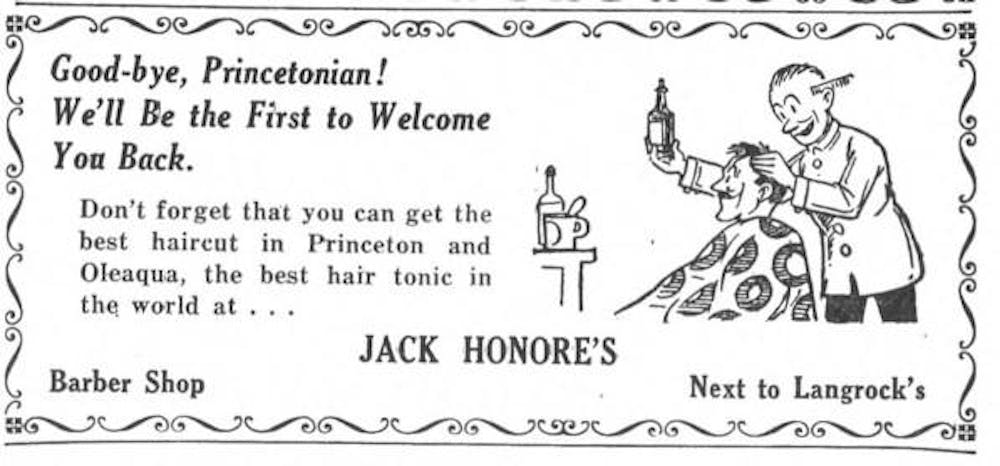
On Feb. 6, 1943, readers of The Daily Princetonian opened the campus paper to see an unexpected headline blazoned across the front page. Articles on the University’s wartime courses and relief programs were accompanied by the announcement of the closure of the very paper reporting on them. The ‘Prince’ was sending out a swan song before shutting down.
The decision to pause publication of the ‘Prince’ for the duration of the war had been a protracted, deliberative process. Initially, the paper reduced circulation to thrice weekly soon after Pearl Harbor. The only other time the newspaper had fully ceased production was in 1918 due to World War I and the Spanish Flu.
“Expected and planned on for some time by officers of the paper, the suspension of publication was directly caused by the immediate prospect of the call to service of a large number of the present board members,” Managing Editor J. Van Ness Philip ’44 wrote in 1943. The officers were concerned that, with fewer editors, the paper could not “continue either adequate news coverage or maintain solvency of finances.”
In their final articles, members of the 66th board reminisced about their ‘Prince’ experience. Much of the staff had been working on the paper since the “days before Pearl Harbor,” when America had not yet invested in the war, according to Managing Editor Ben Walker ’44. He described the writers’ nostalgia as they cleaned the “littered office” and linotype machines fell silent.
Without the ‘Prince,’ students turned to its replacement — the temporary University-run Princeton Bulletin — for their campus news.
The Princeton Bulletin was published on Mondays, Wednesdays, and Fridays from Feb. 8, 1943 through Dec. 21, 1945. According to its banner, it billed itself as the “Wartime Successor to The Daily Princetonian,” but had no affiliation with the shuttered student newspaper. The Princeton Bulletin completely replaced The Daily Princetonian for almost three years.
“The University assumes for the duration of the war the responsibility of publishing a campus newspaper,” a notice in the first edition of the Princeton Bulletin read. “The Bulletin is strictly a stop-gap publication, designed to maintain the necessary contact between undergraduates and the administration and faculty.”

In addition to official notices, the Bulletin covered campus news in each volume, soliciting “assistance” from “the organizations and members of the Princeton community in providing news matter.” Students could send in material for news columns until 10 a.m. on publication days. Each edition was four pages and seldom contained pictures.
On Sept. 24, 1945, a group of students spearheaded by Robert Sharkey ’48 started a coup against the Princeton Bulletin and gained control of it. From the basement of Whig Hall, they composed the first “Undergraduate Issue” using only “one pair of scissors, a small jar of paste, one ruler, and Mark Ethridge, Jr. ’47, son of the globe-trotting editor of the Louisville Courier Journal.” Students avidly read the illicit edition and even “framed the paper and put it up in their rooms,” the writers reminisced in 1946.
“The ‘Prince,’ in embryonic stage, had once more appeared on campus for the first time since February 6, 1943, ” they added.
Eight students, including Sharkey and, temporarily, Ethridge, would continue to work on the Bulletin until December 1945, when they convinced the administration to reestablish The Daily Princetonian after winter break.
Publication of the ‘Prince’ resumed on Jan. 5, 1946, effectively replacing the Bulletin’s run as the campus newspaper. It resumed daily publication on March 4 for the first time in four years. In a box near the masthead, the ‘Prince’ proclaimed: “Founded in ’76. Reborn in ’46.”
By the paper’s renaissance, the Classes of 1945 and 1946 — who had staffed the ‘Prince’ before its closure — were either in their final years or had already graduated. Instead, new Princetonians filled the paper’s ranks, but still paid homage to their older and former classmates. In its first edition back, the 70th Board honored its predecessors and the 355 Princeton men who died in the war, including ‘Prince’ writers Frederic C. Gordon ’45 and Willis Altenderfer ’46, who were on the last pre-war board.

“The members of the staff plan to live up to the standard set by the men of the Princetonian of old,” they wrote as the ‘Prince’ reestablished itself under new leadership, taking its place again as the “fingers on the pulse of the campus.”
Lucia Zschoche is the associate editor for Archives and an assistant editor for Features for the ‘Prince.’
Please send any corrections to corrections[at]dailyprincetonian.com.
Read More

Princeton’s Baked Bear: a new standout or just bearable?
Alexis ChoiContributing writer for The Prospect Alexis Choi reviews the new Baked Bear location in downtown Princeton.
Contributing writer for The Prospect Alexis Choi reviews the new Baked Bear location in downtown Princeton.

Building community one porch at a time at Princeton Porchfest 2026
Kellen FisherContributing writer for the Prospect Kellen Fisher shares his experience at Princeton Porchfest 2026.
Contributing writer for the Prospect Kellen Fisher shares his experience at Princeton Porchfest 2026.

Princeton Council restricts ICE actions on municipal-owned grounds
Reem TelhaouiCouncil members voted unanimously to bar federal immigration officers from non-public, municipally owned land without a judicial warrant. Residents also urged the Council to reverse its 2024 ban on skating at Lake Carnegie, a decision the municipality is now reconsidering.
Council members voted unanimously to bar federal immigration officers from non-public, municipally owned land without a judicial warrant. Residents also urged the Council to reverse its 2024 ban on skating at Lake Carnegie, a decision the municipality is now reconsidering.