



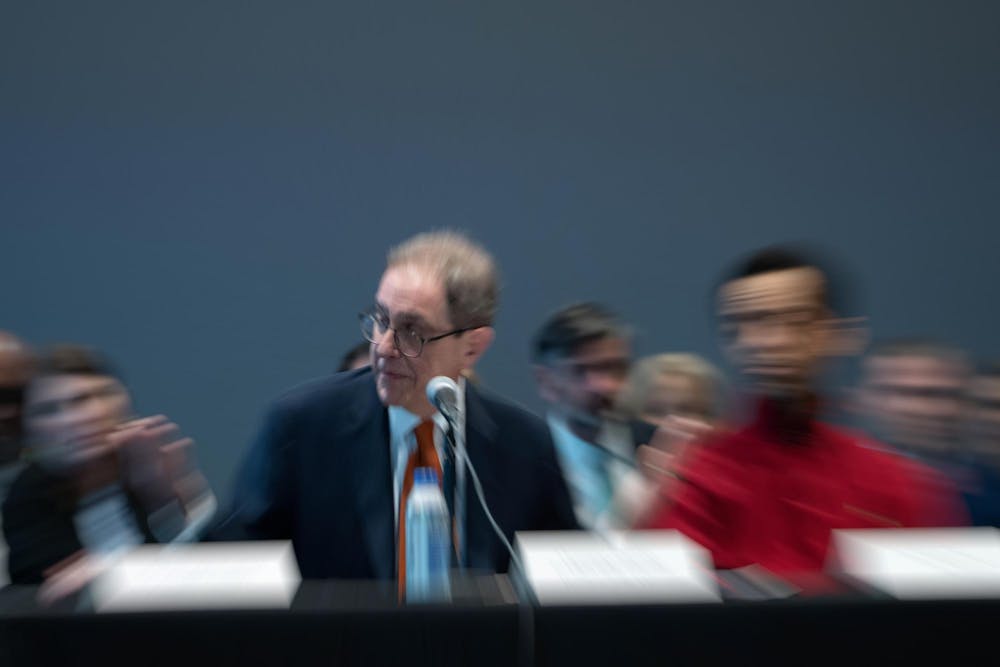
Princeton is an undemocratic place. Its premier open deliberative body, the Council of the Princeton University Community (CPUC), is fraught with attempts to filter legitimate dialogue and debate between various campus interests. Indeed, as my colleague Siyeon Lee argued last fall, CPUC meetings “mostly functioned as a Q&A, the decision already made, and the damage already done.”
This institutional problem with CPUC — which Lee identifies as “a contrived performativity” — results in a stark absence of opportunities to hold powerful figures accountable for the decisions they make on our behalf.
However, in just under two weeks, at the upcoming Feb. 9 CPUC meeting in the basement of Frist Campus Center, the University community — students, faculty, and staff — will have a rare opportunity for unfettered access to University President Christopher Eisgruber ’83. We must use this opportunity to interrogate the various decisions that have been made in the past year, from big-ticket political issues like not dissociating from Israeli companies to student life concerns such as ending independent dining.
To an ordinary member of the campus community, Eisgruber is strikingly difficult to reach. Aside from his monthly sanitized appearances at CPUC meetings, during which community members can ask pre-screened questions and receive pre-prepared answers, he holds biannual conversations with pre-registered groups of students in each of the residential college dining halls, and just two hour-long sections of office hours per year reserved for one-on-one, off-the-record meetings.
The upcoming opportunity is so distinct because of Eisgruber’s inaccessibility. Questions at CPUC are usually submitted three days in advance; this length of time between question submission and CPUC meeting gives Eisgruber and the University administration plenty of time to prepare carefully worded responses to dodge accountability. That often entails bringing other administration figures to answer the questions instead of Eisgruber.
But on Feb. 9, pre-meeting question submission isn’t required, and Eisgruber alone has to answer our questions. When this sort of opportunity comes around, we should seize it to advocate for our interests and opinions to one of the few true decision makers at the University.
Questions that necessitate unprepared answers often reveal more of the truth. Unexpected questions — in certain cases — can help questioners extract a fuller truth than when their respondents use prepared answers to expected questions.
That is potentially part of the reason Eisgruber was so aggrieved about the unexpected questions he received at the March 2025 CPUC meeting, and why CPUC began to project original questions onto the screen when they are read. Asking questions without allowing the administration to prepare a response will likely produce a more unpolished, whole-truth answer.

In that sense, progress is possible: While pre-screened questions allow Eisgruber to dodge difficult topics, asking him to pick a side on an issue of importance to the University and its students, faculty, or staff without preparation may result in less smoke and mirrors and a more direct answer.
While in a world of pre-screened questions and prepared answers, a decision-maker can obfuscate their true position behind rhetoric, in a world of unexpected questions and off-the-cuff answers, a decision-maker might be forced to “pick a side.” Given that Eisgruber and his colleagues are likely media-trained, they are perhaps still unlikely to deviate from set talking points. Even in this case, your questions — at the minimum — force them to think about the issues that matter most to you and enter them into the public consciousness as well.
If they do pick a side, though, it’s useful to those who want change, no matter what side they pick. That’s because, either way, the next steps are clear: if they pick the side advocates agree with, it’s a success; if they pick the opposite side, we can more clearly point out the fault in that decision and push for change.
That means that a question for Eisgruber about dining, divestment, international student protections, research funding, mental health, or any of the many other issues facing our community has the chance, however small, to prompt an actual change in the University’s course of action over the coming year.
We have a rare opportunity on Feb. 9 to ask Eisgruber questions about those issues in a way we wouldn’t otherwise be able to. I urge you to attend the CPUC meeting that day and bring hard, unexpected questions.
CPUC and University governance as a whole are usually mere performances of democracy at best. But on Feb. 9 at 4:30 p.m. in the Frist Multipurpose Room, for an unmitigated hour and a half, President Eisgruber answers to us. Let’s not squander that opportunity.

Isaac Barsoum ’28 is an associate Opinion editor from Charlotte, N.C. He thinks “smoke and mirrors” should be reserved for Terrace, not University governance processes. He can be reached at itbarsoum[at]princeton.edu.
Correction: A previous version of this piece omitted the illustration credit on the attached graphic. The credit has been corrected in the caption.
Read More

Keep academic advising human only
Shane McCauleyWhen generative AI threatens academia in so many ways, both structurally and symbolically, it’s nonsensical for colleges to encourage its uptake through a tool that doesn’t really work in the first place.
When generative AI threatens academia in so many ways, both structurally and symbolically, it’s nonsensical for colleges to encourage its uptake through a tool that doesn’t really work in the first place.

The real crisis on campus isn’t cheating, it’s thinking
Jack GoodmanFurther, a growing body of research confirms that use of generative AI undermines the cognitive effort that is essential to the development of the human brain. As AI use increases, learning, recalling, and critical thinking skills decline.
Further, a growing body of research confirms that use of generative AI undermines the cognitive effort that is essential to the development of the human brain. As AI use increases, learning, recalling, and critical thinking skills decline.

Trust in academia is at a low. Can Writing Seminar help?
Ian RosenzweigAcademia has a PR problem, and no amount of insular critical inquiry is going to solve it. Writing Seminars should live up to their name and teach us not just to solve thorny research problems but also to effectively communicate our solutions through clear and — perhaps more importantly — stylistically compelling prose.
Academia has a PR problem, and no amount of insular critical inquiry is going to solve it. Writing Seminars should live up to their name and teach us not just to solve thorny research problems but also to effectively communicate our solutions through clear and — perhaps more importantly — stylistically compelling prose.