



In the wake of the Justice Department’s gradual release of files detailing the activities of the late New York financier Jeffrey Epstein, Harvard University has been thrust into the national spotlight for its various ties to the convicted sex offender, but Princeton has avoided the same degree of scrutiny.
Princeton’s other peer institutions have also been mentioned in the files. The Yale Daily News reported that Epstein had been offered an introduction to Yale law school professor Jed Rubenfeld, but Rubenfeld denied that they were ever in touch. The Daily Pennsylvanian reported that University of Pennsylvania senior administrator David Asch had supposedly toasted to Epstein in 2014. The Dartmouth reported that Dartmouth College has no “current financial relationship” with alumnus Leon Black, a client of Epstein’s tax and estate-planning services.
Are Princeton alumni also entangled in the Epstein files? The Daily Princetonian reviewed the newly released Epstein files and found two mentions of alumni with legal connections.
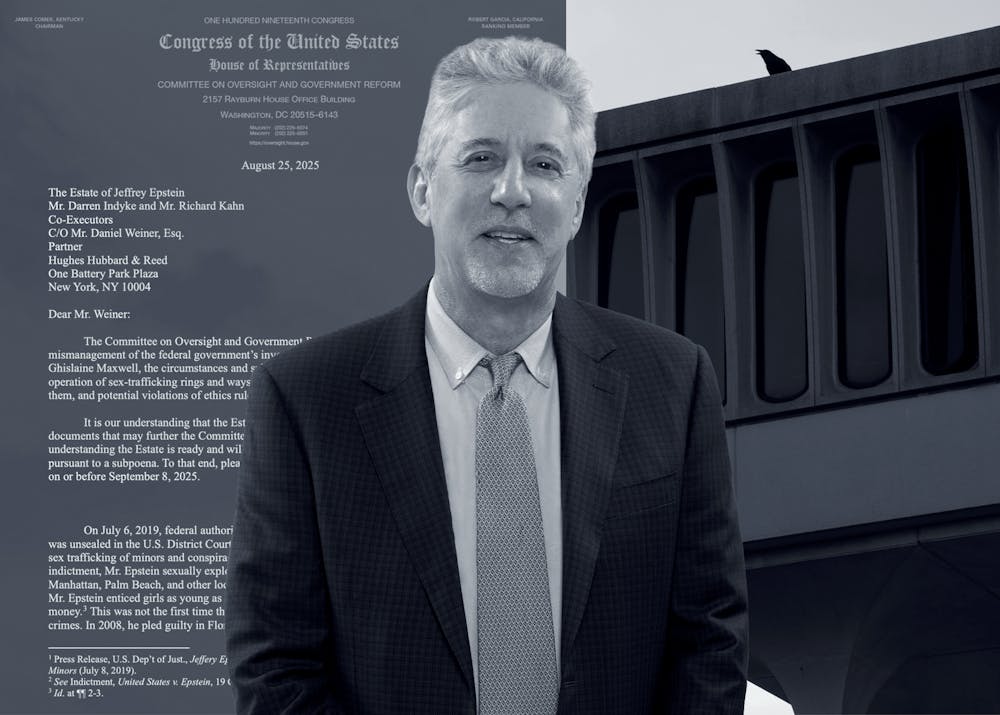
Lawyer Daniel H. Weiner ’81 represents Epstein estate and its co-executors
One alumnus featured in the files is Daniel H. Weiner ’81, who is an attorney for Darren K. Indyke. Indyke was Epstein’s longtime personal lawyer and is a co-executor of the Epstein estate, which comprises Epstein’s collective assets, property, and legal affairs.
Weiner graduated cum laude with an A.B. in Politics and currently works as a partner at Hughes Hubbard & Reed LLP in New York City. In an interview with the ‘Prince,’ Weiner discussed his legal history with Epstein.
Following Epstein’s death in August 2019, Indyke retained Weiner’s law firm to represent the Epstein estate and set up the Epstein Victims’ Compensation Program (EVCP), according to Weiner. The EVCP was a victim-oriented fund that paid over $121 million to 136 women who suffered abuse at Epstein’s hands.
Within two months of being retained, Weiner told the ‘Prince’ that he helped the co-executors hire Kenneth Feinberg, a lawyer who regularly handles large-scale crisis compensation, and his colleagues Camille Biros and Jordana Feldman, to create the EVCP and manage its operations until they ended in August 2021.

The EVCP, designed by the co-executors with significant input from much of the women claimants’ counsel, was administered primarily by Feldman and funded entirely through the Estate. The Estate “just wrote checks,” according to Weiner, and placed no limit, on either individual awards or in the aggregate, on the amounts the EVCP could award. 92 percent of the victims accepted their EVCP awards, which they received after an application process reviewing the details of their relationship with Epstein.
In January 2020, then-U.S. Virgin Islands Attorney General Denise George brought a case against Indyke and Richard Kahn, the other co-executor of the Epstein estate, arguing that the presence of the Estate in the Virgin Islands was a criminal enterprise — and thus, a racketeering scheme. Epstein’s primary residence was in the Virgin Islands. In February 2021, George called Indyke and Kahn “indispensable captains” of the enterprise, which she alleged they “knowingly facilitated.”
Weiner was one of the lead attorneys defending Indyke and Kahn during this suit and helped negotiate a $105 million settlement reached in 2022 — a settlement which, Weiner announced in a public statement, did not constitute an admission of the executors’ involvement in Epstein’s crimes.
Weiner is currently defending Indyke and the Estate in multiple civil suits.
One of these suits, Allyson Ward v. Indyke et al., was stayed by a New York federal court on Dec. 24, with a positive settlement update sent on Jan. 9.
Weiner is also currently defending the Estate and its co-executors in a civil suit filed by Ghislaine Maxwell, Epstein’s top accomplice, who claims that the Estate should reimburse her legal expenses. Weiner expressed to the ‘Prince’ that he expects this suit to be dismissed.

“We’re not going to pay the bills for someone who has been found by a jury to be a criminal,” Weiner said. “When the suit had been initially filed, she had not yet been found guilty. But her conviction eliminated any possibility that her claim would prevail in court.”
Weiner said that he still continues to handle affairs related to the Estate, which included managing and selling Epstein’s former residences in New York City, Paris, New Mexico, Palm Beach, Fla., and the Virgin Islands.
Weiner also assisted the Estate in its response to two subpoenas issued by the U.S. House of Representatives Committee on Oversight and Government Reform over the summer. Those subpoenas asked for a “complete, unredacted copy” of Epstein’s “Birthday Book,” which contained numerous messages from Epstein’s acquaintances, as well as all video and still photographs taken on Epstein’s former properties. According to Weiner, the Estate cooperated fully with these requests, providing a copy of the book and about 95,000 photographs in which the Estate redacted nudity out of respect for the privacy of the women photographed.
Another subpoena, approved by the Oversight Committee on Jan. 7, will request more material from the Estate’s co-executors. Weiner stated that “the Epstein Estate has pledged to continue its cooperation with the House Oversight Committee, including in response to these latest subpoenas.”
Weiner told the ‘Prince’ that when he first began representing the Estate, his two college-aged daughters asked him why he was involving himself with Epstein. In response, Weiner affirmed his commitment to ethical legal standards.
“I have two daughters, then teenagers now in their mid-20s, who asked me, ‘What are you doing, defending Epstein?’ Epstein was a creep and sex abuser, no one’s denying that. But Indyke and Kahn have not been implicated in his affairs. No court anywhere has found that either Indyke and Kahn had any knowledge of any misconduct by Epstein at the time it occurred,” Weiner said.
Prosecutorial ethics scholar Bennett Gershman ’63 asked to be expert witness in Maxwell trial
Weiner is not the only alumnus with a legal connection to the files. Bennett Gershman ’63 was identified in the files as an expert witness who was contacted by Maxwell’s lawyers to testify in United States v. Maxwell. Gershman is a professor of law at Pace University Elisabeth Haub School of Law and an expert in prosecutorial ethics.
According to the letter submitted to the court by Maxwell’s lawyers in Nov. 2021, Gershman was to be hired to “provide testimony on best practices to ensure the integrity of any prosecution, focusing on investigation, witness preparation, media contact, neutrality, obligations to provide accurate information, and relationship with crime victims, their counsel, and case-related civil litigation.”
However, before the case could even reach court, District Judge Alison Nathan filed an order dismissing Gershman as an expert witness and requiring Maxwell’s lawyers to resubmit their request, which they did not do.
The reason, Gershman explained to the ‘Prince’ in an interview, was because prosecutorial ethics did not have any relevance to the case.
“In many cases, it doesn’t seem to have any bearing on the case, the prosecutor’s conduct — that does not factor into the evidence. And I guess that was the way the judge saw the Maxwell trial. There’s no issue involving prosecutorial conduct that really matters here,” Gershman said. “We’re looking at the evidence, conspiracy witnesses, what they say — the prosecutor didn’t apparently hide anything. There’s no claim that the prosecutor did anything wrong.”
Gershman is an acquaintance of Bobbi Sternheim, Maxwell’s lead defense counsel who gave the opening remarks at the trial.
“I think it was a clever move by Maxwell’s lawyers to try to beef up their case with some additional ammunition,” Gershman said of the legal team’s decision to approach him. “The more money you have to hire experts, you might have a better shot, because juries like and respect experts.”
Although he cast doubt on how effective his testimony for Maxwell would be, considering that her associate Epstein was clearly “a vile and contemptible character who did bad things,” Gershman added that, as an expert witness, the morality of the defendant is not of his concern.
“I don’t really have to care about the defendant. If I’m representing a defendant or if I’m hired by a defense lawyer, it doesn’t mean anything to me,” Gershman said. “They want my opinions. I’m not going to make up an opinion. I’m not going to exaggerate or falsify or misrepresent anything. I would never do that, but I would give my expertise.”
The role Gershman was to play as an expert witness is one that has “a whole range of ways of influencing a jury.” However, Gershman explained that the expectations Maxwell’s lawyers had of him were unclear from the start.
“From the beginning, it wasn’t really that clear exactly what they wanted from me,” Gershman said. “I’ll tell you the truth: I wasn’t shocked that the judge decided to not allow me and other experts to testify.”
However, despite the judge denying the request for him to serve as an expert witness, Gershman maintained interest in the legal dimensions of both Maxwell and Epstein’s trials and published an opinion in the New York Law Journal on the complexities of the “Epstein Saga.”
He has not since been approached by Maxwell’s lawyers. At the time he had been asked to serve as an expert witness, negotiations for payment had not yet begun, and Gershman said that he had no direct interactions with Maxwell.
As of Dec. 24, the DOJ has found close to a million more Epstein documents, which will take “a few more weeks” to be processed and released.
Luke Grippo is a head News editor for the ‘Prince.’ He is from South Jersey, and typically covers high-profile interviews and University and town politics on a national, regional, and local scale. He can be reached at lg5452[at]princeton.edu.
Please send any corrections to corrections[at]dailyprincetonian.com.
Read More

VP for Campus Life Calhoun to retire, leaving behind mixed legacy
Luke GrippoVice President of Campus Life W. Rochelle Calhoun will retire at the end of the 2026–2027 academic year. She entered the position in 2015 and has worked to expand mental health resources on campus, though she was criticized for her response to a sit-in at Clio Hall during the “Gaza Solidarity Encampment.”
Vice President of Campus Life W. Rochelle Calhoun will retire at the end of the 2026–2027 academic year. She entered the position in 2015 and has worked to expand mental health resources on campus, though she was criticized for her response to a sit-in at Clio Hall during the “Gaza Solidarity Encampment.”

Students awarded prizes for academic achievement, discuss Princeton experience
Mia ChenSeven undergraduate students were awarded four different awards during Opening Exercises on Aug. 31. These awards spotlight academic excellence among students.
Seven undergraduate students were awarded four different awards during Opening Exercises on Aug. 31. These awards spotlight academic excellence among students.

The Experimental College: the short-lived radical intellectual guild
Chris XinIn 1966, discontent with Princeton’s curricular offerings and preceptorial system, a group of students from the already avant-garde Woodrow Wilson Society founded an even more radical institution: the “Experimental College.” In its short lifespan of two years, the Experimental College provided a glimpse into a different possibility for Princetonians’ social and intellectual life.
In 1966, discontent with Princeton’s curricular offerings and preceptorial system, a group of students from the already avant-garde Woodrow Wilson Society founded an even more radical institution: the “Experimental College.” In its short lifespan of two years, the Experimental College provided a glimpse into a different possibility for Princetonians’ social and intellectual life.