



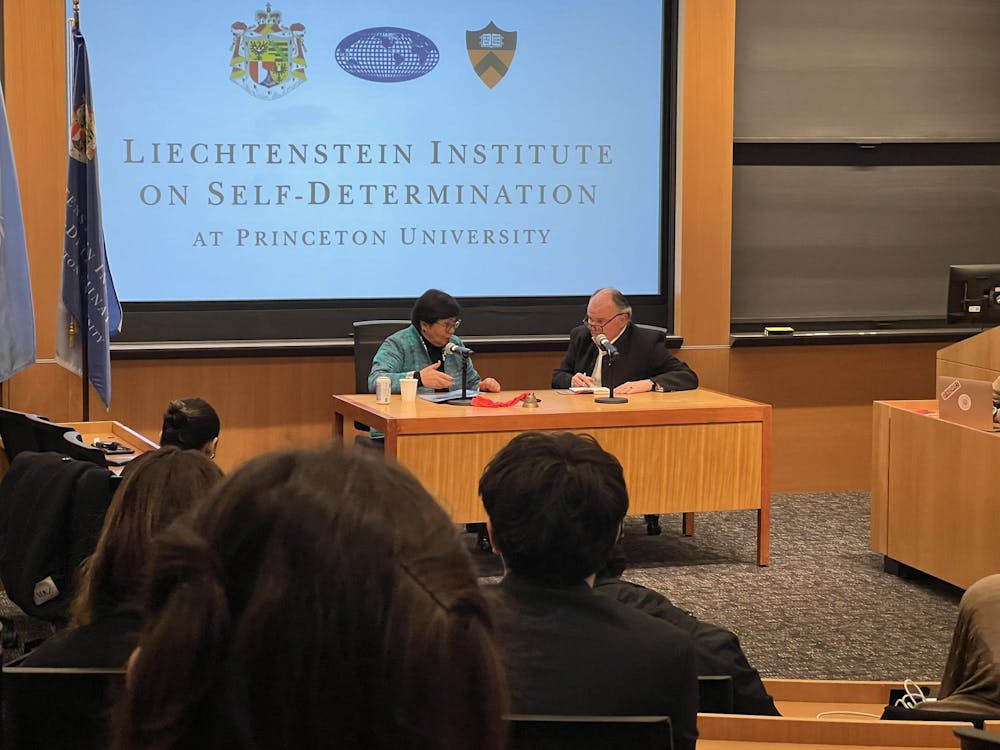
Long before he founded the Liechtenstein Institute on Self-Determination (LISD), Princeton’s boutique center for hands-on diplomacy and research, Dr. Wolfgang F. Danspeckgruber was working with Prince Hans-Adam II of Liechtenstein to hold worldwide private diplomacy colloquiums that subtly influenced United Nations policy. One significant outcome of these colloquiums was the recognition of the former Yugoslav Republic of Macedonia as a sovereign entity, after a 1993 conference in Vaduz, Liechtenstein.
These colloquiums eventually took shape as the institute Danspeckgruber founded in 2000 — what we now know as LISD. Marking its 25th anniversary late last year, the organization occupies a singular role in international affairs as an intersection of academics and policymaking through student-led research, conferences, and collaborations. In a new era of shifting geopolitical alliances, LISD prioritizes student initiatives to adapt to modern-day challenges to self-determination.
Danspeckgruber’s early career in Austria began as a trained military officer and lawyer. He originally expected to become a diplomat, completing his studies at the Graduate Institute of International and Development Studies before attending Harvard University as a visiting fellow in 1984 where he met Hans-Adam.
Together they began organizing private diplomacy seminars, but Danspeckgruber decided to take their ventures to Princeton.
“The joke has always been that if I stayed at Harvard, the Liechtenstein Institute on Self-Determination would have been at Harvard today,” Danspeckgruber explained.
In 1987, Danspeckgruber came to Princeton as a visiting fellow and, a year later, began teaching at the University. When LISD was established in 2000, its focus was on self-determination, the idea that peoples have the right to shape their own political identity, a concept crucial for small nations whose independence rests on the ability to form their own political entity.
Despite being funded by the House of Liechtenstein, Danspeckgruber insists on maintaining LISD’s academic independence.
“The House of Liechtenstein has never ever interfered with anything concerning what we do here at our Liechtenstein Institute. Never,” he said, instead attributing the success of the institute to Princeton students and the values of their university.

“My idea has always been that we have [LISD] for generations and we do this in view of all the Princeton ideals: with top academic research, to the best of our abilities, non-polemic, and in the service of humanity,” Danspeckgruber said.
With these ideals anchoring the institute, LISD has given their input on many political developments over its 25 years.
Luke Carroll ’26, an International Policy Associate in the institute, described looking at past debates at the institute, from the Iraq War to the expansion of NATO.
“To be continuing in that tradition is really a gift,” he said.
LISD is now grappling with modern challenges to self-determination, including artificial intelligence. Danspeckgruber explained the development of AI and technological change as similar to history, where “few things develop linear, upward or downward.”
Yet, he remains optimistic about the role students will play in shaping LISD’s future, emphasizing the importance of academia in overcoming technological upheaval and rapidly changing global power.

“It is education which will ... come to terms with AI, to somehow grasp its potential and inherent dangers,” he said.
“What does it mean to be a self-determining human in a world where AI is running things?” wondered Professor of Politics and International Affairs Andrew Moravcsik, Director of LISD.
Moravcsik described the development of a possible project on AI, stating that, “Another priority of mine is to make sure that we do things to the maximum extent possible, partnered with other people and across campus.” This project on AI, he explained, would involve working closely across disciplines, particularly with Princeton Engineering.
LISD’s current research projects span continents and integrate various academic disciplines, allowing students to discuss topics with experts, scholars, and diplomats in order to develop effective and informed policy combating issues such as crisis diplomacy, corruption, reconstruction, and global food and water security.
“There is that huge difference between us and a think tank — the deep involvement of our students, which in turn offers them unique experiences,” said Danspeckgruber.
Students in partnership with LISD are at the helm of most initiatives where they must organize and administer international diplomacy colloquia hosted by the institute as well as engage with diplomats, Danspeckgruber explained.
Katherine Holden ’26, another International Policy Associate of LISD, emphasized that the institute is “a remarkable opportunity for students to understand where their career trajectories might lead them eventually, and also the different forms of leadership that exist in the world.”
The opportunities students receive surpass graduation, as many alumni returned to Princeton for LISD’s hybrid seminars at Bendheim Hall celebrating the institute’s 25th anniversary.
“As a Princetonian I feel fortunate and grateful that we have the ability to do so because of our wonderful resources — if you can’t find a good answer here at Princeton, where else could you find it?” said Danspeckgruber.
Hannah Adams is a Features contributor for the ‘Prince.’
Please send any corrections to corrections[at]dailyprincetonian.com.
Correction: An earlier version of this piece misstated the name of LISD. It is the Liechtenstein Institute on Self-Determination, not the Liechtenstein Institute for Self-Determination. The ‘Prince’ regrets this error.
Read More

Undergraduate cyclist struck by University employee sues for damages
Haeon LeeThe student, who was seriously injured, is suing the University, the employee, and the owner of the vehicle for damages.
The student, who was seriously injured, is suing the University, the employee, and the owner of the vehicle for damages.

Former Princeton standout Xaivian Lee signs with the Cleveland Cavaliers on Exhibit 10 contract
Jordan HalagaoFormer Princeton men’s basketball player Xaivian Lee signed an Exhibit 10 contract with the Cleveland Cavaliers to participate in training camp and Summer League.
Former men’s basketball player Xaivian Lee signed an Exhibit 10 contract with the Cleveland Cavaliers to participate in training camp and Summer League.

Princeton names eight new trustees, increasing total trustee count by three
Nico David-FoxThe board now has 40 members, the maximum number permitted under its bylaws.
The board now has 40 members, the maximum number permitted under its bylaws.