



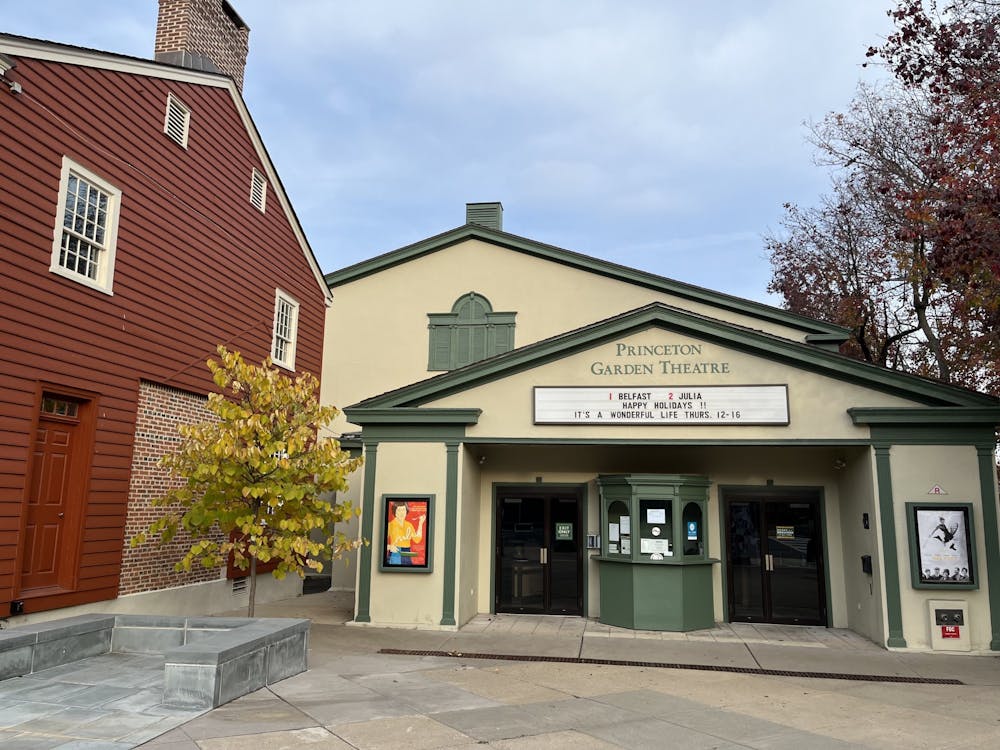
As a Princeton student with no car and a Pavlovian aversion to the library, I often find myself spending weekends at the Garden Theatre. With their USG partnership and student discount, the Garden makes moviegoing relatively inexpensive, which was perfect for my semester goal: see every single movie they show.
I was mostly successful in my ambitions, only (regrettably) missing “One Battle After Another” and a few Friday USG re-runs. With Oscars season approaching, and news outlets like Rolling Stone and TIME compiling roundups of the year’s top movies, I decided to make my own top-five list out of the 18 movies I saw at the theatre this fall.
1. “It Was Just An Accident”
This film is remarkable in both the circumstances of its production, as well as the final product. Shot in Tehran in secret, “It Was Just An Accident” won the Palme d’Or at the Cannes Film Festival this past summer and led to writer-director Jafar Panahi’s second arrest by the Islamic Republic of Iran in the past few years for his filmmaking. The movie follows a group of political activists who kidnap their former jailhouse torturer, with exceptional performances from six lead actors often crammed into the back of a van.
Though the film has been categorized as a political thriller, it pushes the conventions of the genre; the plot is propulsive and suspenseful, but doesn’t skimp on developing intricate relationships between characters that feel complexly human. The precise script and long takes — sometimes entire scenes play out in a single angle — creates a palpable tension shared between characters and audience. Although the film probes deeply into topics like PTSD and rebuilding life after trauma, it doesn’t spoon-feed its viewers any oversimplified conclusion — in fact, sound design is used brilliantly to keep the tension going beyond the final frame. The film is in Persian with English subtitles.
2. “After the Hunt”
For fans of Luca Guadagnino’s beautiful, gay, sun-soaked films like “Challengers” and “Call Me By Your Name,” “After the Hunt” may come as a bit of a surprise. Set at Yale University, the movie centers two associate professors in the Philosophy department — played by Andrew Garfield and Julia Roberts — who are both up for tenure when Garfield’s character is accused of sexually assaulting the department’s top Ph.D student, played by Ayo Edebiri.
The movie opened to generally negative reviews from critics, and was financially a bit of a disaster: It grossed $3.2 million in its domestic opening weekend against an estimated production budget of $80 million. However, I’d argue that it’s a great — if somewhat imperfect — project. The script is sharp and thought-provoking, prodding the tension between generations about how to handle issues of capital-P Privilege — Roberts’ character Alma is a white woman in an entirely male department, and Edebiri’s Maggie is a queer Black graduate student whose parents are major donors of the university. If you couldn’t tell by those descriptors, the film earnestly tries not to take a side.

With compelling performances from Garfield, Roberts, and Edebiri, “After the Hunt” is genuinely engaging from start to finish, and both delicately and honestly explores a complex story about assault. Though perhaps not an instant hit, I suspect this will be a film audiences return to in years to come, acting as a time capsule for our current conversation about privilege in what feels like a post-#MeToo world.
3. “The Mastermind”
The concept of a slow heist movie seems funny, but writer-director Kelly Reichardt gets away with it. The story, which unfolds slowly and with fewer guns and ski masks than one might expect, follows financially-struggling family man J.B. — played by Josh O’Connor — who steals several pieces of art from a small museum in suburban Massachusetts. Set in a gorgeously costumed and production-designed ’70s, the film takes place against the backdrop of the Vietnam War’s impassioned counterculture movement — Reichardt carefully contrasts J.B.’s self-servitude with the powerful collective action happening around him.
Similar to Panahi’s “Accident,” Reichardt impressively crafts long shots that hold the audience’s attention at each frame. I’m thinking here of a five-minute sequence in which J.B. climbs a barn ladder, struggles with some boxes, hides his stolen paintings, and then climbs back down — that Reichardt somehow makes … interesting? The script is subtle and at times sparse, with Reichardt always gesturing tastefully towards her thesis but never explicitly stating it. Though the film felt neither particularly plot- nor character-based, Reichardt’s singular vision as writer, director, and editor, combined with the strength of O’Connor’s performance, are unifying enough that it works.
4. “Bugonia”
Because I’m not typically a fan of Yorgos Lanthimos, this movie surprised me. A remake of the 2003 South Korean film “Save the Green Planet!” by Jang Joon-hwan, the film follows two cousins who kidnap powerful CEO girlboss Michelle, portrayed by Emma Stone, because they think she’s an alien plotting to destroy Earth. The image of beekeeping persists throughout the film: the cousins keep beehives, and there’s a broader metaphor about the CEO being a ruthless queen bee who subjugates unknowing worker bees — hence, I’m guessing, the floral title.

Former editor-in-chief of The Onion Will Tracy writes strange, extreme characters that somehow still feel sympathetic; the story maintains a genuine tension, but balances that tension with humor and absurdism. “Bugonia” makes a strong argument for the rise of the darkly comic, moderately political sci-fi movies we’ve seen recently — such as Ari Aster’s “Eddington;” notably, Aster’s production company Square Peg also produced “Bugonia.” It’s funny, weird, and kind of unsettling in the best way.
5. “Wicked: For Good”
HEAR ME OUT! This was a fun watch. Although it takes a moment to get started, and is far from a perfectly faithful adaptation of the original (excellent) musical, “Wicked: For Good” hits the hallmarks of a fun, big-budget, audience pleaser: lots of glitter, gorgeous costumes, big dance sequences, and famous people looking beautiful. It also manages to tug at the heartstrings, with performances, especially from leads Ariana Grande, Cynthia Erivo, and Jonathan Bailey, that feel genuine even in the massive machine that is the movie. I pulled up my hood and cried in the theatre, starting at Fiyero’s capture and continuing through the final number.
I won’t discredit some valid criticisms — particularly the two added songs, which were comically on-the-nose — “The Girl In The Bubble” and “There’s No Place Like Home” — as well as the excessive run times of both halves. My main gripe with them is that they detracted from a movie I generally enjoyed. It was never going to be Scorsese; frankly, it’s great for what it is.
Roya Reese is a contributing writer for The Prospect. She can be reached at rr6422@princeton.edu.
Please send any corrections to corrections[at]dailyprincetonian.com.
Read More

Princeton University Orchestra and men’s ultimate frisbee team named in University’s latest hazing report
Andrew ArthurTwelve students in the Princeton University Orchestra and Men's Ultimate Frisbee team were found responsible for hazing violations in the University's latest Campus Hazing Transparency Report. Sanctions ranged from Dean's warnings to disciplinary probation.
Twelve students in the Princeton University Orchestra and Men's Ultimate Frisbee team were found responsible for hazing violations in the University's latest Campus Hazing Transparency Report. Sanctions ranged from Dean's warnings to disciplinary probation.

Murray-Dodge Café celebrates 50th Anniversary, drawing over 260 students
Hifza KaleemOn Wednesday, Murray Dodge Cafe celebrated its 50th anniversary, drawing more than 260 students to celebrate with free cookies and merchandise.
On Wednesday, Murray Dodge Cafe celebrated its 50th anniversary, drawing more than 260 students to celebrate with free cookies and merchandise.
Students share mixed reactions as mandated officer and treasurer trainings return to in-person format
David EstradaThe University's student organization officers and treasurers returned to mandatory in-person training this fall after years of online sessions. Student reactions found parts of the training redundant or tedious, though most agreed the sessions were important.
The University's student organization officers and treasurers returned to mandatory in-person training this fall after years of online sessions. Student reactions found parts of the training redundant or tedious, though most agreed the sessions were important.