



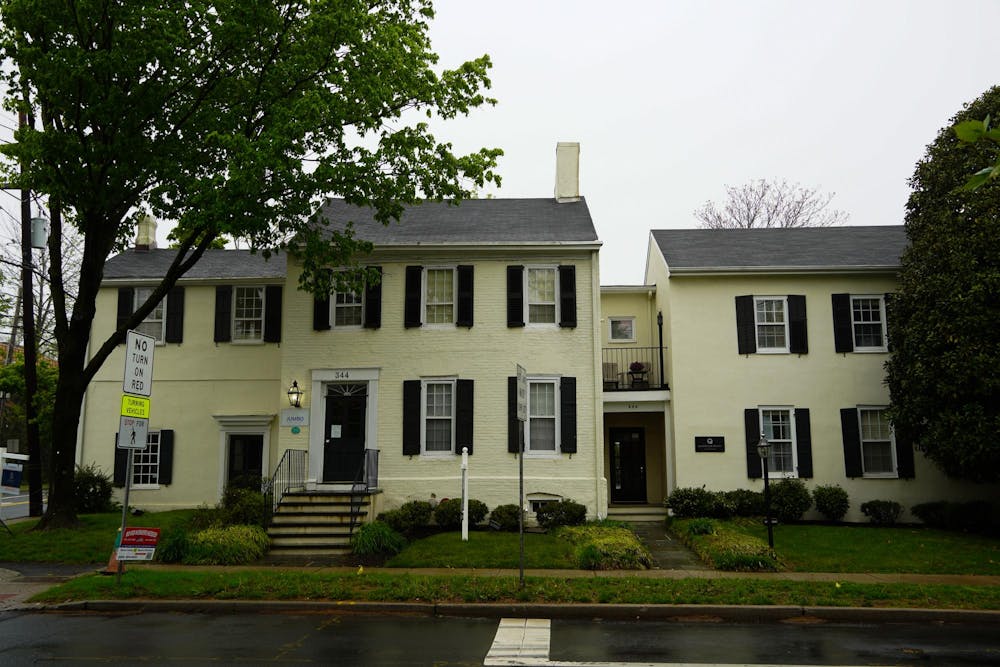
In a years-long fight over the approval of a single new building plan at 344 Nassau Street in the historic Jugtown District, a new proposal has finally cleared Princeton’s Historic Preservation Commission (HPC). If approved by the Princeton Environmental Commission, the plan will move to the Zoning Board for special permission to deviate from several zoning rules, primarily regarding parking.
Last May, a proposal for a four-story apartment complex at the intersection of Nassau and Harrison Street was brought to the HPC. The Joseph Hornor House, built in the 1760s by the grandson of one of Princeton’s founders, currently stands at this location. The proposal for the new building included plans to demolish a section of a 1985 addition to the house. The HPC rejected the proposal unanimously.
The initial development proposal was submitted by R.B. Homes under the town’s Affordable Housing Overlay (AHO-2) ordinance, a code passed in 2020 that promotes mixed-use buildings with affordable housing units. The original proposal called for a four-story, approximately 20,000 square foot building with 15 residential units, including three affordable units, and 15 parking spaces.
The citizen-led Save Jugtown campaign vigorously argued against the physical demolition of the portion of the Hornor House addition and the proposed apartment building’s visual overshadowing of the historic house.
On Dec. 1, the HPC approved a revised plan for the apartment complex, which addresses concerns about the original project raised by the Save Jugtown campaign. Led by architect Marina Rubina in collaboration with project leader and developer Daniel Barsky of R.B. Homes, the new design would leave the house untouched and only reach three stories high, at roughly one-third of the original square footage. It also reduces the number of proposed new residential units from 15 to 10, with two designated as affordable, and introduces a five-foot setback from Harrison Street.
Despite the HPC’s approval for the revised design, Commission member Shirley Satterfield voiced reservations about the project’s affordability. Though she approved of the architecture of the new proposal, she argued that it is unlikely to be accessible to low-wage workers in Princeton.
“So, whether you live on Nassau Street or you live on Clay Street, I’m really concerned about developers coming here and taking every bit of land we have… and you’re making the money,” Satterfield said. “And those day laborers will not be serving you because they won’t have any place to live.”
Notably, the new proposal will require special approval from the Zoning Board to deviate from Princeton’s standard zoning rules. The project, as proposed, will feature fewer parking spaces than typically required, have more compact spaces than normally allowed, reduce the minimum distance between the building and property lines, and narrow the drive aisle used for vehicle circulation. The proposal places two affordable apartments on the ground floor, which is ordinarily required to be commercial under the AHO.

With the HPC’s approval, the project will move to the Princeton Environmental Commission. If approved, the Zoning Board must decide whether to grant these variances following a public hearing.
Nico David-Fox is an assistant News editor for the ‘Prince.’ He is from Washington, D.C. and runs the Administration coverage area.
Luke Grippo is an assistant News editor for the ‘Prince.’ He is from South Jersey, and typically covers University and town politics, on a national, regional, and local scale. He can be reached at lg5452[at]princeton.edu.
Correction: An original version of this article did not mention the Princeton Environmental Commission. The 'Prince' regrets this error.
Please send any corrections to corrections[at]dailyprincetonian.com.
Read More

NJ AI Hub marks first anniversary with inaugural startup cohort
Zihan (Frank) XuFourteen selected start-ups receive weekly workshops, reverse pitches, corporate introductions, among other guidance over 12 weeks. The “AI accelerator” helps to test each company’s technology and fast-track its path to commercialization.
Fourteen selected start-ups receive weekly workshops, reverse pitches, corporate introductions, among other guidance over 12 weeks. The “AI accelerator” helps to test each company’s technology and fast-track its path to commercialization.
Three Princeton alumni awarded 2026 Fields Medal
Clara DochertyThe three alumni who received the medal are Yu Deng GS ’15, John Pardon ’11, and Jacob Tsimerman GS ’11.
The three alumni who received the medal are Yu Deng GS ’15, John Pardon ’11, and Jacob Tsimerman GS ’11.

How Charles Plohn ’66 brought his classmates together on the shelves
Nikki HanFor decades, Charles J. Plohn, Jr. ’66 has been collecting books published by members of his class. With nearly 700 titles in this collection, Plohn is attempting to find his library a permanent home.
For decades, Charles J. Plohn, Jr. ’66 has been collecting books published by members of his class. With nearly 700 titles in this collection, Plohn is attempting to find his library a permanent home.