



“Abrahm, male, age 26. Binah, female, age 18. Ann, female, 12-months.” These details are how the enslaved people who inhabited New Jersey during the 1800s are identified in the records of the Potters, a slave-trading, plantation-owning family with a strong connection to Princeton, N.J.
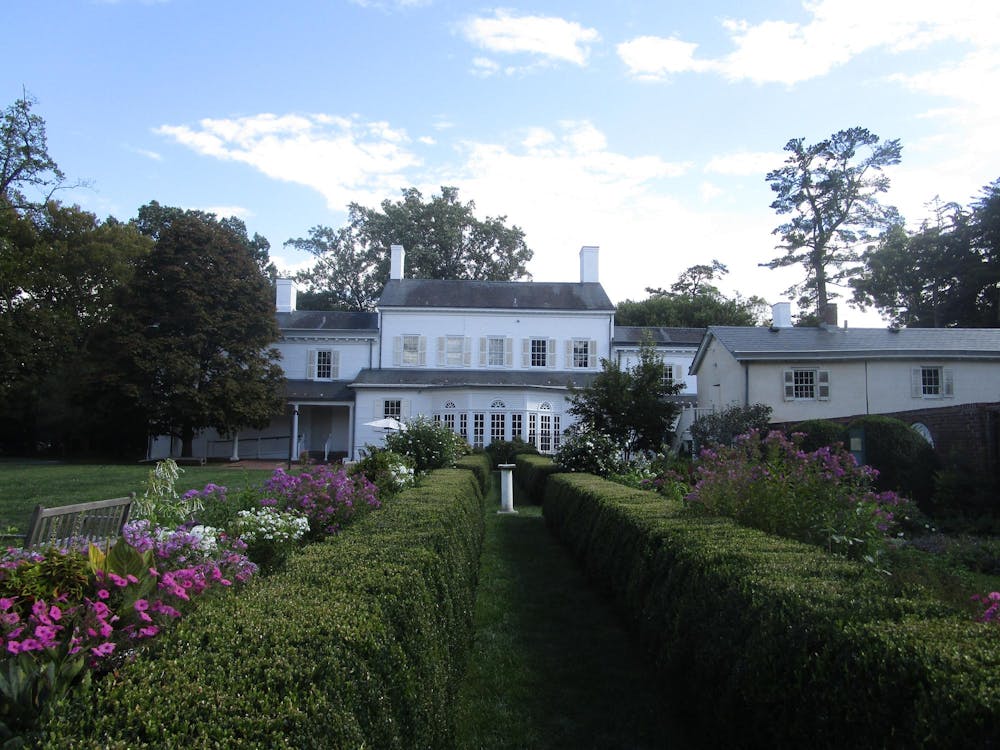
The Potter records are just one piece of the often overlooked history of slavery in the North. In the past decade, Morven Museum and Garden (Morven), located ten minutes from campus on Stockton Street, has begun working to change that.
Built in the 1750s, Morven was once the home of the Stockton family, including Richard Stockton, a Declaration of Independence signatory. For the first two generations of Stocktons, Morven was a plantation farmed by slave labor.
On Nov. 6, 2025, Morven opened its newest exhibition, “Northern Families, Southern Ties.” The exhibit investigates the connections between the Stockton and Potter families and their relationship with slavery.
This focus represents Morven’s growth over the years. When Deputy Director and Curator Elizabeth Allan began working as a curator in 2010, Morven did not cover slavery in its permanent exhibitions despite its own history. Over the years, the curators say they encountered visitors who were unaware that slavery existed in New Jersey, given its status as a Northern state. Such visitors might only have learned the truth if paired with a tour guide who had background knowledge.
In 2017, Morven revamped its permanent exhibit with a focus on capturing the perspective of everyone who lived at Morven, not just its wealthy, white inhabitants. “If you’re leaving out half the people living in this house, you’re losing an entire point of view,” Allan said.
This is a hefty goal for a museum that typically hosts afternoon teas, Victorian concerts, and clock showcases that have high ticket prices despite being open to the public. However, Morven’s curators believe that its festivities can coexist alongside more meaningful content.
“Maybe you’re coming here for that — a tea or yoga or [Christmas] trees,” Curator Jesse Gordon Simons said. But referring to the exhibits, she added, “You might stay and say, ‘That’s really interesting. I didn’t know that before.’”

The new exhibit builds upon the work Morven did in 2017. It covers the marriage of Harriet Maria Potter, who came from a wealthy slave-owning family from the South, to Robert Field Stockton of Princeton. Through a combination of documents and objects, the collection explores how despite the abolition of slavery in the North in 1804, many Northern families, particularly in New Jersey, continued to engage in the practice.
“The more we looked at it, the more we thought, ‘Oh my God, this [North-South] divide is so much blurrier than we realize,’ and that this isn’t unique just to the Stocktons,” Allan said.
John Potter, Harriet Potter’s father, was a merchant who split his time between Charleston and Princeton. The Potter family played a significant role in Princeton’s development. They invested heavily in the D&R Canal, influencing Princeton’s natural landscape.
While conducting research for this exhibit, the curators had to deal with the complicated historical language that often shrouds the significance of slavery to the United States. “We kept saying ‘John Potter is a merchant. John Potter is a merchant.’” Allan said. “What is he a merchant of? Well, he’s a merchant of abducted human cargo.”
By tracing newspaper ads, the curators were able to discover the stories of the countless enslaved people that Potter sold. In one striking example, they found three enslaved people’s “African country names,” meaning the names they were given at birth before they were forcibly given Christian names when Potter sold them.
One display features a record of Wooh, Gaumba, and Beta’s sales before they were renamed John, Leah, and Isaac. “This was incredible, because I think a lot of people recognize that their names that they are born with and given are often lost to us as enslavers rename them,” Allan said. “This is a diamond that actually shows that.”

The curators were tasked with tracking down paintings and archives and bringing these disparate objects together. “[The exhibit] is this constellation of objects and archives that they had drawn together to build this history,” said Anamika Singh, a Princeton graduate student, who visited the exhibit with the class Museums and Medicine in November.
Central to the exhibit is a small painting depicting a wealthy white family traveling along the Savannah River with a number of enslaved people. The curators found this painting to be one of the most elusive parts of this exhibit, unearthing only a single photograph of it in their first search. Still, they did not give up on finding the original painting, which serves as proof that the Potters, a family central to Princeton, were also entangled with plantation life in the South.
“We did one final Google search in July, and it popped up as having been sold at auction last September,” Allan said. Morven was then able to connect with the buyer, who lent the painting to them. “It’s hard to say how excited we were. It was just unbelievable that it worked out.”
This pursuit of rare historical materials is one aspect of Morven’s commitment to connecting the public with aspects of the past they might not otherwise be able to access. Currently, Morven is also in the process of uploading much of their archives online for public use.
One of the most extensive parts of these archives which Morven is digitizing are the records of the Potters moving their slaves from their southern plantations to Princeton nearly every six months as a way to avert Northern policies on slavery. “[These records] give us a trove of data around these people that are being moved,” Allan said. “You’re getting all this information: name, sex, age, height, class.”
According to Princeton Professor of African-American and Black Diasporic Art Anna Arabindan-Kesson, ‘Their names, their journeys, their experiences are a crucial part of the exhibition’s re-mapping.’ As she explains, the fact that Morven only began discussing these stories in 2017, even with the existence of a surplus of archives on this enslaved population, begs the question ‘How can we look and not see?’”
Looking ahead, Morven plans to continue showcasing New Jersey’s history while maintaining the museum as a community gathering space. Next year, it is planning a number of events for the United States semiquincentennial that involve both meaningful exhibitions and social events. “We want to examine all sides of this anniversary and really bring complexity and nuance,” Greer Luce, Curator of Education and Public Programs, said.
Currently, Morven has a board of post-it notes where its visitors can leave their wishes for America’s next 250 years. The responses range from “peace” and “friendship” to “for it to be everyone’s birthday every single day” and “no bugs” in children’s handwriting.
“We really try and get people on site and engage them in what they believe it means to be an American,” Luce said.
Rebecca Dean is a contributing Features writer for the ‘Prince.’
Please send any corrections to corrections[at]dailyprincetonian.com
Read More

Trustees advise dissociation committee to ‘quickly dispose’ of some petitions, avoid ‘intensifying division’
Sena ChangIn a public statement, Princeton’s Board of Trustees advised the Resources Committee to dispose of petitions that lack potential for campus consensus. The statement also reiterated the Board’s “strong presumption against dissociation.”
In a public statement, Princeton’s Board of Trustees advised the Resources Committee to dispose of petitions that lack potential for campus consensus. The statement also reiterated the Board’s “strong presumption against dissociation.”

Staff Picks: Football vs. Columbia
Brooklyn Fraser, Alex Beverton-Smith, and Antonio TakataThe Daily Princetonian Sports section provides its predictions on the upcoming matchup between Princeton football and Columbia.
The Daily Princetonian Sports section provides its predictions on the upcoming matchup between Princeton football and Columbia.

As Princeton Fire Department expands paid force, building renovations on hold
Meiya XiongThe Princeton Fire Department and Princeton First Aid and Rescue Squad are both shifting from volunteer based to primarily paid staffing as volunteer numbers decline, with a firehouse expansion estimated at $10–20 million stalled until funding is found.
The Princeton Fire Department and Princeton First Aid and Rescue Squad are both shifting from volunteer based to primarily paid staffing as volunteer numbers decline, with a firehouse expansion estimated at $10–20 million stalled until funding is found.