



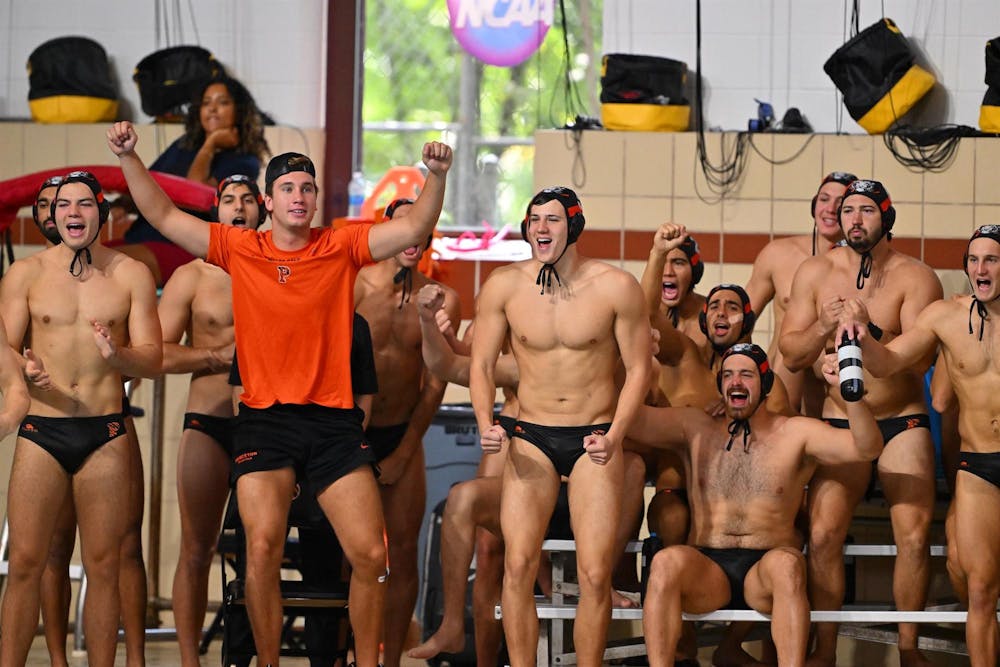
I actually felt like I could drown.
I was baffled. I have played water polo since I was seven years old. I have been held underwater and punched in the face. I have been put in a choke hold and then kneed in the back of the head. I knew someone who drowned. And I knew someone who died during a practice. Still, I never believed I was in danger.
But now the injuries had taken a toll on my body — and my mind.
When I think of athletics and pain I don’t think physical. I think about missed shots, lost games, and the look on your teammates’ faces when you let them down.
Any sport requires physicality and, of course, the constant risk of injury. The latter alone might drive an athlete crazy. To compete, fear of injury must be in the back of our minds or, preferably, out of our minds entirely.
That is easier said than done.
My experience is not exactly one of a kind. I have gone through two surgeries while a member of the Princeton men’s water polo team and I know several Princetonians who have gone through similar challenges.
Admittedly, this fact is comforting.

Many of us are not ironmen — although I am convinced some of my teammates are. It is comforting to share stories in the “injury sanctuary” of Caldwell Fieldhouse.
During my first week at Princeton, I began having shoulder pain in my throwing arm. It was preseason, and, like any freshman, I was just overjoyed to be at Princeton. The team had just returned from a preseason training trip in Hawaii where most of us were working on getting back into proper shape.
I competed the entire summer leading into freshman year. Since I was ten years old, I’ve only taken a few weeks off at a time — and that finally caught up to me.
In my first week on campus, there was already uncertainty about whether I could actually play, keep up, and compete at the level that I was expected to.
The beautiful thing about Princeton Water Polo is that you’re expected to contribute as a first-year from day one. But that expectation, which had always been a source of motivation for me, quickly turned into a double-edged sword.
As it became more and more difficult to throw the ball and swim, I looked toward my trainer, Catherine. Our trainers really are the backbone of the team. But after two months of treatment, my training in the pool would always reverse whatever temporary remedy Catherine and I came up with.

There was something structurally wrong with my shoulder.
I eventually got an MRI, which revealed a torn labrum; frankly, after months of uncertainty and frustration, I found relief in knowing what was wrong with my body. Still, the expectation to contribute still loomed over me.
I continued to play the rest of the season, albeit limited by my coaches. When I wasn’t playing, I’d be on the sideline, watching my teammates battle in practices and games.
That was a terrible feeling.
As the season finished up, I had to get surgery. Thankfully, I was extremely positive about it. My mindset, like many athletes at this school, was “this is why I am here.” It was never a thought to quit. My schedule was already treatment and rehab five days a week — post-surgery would be no different.
I was put in a restrictive sling that prevented me from raising my arm above my head for two months. Everything from opening doors to giving a hug were painful. With the help of my teammates, training staff, and coaches, I did a summer of rehab and looked forward to the next season.
But as my sophomore season began, my shoulder was still not fully healed. I was told it probably wouldn’t feel right for at least another six months. Only now, as a senior, I am comfortable throwing at full strength.
Yet, shoulder health was not the biggest obstacle I would face that year. Soon, I would find myself picking up another serious injury.
In the first month back, I began to feel a sharp pinch around my hip every few kicks while I treaded water. In water polo, treading water literally keeps you afloat and relies on your leg flexibility.
An MRI showed I had now torn my hip labrum.
I was pissed. What now? How was I going to play the season? I considered sitting it out, but I would lose a whole year of eligibility because I had already played in games. I thought I might as well struggle through and ride it out.
It would be brutal, but my teammates would be there for me every step of the way. After getting a steroid shot to help relieve pain, I was able to finish out the year. But I was not happy about it; I didn’t perform how I would have liked to — I left a lot off the table.
Again, I needed surgery in January, but this time I’d be in a wheelchair for a month, then crutches for another month. On top of three months of recovery, there were only six months until the start of my junior season.
Everyone had to do things for me, from helping me put on socks to getting my food at every meal to even pushing my wheelchair across campus when the battery died.
As my junior season rolled around, it felt like I was fighting two physical battles: one with my shoulder and another with my hip.
I had to relearn how to tread water, and I was struggling just to keep my head above water during practice or games.
I felt like this for about the first month of my junior season. I’d choke on water all the time while running out of breath. The first games of the season were hell.
The lack of confidence in my body converted to a lack of confidence in my mind. A third, mental battle, entered the ring. Worry went straight to my head, affecting my play.
I had to change the way I would tread water because I couldn’t properly kick. The range of motion in my hip had been permanently changed. I wouldn’t be able to move how I used to in the water, and that sucked. I felt like I’d never achieve my potential.
But rather than stay caught up in the negative, I was forced to think neutrally. I couldn’t, wouldn’t, magically play how I once did. I can only play the way my body allows me to now. I have to work through my injuries, taking pleasure in the minor victories.
Sometimes, for athletes that is just it. We are not always going to be in our prime. Coming to terms with that is just as much of the battle as the physical.
Through this mindset, and with time, I have regained my confidence. I have played this entire season, my senior season, without injury.
Luke Johnston is a senior on the men’s water polo team.
Please send any corrections to corrections[at]dailyprincetonian.com.
Read More

Princeton Council discusses community resources, e-bikes during summer meetings
Hifza Kaleem, Kevin Jin, and Michelle HarrisOver the summer, the Princeton Council surveyed residents’ needs, discussed new state legislation around e-bikes, and chose to hold off on updating the municipality’s public parking fees and regulations following community pushback.
Over the summer, the Princeton Council surveyed residents’ needs, discussed new state legislation around e-bikes, and chose to hold off on updating the municipality’s public parking fees and regulations following community pushback.
Princeton considers AI and data science-focused ‘evolution’ for ORFE department, specifics unclear
Sena Chang and Luke GrippoThe ORFE major could undergo changes in the coming years as a new ad hoc faculty committee considers how the University can strengthen its research and scholarship in AI and data science.
The ORFE major could undergo changes in the coming years as a new ad hoc faculty committee considers how the University can strengthen its research and scholarship in AI and data science.
Upperclassmen receiving financial aid see no increase to food budget for first time in 18 years
Joann Kim, Rajbir Toor, and Grace MeyerleThis year marks the first year without an increase to the budget since Princeton began to cover the average cost of eating club dues in 2007, sparking concerns among low-income students.
This year marks the first year without an increase to the budget since Princeton began to cover the average cost of eating club dues in 2007, sparking concerns among low-income students.