



“Anyone who considers arithmetical methods of producing random digits is, of course, in a state of sin,” former Princeton mathematics professor John von Neumann once said.
That means you, Undergraduate Housing Office.
Undergraduate room draw is based on a list of randomly assigned draw times selected by a computerized random number generator program. Draw times have been assigned that way for more than 30 years, Undergraduate Housing Manager Angela Hodgeman said.
For that, von Neumann would condemn Hodgeman and her colleagues as sinners. Why? Because to be truly random, numbers should be chosen by chance, not by deterministic machines like computers.
Computers typically use one of two methods for generating random numbers. One technique is to base the output on a random process external to the computer, such as radioactive decay. Alternatively, a computer can generate pseudorandom numbers based on arithmetic algorithms, like the one used by the Housing Office.
Pseudorandom numbers look random in terms of their statistical properties and distribution, but they are not chosen randomly. They’ve been determined by a logical mathematical process, which is, in a sense, the very opposite of random.
Pseudorandom number generators (PRNGs) usually work by manipulating an initial “seed” value, usually based on the current date and time. For instance, the seed could be the number of seconds that have elapsed since a certain day, say, Aug. 15, 1989. This way, the seed is different each time the program is used.
Certain arithmetic manipulations of the seed can produce long sequences of pseudorandom numbers. Good PRNGs typically exhibit no repetition or predictability of output and a roughly equal frequency of each output number over a long period of time.

There are also bad PRNGs. Most notably, the IBM PRNG, called RANDU, was popular in the 1960s and ’70s until it was discovered to generate spectacularly nonrandom numbers.
“We guarantee that each number is random individually, but we don’t guarantee that more than one of them is random,” a company representative stated at the time. Individually, of course, any number is random.
When it turns out that supposedly random numbers fail to exhibit random properties, the consequences can be tremendous, as in the case of the 1969 draft lottery for the Vietnam War.
On Dec. 1 of that year, the U.S. government held a lottery to determine the order in which men would be drafted. Each day of the year, including Feb. 29, was written on a separate slip of paper and put inside a cylindrical plastic capsule. The 366 capsules were then mixed together and drawn one at a time. The first day drawn was Sept. 14, and all American men born between 1944 and 1950 on that day were drafted.

Controversy broke out in January 1970 when a group of politicians and statisticians charged that the order in which birthdays were drawn did not display statistically random properties. Men with birthdays in the month of December were drafted far earlier than most, and men with March birthdays more likely to be drafted later.
Draft officials later acknowledged that the capsules containing dates in the later months were not mixed as thoroughly as those containing earlier dates because the January capsules were first mixed together, and then the February capsules were added and mixed with the January dates, and so on, one month at a time, so that, ultimately, the January capsules were shuffled 12 times longer than the December capsules.
For Princeton students, less is at stake. But Princeton room draw is also not entirely random. Students may receive preference based on their seniority or a previous residential college draw time. Compared to the room-selection process at other schools, however, Princeton room draw is considerably more randomized.
At George Washington University, the Residence Hall Association raises scholarship money for the university by auctioning off some of the best draw times and holding a raffle for others. Last year, GWU students bid up to $6,800 for a draw time, raising a total of more than $20,000.
At Brown, students can compete for the first choice of housing. The competition allows students to submit videos or other forms of media explaining why they deserve the best room on campus. Last year’s winners made a video called “Skintones” about their alleged naked a cappella group of the same name. The group needed good housing, the video claimed, so that they would have a place to practice, naked.
The randomness of Princeton’s system ensures a fairer draw, Hodgeman said, because it affords all students an equal chance at being first or last in the draw based on their weighted rating.
The University bases room draw on “complete randomization,” she said. Well, complete pseudorandomization.
Read More

Princeton Police reinstates free nighttime Uber rides, future funding uncertain
Ambre Van de Velde and Nika SchindlerA program sponsored by the Princeton Police Department, which covers Uber rides up to $15 at local businesses in order to prevent impaired driving incidents, has returned for the time being.
A program sponsored by the Princeton Police Department, which covers Uber rides up to $15 at local businesses in order to prevent impaired driving incidents, has returned for the time being.

Many Epstein files have been released — and two Princeton alumni have legal connections
Luke GrippoThe Daily Princetonian looked into the Epstein Files and found and spoke to two University alumni who have legal connections to the late New York financier and convicted sex offender.
The Daily Princetonian looked into the Epstein Files and found and spoke to two University alumni who have legal connections to the late New York financier and convicted sex offender.
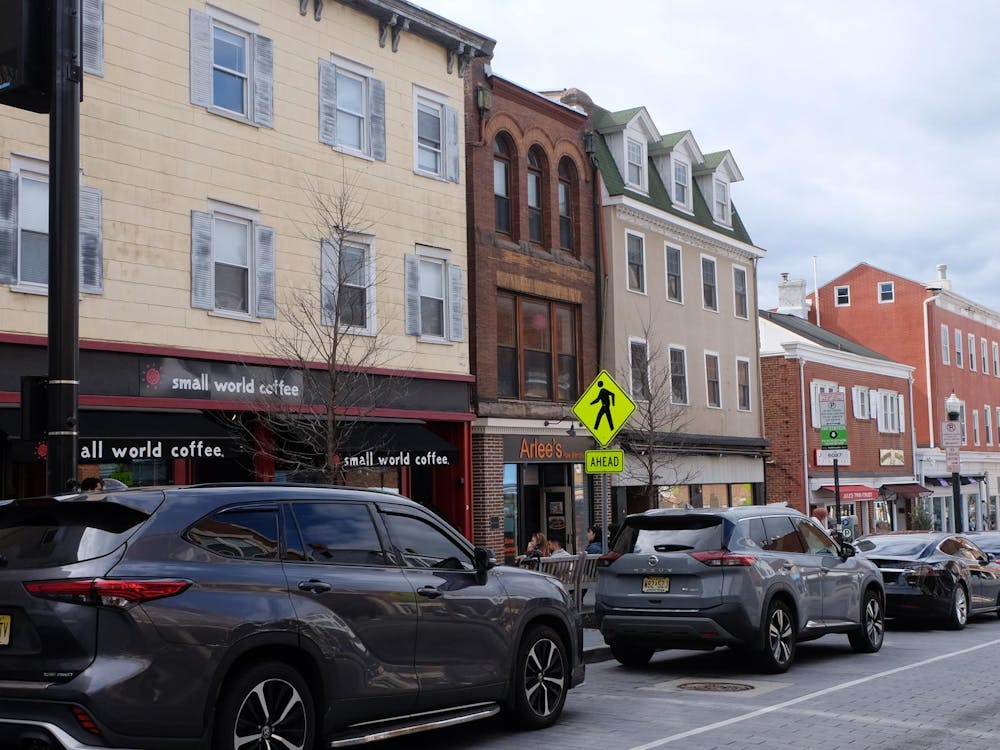
Pirone Lambros sworn in as Council president at reorganization meeting
Oliver WuAt the Jan. 7 Princeton Town Council meeting, councilmembers highlighted a wide range of policy priorities for the coming year, including affordable housing, redevelopment of the Westminster Choir College campus, and major capital projects such as the renovation of Community Park South.
At the Jan. 7 Princeton Town Council meeting, councilmembers highlighted a wide range of policy priorities for the coming year, including affordable housing, redevelopment of the Westminster Choir College campus, and major capital projects such as the renovation of Community Park South.