



If you're like me, sitting at your computer and reading the 'Prince' in its online format, you also have immediate access to an infinite array of web-based sources, many of far greater depth than the feeble dilettantism of an undergraduate.
I'm not as smart as Tom Friedman. Or as funny as Dave Barry. Or as obnoxious as Maureen Dowd. I am little qualified to speculate on the future of the British conservative party or whether Greenland will melt onto Manhattan as Al Gore promises it will. I have very few concrete suggestions for improving the world other than proscribing mullets.
But it seems that improving the world at large is what Princeton students are bred to do. We are told that to be a good student is to travel, to engage, to explore — it is action and adventure. Gone are the passive days of reflection and introspection, of lingering on a notion (and also on campus). The Princeton gentleman has been replaced by the Princeton cosmopolitan.
The change can be detected in campus publications — for every voice critiquing the academic system there is another dissecting Tony Snow's latest gaff, recounting awkward cultural moments during a summer in China or scrutinizing the political conflict du jour.
In the maiden printing of The Princetonian on June 14, 1876 — it had not gone daily yet — the editors wrote that their newspaper "comes into existence, first of all, in answer to a need among us for a larger and more direct medium of discussion of the internal workings of the college." Indeed, the early sheets played host to intense debates as to whether Chapel attendance should be mandatory.
Even half a century later, a 'Prince' editorial from Oct. 20, 1923 noted that "rarely is a social issue placed before undergraduates in the course of a year" and that there is "little or no development of any ideas of social responsibility." The impetus for the editor's complaint was an upcoming conference entitled "What shall we do about war?" As he saw it, the event was an exclusive opportunity to "bring before undergraduates the idea of their social responsibility." It is a measure of how far we have now come, now that we have an entire course devoted to examining its causes.
In 1940, the editors concluded that with the developing crisis of World War II, "the problems and interests of a college campus as expressed in the undergraduate publications seem pitiably insignificant."
While certainly true, the editors also sacrificed attention to the community and academia. Thus in 1959, when 'Prince' columnist J.B. Burnham '61 refers to the "problem of coexistence," he could just as conceivably be invoking America's problem with the Soviets as the University's problem with women or students of darker skin. (It was the former.)

By 1968, the 'Prince' saw no separation between social action and the aims of undergraduate commentary. I include that year's introductory editorial in full, because it highlights the perceived connection between the campus and the globe:
"Prague is quiet now. The tanks are still there, but the passive heroism is over. Chicago is quiet now. Columbia too is quiet...
Martin Luther King is dead. Robert Kennedy is dead. The feeling of last spring is dead too. Then, the students in the streets of New York toppled Johnson. Then, McCarthy and Kennedy appeared to have a change of giving new direction to the country. Then, something new appeared to have been born in Czechoslovakia, in France, in New Hampshire, and at Columbia. But no more. Humphrey, Johnson, Nixon, Wallace, Daley — they live.
And those of us who were here last spring at Princeton, those of us who were in the forefront of the movement which led to the May 2 demonstration, we go back to building better bars and more erotic light displays. Welcome home."
From these lines, the reader must conclude that nothing exists between the desolation of a fizzled social movement and the gaudiness of college night life. What happened to truth?
Princeton students can be too worldly. Intellectual pursuit for its own sake is often ignored or inextricably linked to contemporary political conditions.

Truth is not more present in Africa than central New Jersey, and a student's responsibility does not require an analysis of the Bush presidency any more than the Tilghman presidency.
The University is host to numerous problems and controversies — the status of early admission, the Robertson Foundation lawsuit and an undeniable marriage to the financial sector, to name a few — and we, as students, are best placed to answer them. J.R. de Lara is a politics major from Ithaca, N.Y. He can be reached at jdelara@princeton.edu.
Read More

Students need to know where their food comes from
Angela BahnaThe sad reality is that you could be sitting in a restaurant or a dining hall surrounded by rich farmland without any of the food on your plate coming from it.
The sad reality is that you could be sitting in a restaurant or a dining hall surrounded by rich farmland without any of the food on your plate coming from it.

Make the Pre-read a work of fiction
EmmaRose ZillaA story that’s intellectually ambitious and philosophically provocative doesn’t necessarily have to be nonfiction. A fictional text can help us understand political tensions or erosion of autonomy just as much as an explanatory novel can.
A story that’s intellectually ambitious and philosophically provocative doesn’t necessarily have to be nonfiction. A fictional text can help us understand political tensions or erosion of autonomy just as much as an explanatory novel can.
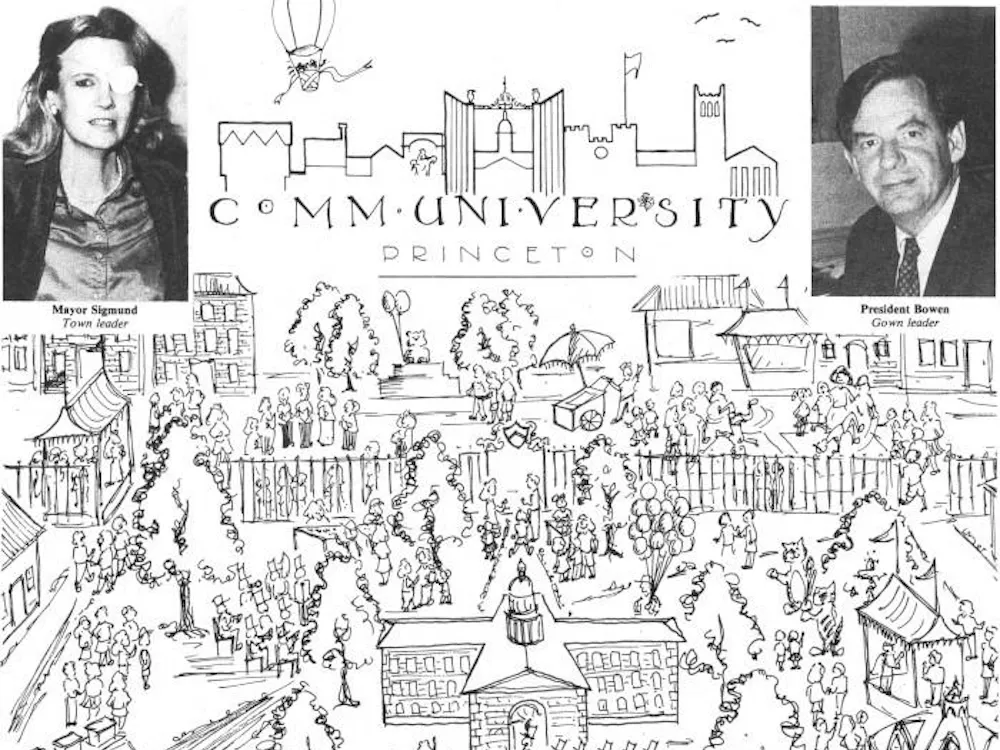
Bring back Communiversity
Isaac BarsoumFrom its inception in 1985, when it subsumed the Arts People Party — the Arts Council’s pre-existing festival — Communiversity always aimed to be more than just an arts festival. It was both a physical and symbolic coming-together of the University and the town in a celebration of all that we have in common and all that makes us different.
From its inception in 1985, when it subsumed the Arts People Party — the Arts Council’s pre-existing festival — Communiversity always aimed to be more than just an arts festival. It was both a physical and symbolic coming-together of the University and the town in a celebration of all that we have in common and all that makes us different.