



Christopher Reeve, who spent his childhood and adolescence in Princeton before gaining fame for his cinematic role as Superman and advocacy for spinal cord research, died of heart failure Sunday in Pound Ridge, N.Y. He was 52.
Reeve had been paralyzed since a 1995 equestrian accident. Wheelchair-bound, he continued to act and direct and became a vigorous advocate for stem cell research.
With an iconic red cape and blue suit, Hollywood introduced Reeve to the world as "the man of steel" in the 1978 release of "Superman." The successful premiere spawned multiple sequels, and Reeve's fame as Superman was sealed.
But, according to his childhood friends from Princeton, Reeve was always "Chris" to them.
At age 4, Reeve, who was born in New York City on Sept. 25, 1952, moved to Princeton with his younger brother and mother after his parents divorced. He spent the rest of his childhood in Princeton, where he honed his acting and singing skills, most notably at the Princeton Day School (PDS) and McCarter Theatre.
"He was very active in the theater and had a wonderful presence on stage," said Kathrin Poole, an alumna of PDS who graduated one year after Reeve. "He was just a down-to-earth, warm personality."
Many neighbors and close childhood friends recalled Reeve's magnetic personality and his talents on and off the stage. Because his loss was deeply personal to them, they asked not to be named.
Reeve's family was active in the Princeton community, particularly in the Nassau Presbyterian Church, where his mother, Barbara Johnson, a former journalist, taught Sunday school. After briefly living on Campbelton Circle, the family moved to a single family house on Cleveland Lane in the western section of Princeton.

Neighbors recalled a young, energetic Reeve running to play dates with his friends after Sunday school.
From very early on, Reeve was also drawn to the stage. At age 9, he was cast in a Gilbert and Sullivan operetta at McCarter Theatre. He stayed with the theater and contributed to a number of other productions.
The theater recognized Reeve's contributions in a statement Monday.
"He graced this stage throughout his high school days in Princeton where he was encouraged to pursue his acting career," McCarter artistic director Emily Mann said.
Reeve appeared in plays and musicals by John Lithgow and Milton Lyon at McCarter, Mann said.
Outside of the theater, Reeve found other avenues to express his passion for the arts.

According to friends, Reeve was the lead guitarist of Remnants, a rock-and-roll band that he started in the seventh grade. The band was only together for two years, but during its heyday it played at parties and the local ballroom dancing school. Reeve was also a strong piano player and vocalist.
His early acting and musical experience helped Reeve secure lead roles in many plays at Princeton Day School, a private high school he attended from eighth to 12th grade.
He had notable roles in plays such as "Our Town," "The Boyfriend," "Theme and Variation, Love Conquers All," "Little Mary Sunshine" and "Watch on the Rhine."
According to Poole, Reeve's acting ability was strong and well-received by his peers.
"His performances themselves showed how much he cared," another close friend of Reeve said. "I think because he had such a stage presence, because he was so handsome and tall and was able to give a commanding performance — it all made him stand out."
Reeve was also a part of the Madrigal Singers, a coed group that performed more traditional music.
But offstage, Reeve excelled in other areas. "He was a star in a lot of ways," a friend recalled.
He often started at goalie on the PDS ice hockey team, and he tackled several honors classes in high school. Reeve even dabbled in the school's less popular Russian course because he had an interest in languages. After he graduated in 1970, Reeve went to Cornell and then Julliard.
He became a celebrated actor and director, but also took on the role of activist after the accident left him paralyzed from the neck down. He became chairman of the board for the Christopher Reeve Paralysis Foundation and was recognized for his contributions to spinal cord research.
"We consider him our hero. He was our inspiration," Maggie Goldberg, the foundation's vice president of public relations, said. "He put a name and face to spinal cord injury, raised millions of dollars for the cause and always said it was not just about himself."
Read More

Princeton University Orchestra and men’s ultimate frisbee team named in University’s latest hazing report
Andrew ArthurTwelve students in the Princeton University Orchestra and Men's Ultimate Frisbee team were found responsible for hazing violations in the University's latest Campus Hazing Transparency Report. Sanctions ranged from Dean's warnings to disciplinary probation.
Twelve students in the Princeton University Orchestra and Men's Ultimate Frisbee team were found responsible for hazing violations in the University's latest Campus Hazing Transparency Report. Sanctions ranged from Dean's warnings to disciplinary probation.

Murray-Dodge Café celebrates 50th Anniversary, drawing over 260 students
Hifza KaleemOn Wednesday, Murray Dodge Cafe celebrated its 50th anniversary, drawing more than 260 students to celebrate with free cookies and merchandise.
On Wednesday, Murray Dodge Cafe celebrated its 50th anniversary, drawing more than 260 students to celebrate with free cookies and merchandise.
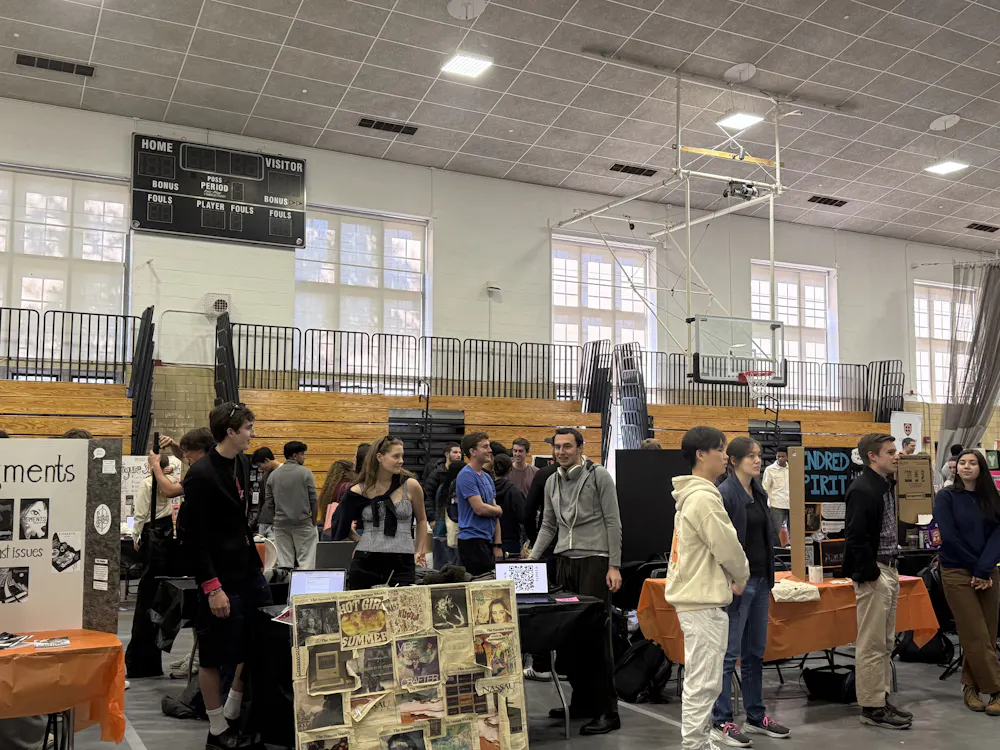
Students share mixed reactions as mandated officer and treasurer trainings return to in-person format
David EstradaThe University's student organization officers and treasurers returned to mandatory in-person training this fall after years of online sessions. Student reactions found parts of the training redundant or tedious, though most agreed the sessions were important.
The University's student organization officers and treasurers returned to mandatory in-person training this fall after years of online sessions. Student reactions found parts of the training redundant or tedious, though most agreed the sessions were important.