



In a complex a few minutes from the University, scientists and meteorologists are working to better understand the earth's climate as Hurricane Ivan brings destruction to sites throughout the country.
The Geophysical Fluid Dynamics Laboratory (GFDL) — home to one of the leading climate-modeling systems — creates models of how certain weather patterns develop over long periods of time.
"[Our] goal is to better understand the earth's climate. To get there, we need to do a lot of research to try and figure out mother nature. And we'd like to apply that understanding to building better climate models," said Brian Gross, deputy director of the GFDL.
Creating the hurricane
The GFDL is one of the five worldwide climate labs that the National Hurricane Center pays the most attention to.
Each lab models hurricanes differently, but then scientists gather the data together to create a more-encompassing model.
For example, the cone that appears on a TV screen of a hurricane's possible path is based on the predictions from all the labs.
But all these models are just approximations, so forecasters are needed to "bring their expertise in creating actual forecasts that the public sees," Gross said.
The GFDL's climate model is made up of several component models, such as the atmosphere, land, ocean and sea ice. Each model only sees a certain part of the atmosphere.

Meshing all these components together to generate an accurate model requires a lot of fine-tuning.
Even the most advanced climate models are just approximations.
Many of today's climate models are based on old mathematical equations, Gross explained. But these equation don't describe everything that is happening. Additionally, there are things that can't be modeled by equations. For example, ordinary equations of fluid dynamics govern the ocean. But certain physical processes — like condensation, rain droplet creation and swirling and mixing — are not physically representable by mathematical models.
So computer codes are developed to take them into consideration during the modeling.
"Developing parameterizations to account for problems that can't be developed in a model is where a lot of the ingenuity comes," Gross said.
History of the lab
The idea for the GFDL was born in 1955 when a John von Neumann of the Institute for Advanced Study proposed creating a computer model of the atmosphere to the federal government. Today, the GFDL falls under the National Oceanic and Atmospheric Administation.

The GFDL, which was called the General Circulation Research Laboratory until 1963, was based in Washington until moving to Princeton in 1968.
GFDL has about 150 employees, of whom about 80 are federal employees and 70 are visiting scientists.
The total lab budget is approximately $30 million a year and goes towards buying and maintaining computer equipment to run the models, collaboration with Princeton's Atmospheric and Oceanic Sciences and the Princeton Environmental Institute, as well as employee salaries.
Read More

Princeton University Orchestra and men’s ultimate frisbee team named in University’s latest hazing report
Andrew ArthurTwelve students in the Princeton University Orchestra and Men's Ultimate Frisbee team were found responsible for hazing violations in the University's latest Campus Hazing Transparency Report. Sanctions ranged from Dean's warnings to disciplinary probation.
Twelve students in the Princeton University Orchestra and Men's Ultimate Frisbee team were found responsible for hazing violations in the University's latest Campus Hazing Transparency Report. Sanctions ranged from Dean's warnings to disciplinary probation.

Murray-Dodge Café celebrates 50th Anniversary, drawing over 260 students
Hifza KaleemOn Wednesday, Murray Dodge Cafe celebrated its 50th anniversary, drawing more than 260 students to celebrate with free cookies and merchandise.
On Wednesday, Murray Dodge Cafe celebrated its 50th anniversary, drawing more than 260 students to celebrate with free cookies and merchandise.
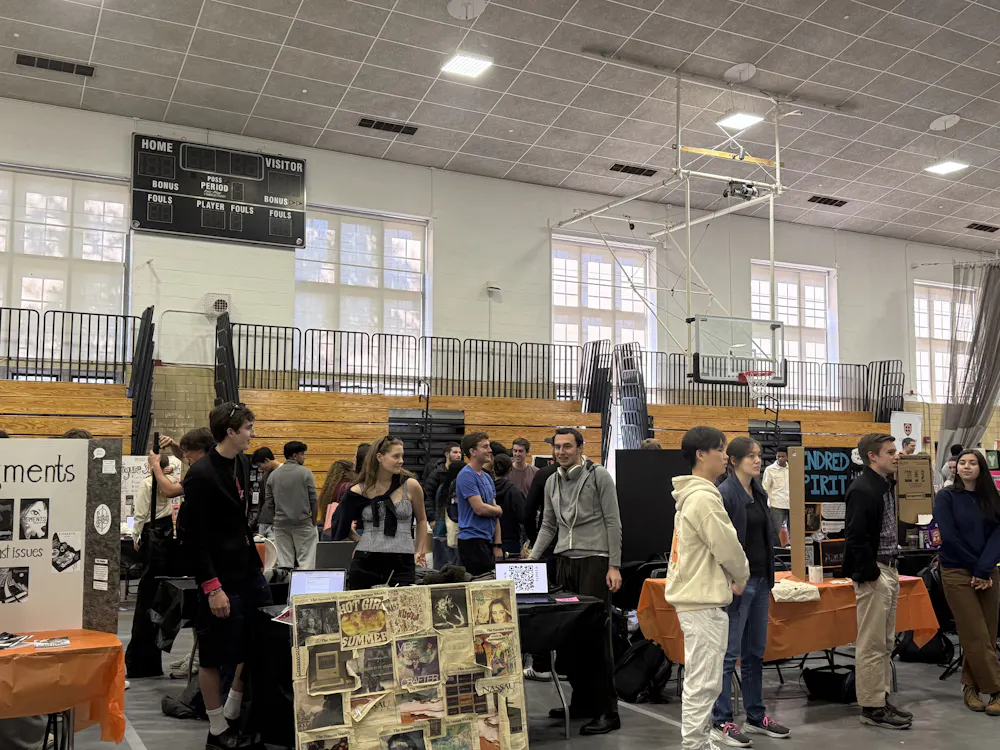
Students share mixed reactions as mandated officer and treasurer trainings return to in-person format
David EstradaThe University's student organization officers and treasurers returned to mandatory in-person training this fall after years of online sessions. Student reactions found parts of the training redundant or tedious, though most agreed the sessions were important.
The University's student organization officers and treasurers returned to mandatory in-person training this fall after years of online sessions. Student reactions found parts of the training redundant or tedious, though most agreed the sessions were important.