



Mechanical and aerospace engineering professor Naomi Leonard '85 was named a 2004 MacArthur Fellow for her work on constructing underwater gliders that survey the ocean.
A MacArthur Fellowship, commonly referred to as the "genius award," includes a $500,000 "no strings attached" grant for five years.
Leonard's work, focused primarily on how to program the gliders to efficiently survey the ocean, was funded by the Office of Naval Research.
The vehicles can be used both to predict the weather and in a military context.
"We could understand what an environment is like quickly and determine if it is safe for people," Leonard said. "We would know if water currents and temperature were safe for boats or swimmers."
Leonard was responsible for programming gliders to move in formation and make decisions about where to collect data. Her inspiration came from the natural world, she said.
Leonard said she asked herself, "Could one think about mimicking biology?" The natural world is incredibly skilled and efficient in the way it collects data, she said, and she tried to understand this ability and apply it to the way her gliders would survey the ocean.
Leonard used "bio-inspired control laws" in her programming to make the gliders behave similarly to a school of fish.

"[The gliders] are really lovely buoyancy vehicles that pump water to glide up and down. They are very efficient," Leonard said. "We could use them to predict the movement of plankton that bloom and absorb carbon dioxide gas which makes the atmosphere colder."
A better understanding of this phenomenon has direct applications in our ability to predict weather patterns like El Niño, she said. Leonard also hinted at the possibility of using similar gliders in the air.
This year's 23 recipients of the award include a nanotechnologist, an archaeological illustrator, a high school debate coach and a farmer.
After learning of her award Leonard was "speechless," she said. "I was standing in the parking lot next to the E-Quad when I got the phone call," Leonard said. "It was a shock . . . I had no idea."
Fellows are nominated by anonymous sponsors of the MacArthur Foundation and recipients are not aware of their nomination.
When asked what she plans to do now that she has won, Leonard said "it is really hard to come up with a plan for what to do with half a million dollars." She plans to spend more time with her family, she added.

Since receiving her award, Leonard has been interviewed by many newspapers and spoke to Michele Norris and Robert Siegel on NPR's "All Things Considered."
Of the 23 recipients, four have current or past affiliations with the University.
John Kamm '72, businessman and human rights advocate, received the award for his work on "demonstrating the efficacy of leveraging business relationships to free prisoners of conscience in China," according to the MacArthur Foundation's website.
Sculptor Judy Pfaff once held a visiting professorship at the University and novelist Edward Jones held a part-time teaching appointment, the website says.
Read More

Princeton University Orchestra and men’s ultimate frisbee team named in University’s latest hazing report
Andrew ArthurTwelve students in the Princeton University Orchestra and Men's Ultimate Frisbee team were found responsible for hazing violations in the University's latest Campus Hazing Transparency Report. Sanctions ranged from Dean's warnings to disciplinary probation.
Twelve students in the Princeton University Orchestra and Men's Ultimate Frisbee team were found responsible for hazing violations in the University's latest Campus Hazing Transparency Report. Sanctions ranged from Dean's warnings to disciplinary probation.

Murray-Dodge Café celebrates 50th Anniversary, drawing over 260 students
Hifza KaleemOn Wednesday, Murray Dodge Cafe celebrated its 50th anniversary, drawing more than 260 students to celebrate with free cookies and merchandise.
On Wednesday, Murray Dodge Cafe celebrated its 50th anniversary, drawing more than 260 students to celebrate with free cookies and merchandise.
Students share mixed reactions as mandated officer and treasurer trainings return to in-person format
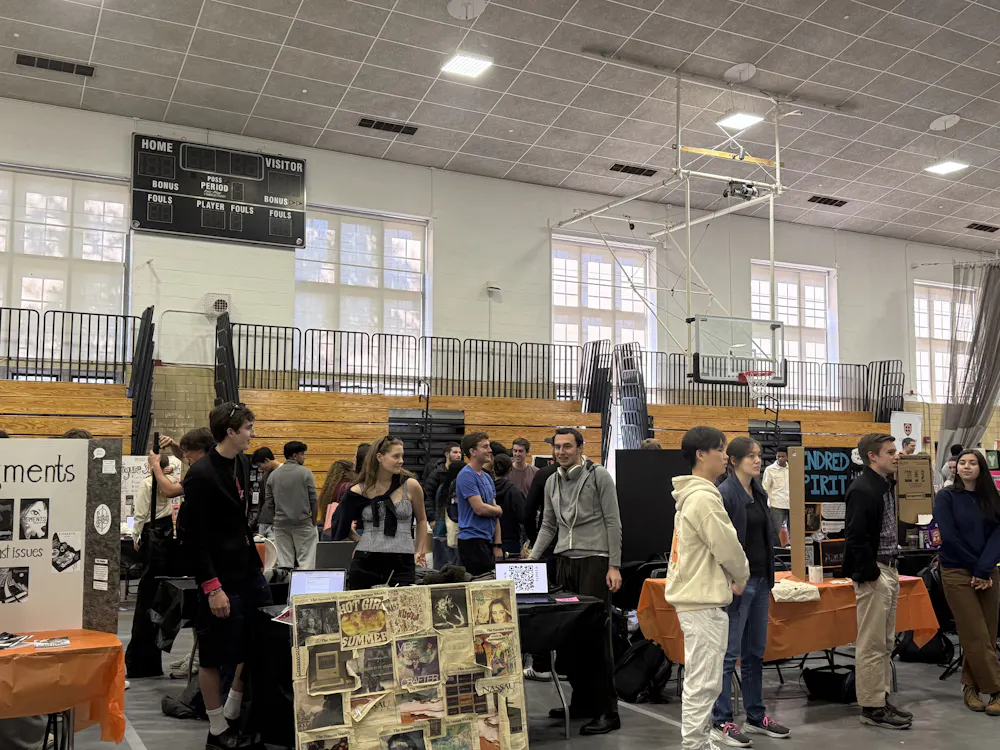
David EstradaThe University's student organization officers and treasurers returned to mandatory in-person training this fall after years of online sessions. Student reactions found parts of the training redundant or tedious, though most agreed the sessions were important.
The University's student organization officers and treasurers returned to mandatory in-person training this fall after years of online sessions. Student reactions found parts of the training redundant or tedious, though most agreed the sessions were important.