



Diebold, Inc., a supplier of touchscreen voting machines, agreed not to sue or further threaten student activists around the country after months of legal haggling over the publication of sensitive Diebold documents on the Internet.
After two students at Swarthmore College first published the company's internal memos and emails, which seemed to show the company knowingly produced voting machines that were subject to tampering, Diebold issued cease-and-desist orders to Swarthmore to have their documents taken down.
While saying it would not take a political stance on the issue, Swarthmore did require the students to remove the material from their websites.
However, before removing the materials, the Swarthmore students petitioned students at other colleges and universities through emails chains to start posting "mirrors" of documents.
Three students at the University — Bryan Cattle '07, Charles Pence '07 and 'Prince' staff writer Aaron Kleinman '06 — became part of the movement to propagate the mirrored material on the Internet.
Soon after the nationwide campaign began, the Swarthmore students joined the Online Policy Group, a nonprofit ISP that also received a cease-and-desist order, to file a joint suit against Diebold for the right to disseminate the documents under the "fair use" clause of copyright law.
Since that time Diebold has been threatening all parties who have been posting the company's memos on the Internet with suits in federal court.
But with last Tuesday's announcement, the threats stopped.

"I think [the nationwide press coverage] brought [Diebold] more attention than they wanted," Cattle said. "They didn't want the negative press."
A spokesman for OPG echoed Cattle's comments.
"[Diebold] had little further to gain in sending cease-and-desist notices, given that the underlying content had already been spread far and wide and that the media coverage surrounding this case was portraying them as a bully by continuing to threaten ISPs like the Online Policy Group," David Weekly, a director for OPG, said in an email.
Others involved in the campaign were looking for a more directed apology from Diebold.
"There's a 50 percent feeling of vindication and victory, but we're still awaiting the outcome of the court case," Pence said. "Ideally, we'd want for the judge to come out and say the cease-and-desist orders were spurious in the first place."
Despite Diebold's announcement, the Swarthmore students and OPG are still pursuing their suit in federal court.

U.S. District Court Judge Jeremy Fogel ordered the case to mediation with a hearing scheduled for Feb. 9.
"We're still hoping to get a ruling that these postings are not infringement of fair use," said Wendy Seltzer, a staff attorney for the Electronic Frontier Foundation, a digital technology civil liberties group representing the plaintiffs along with the Center for Internet and Society Cyberlaw Clinic at Stanford University.
"Furthermore, we want a ruling that says ISPs are not liable for links posted by their users," she said.
Diebold's legal representation could not be reached for comment.
Though Diebold denies the authenticity of the students' postings, the company's voting machines have been implicated in voting irregularities in recent years.
To guard against future irregularities, Princeton's Rep. Rush Holt has introduced a bill in Congress requiring all electronic voting machines to leave an auditable paper trail.
Voting machine flaws may negatively affect the democratic process, University economics professor Paul Krugman wrote in an opinion article for The New York Times on Monday.
Read More

Princeton University Orchestra and men’s ultimate frisbee team named in University’s latest hazing report
Andrew ArthurTwelve students in the Princeton University Orchestra and Men's Ultimate Frisbee team were found responsible for hazing violations in the University's latest Campus Hazing Transparency Report. Sanctions ranged from Dean's warnings to disciplinary probation.
Twelve students in the Princeton University Orchestra and Men's Ultimate Frisbee team were found responsible for hazing violations in the University's latest Campus Hazing Transparency Report. Sanctions ranged from Dean's warnings to disciplinary probation.

Murray-Dodge Café celebrates 50th Anniversary, drawing over 260 students
Hifza KaleemOn Wednesday, Murray Dodge Cafe celebrated its 50th anniversary, drawing more than 260 students to celebrate with free cookies and merchandise.
On Wednesday, Murray Dodge Cafe celebrated its 50th anniversary, drawing more than 260 students to celebrate with free cookies and merchandise.
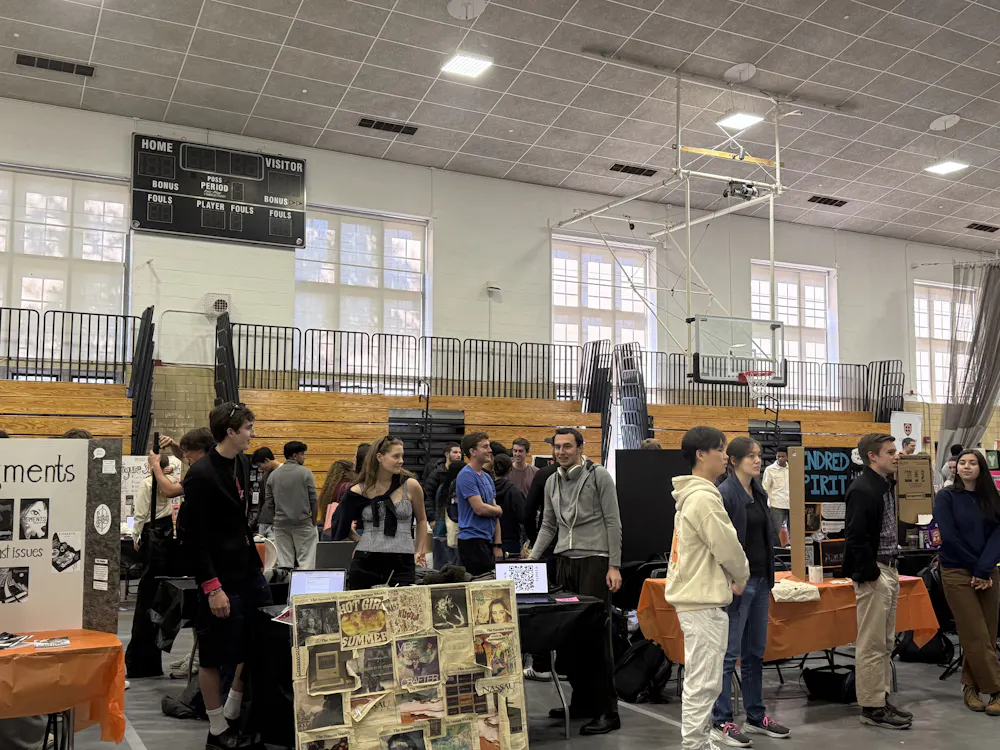
Students share mixed reactions as mandated officer and treasurer trainings return to in-person format
David EstradaThe University's student organization officers and treasurers returned to mandatory in-person training this fall after years of online sessions. Student reactions found parts of the training redundant or tedious, though most agreed the sessions were important.
The University's student organization officers and treasurers returned to mandatory in-person training this fall after years of online sessions. Student reactions found parts of the training redundant or tedious, though most agreed the sessions were important.