



The stuff of science fiction is fast becoming fact in a Princeton laboratory, where electrical engineering professor Sigurd Wagner and researcher Stephanie Lacour are developing a new sensitive skin that will revolutionize robotics and medical technology.
This skin is made from a corrugated gold film, just 25 nanometers thick embedded in a silicone membrane, that can stretch at least 15 percent while still conducting electricity.
Wagner compared the skin to an electronic surface that can "stretch like rubber."
One of the primary applications for this new technology, Wagner said, is to "make a skin that is like a human skin for robots." Since the skin is elastic enough to accommodate a large range of movement and is also an electrical conductor, it will allow robots greater sensory abilities.
"The first step is to get robots and machines that are cautious," said Wagner. "One big issue is [that robots] cannot sense over their entire surface." If robots do not have a camera or impact sensor on a given spot, they have no way of knowing what is happening in their immediate environment.
With the new conductive skin, however, robots could achieve sensory capabilities all over their bodies, facilitating increased caution.
Lacour used the analogy of an elbow to illustrate the necessity for a sensitive skin. Even the most basic arm movement, she said, requires the skin around an elbow to stretch and deform. Today, a robot's skin can be either sensitive or flexible, but the stretchable conductor will allow for both attributes simultaneously. "The material [used] now breaks, and that's the end of the circuit," Lacour said.
By using a thin gold film, Wagner and Lacour have been able to remedy this problem. The original sample they constructed was able to stretch up to twice its length while maintaining its conductivity.

They achieve this astounding capability by taking an elastomer, a rubbery silicone product, and stretching it until it becomes flat. Once the elastomer is flat, they deposit a thin gold film over it. The elastomer's tension causes the film to buckle, creating a conductive surface that "behaves exactly like a rubber band," according to Lacour.
Brave new world
Though it may seem difficult to envision a world in which robots have human-like sensory capabilities, Lacour points to an event in the next 50 years that will demand just that: a soccer match between a human team and a robotic team.
This event, scheduled for 2050, is the ultimate goal of RoboCup, an international project with the aim of promoting robotics and artificial intelligence by planning to mount a team of humanoid robots against a world champion soccer team.
Lacour said these plans will not be realized without two significant technological advances: artificial muscles and sensitive skin.
In addition to her work on the sensitive skin, Lacour is engaged in developing an artificial muscle as a side project.
Interestingly, the interactive polymer activators that will be used to create artificial muscles are made from the same materials that are employed in developing the stretchable conductor, Lacour said. Though she is focusing her attention on her work with Wagner, Lacour has adopted the artificial muscle as a side-project that she intends to devote more time to in the future.
'Electronic pajama'

Robotics is cited as one of the main applications for the new skin, but it is by no means the only one. Wagner indicated that medical equipment companies have also expressed interest in the new technology.
Though Wagner said that he and Lacour are "pleasantly surprised that companies are interested now," it is easy to see why their work has aroused so much excitement.
A conductive material with the capability to stretch will be an important commodity for surgical equipment. "For surgery you need to insert probes [that] need to be flexible," Wagner said.
He also gave the example of a tube that is inserted into a trachea. Probes at the end of the tube need not only be flexible, but also need to be conductive.
Wagner also described what he called the electronic pajama. "If you are in intensive care, you have all these probes attached to your body," he explained. Instead of suffering the discomfort of the probes, an "electronic pajama" made from the flexible, conductive skin would be a painless alternative.
Another important application for this new technology is in human prosthesis. The new skin's conductivity could provide sensing capabilities for prosthetic body parts.
Lacour said these capabilities could be accomplished using cells distributed all over the skin, providing not only sensing capabilities, but actuating capabilities. She described actuation as the skin's capacity to deform itself, giving it the flexibility to move naturally.
Macroelectronics
Wagner traces his work with the development of the sensitive skin to his interest in macroelectromics, or large-scale electronics.
Macroelectronics is a new industry that began with thin-film solar cells, progressing to flat-panel displays, and now to sensitive skin.
"My interest has been for many years what can be done if electronics can be spread over large surfaces" like walls or textiles, Wagner said. "I think it's a field that can have tremendous growth."
When Lacour arrived at Princeton two years ago as a post-doctoratal researcher, she became involved in Wagner's program on flexible electronics. Lacour sees herself engaged in related work for the next five to 10 years.
Wagner describes an electronic dress as an example of the type of product that could potentially be developed within the next decade. People could download patterns they want to wear and simply turn on the dress, transforming its appearance from colorless to elaborately decorate.
Though the electronic dress is just an example, it serves to illustrate the applicability of macroelectronics.
"There hasn't been much [done with] large electronic surfaces, and so one challenge in the field is . . . you don't know what the market is," Wagner said. He feels confident, however, that companies will find applications for the sensitive skin.
To manufacture a complete system like the electric dress would take more time and development. Wagner estimated it would take at least five more years. The stretchable conductor, or sensitive skin, is just one piece of the larger project.
It is "like the wire you need to light a light bulb," Wagner said.
Read More

Princeton University Orchestra and men’s ultimate frisbee team named in University’s latest hazing report
Andrew ArthurTwelve students in the Princeton University Orchestra and Men's Ultimate Frisbee team were found responsible for hazing violations in the University's latest Campus Hazing Transparency Report. Sanctions ranged from Dean's warnings to disciplinary probation.
Twelve students in the Princeton University Orchestra and Men's Ultimate Frisbee team were found responsible for hazing violations in the University's latest Campus Hazing Transparency Report. Sanctions ranged from Dean's warnings to disciplinary probation.

Murray-Dodge Café celebrates 50th Anniversary, drawing over 260 students
Hifza KaleemOn Wednesday, Murray Dodge Cafe celebrated its 50th anniversary, drawing more than 260 students to celebrate with free cookies and merchandise.
On Wednesday, Murray Dodge Cafe celebrated its 50th anniversary, drawing more than 260 students to celebrate with free cookies and merchandise.
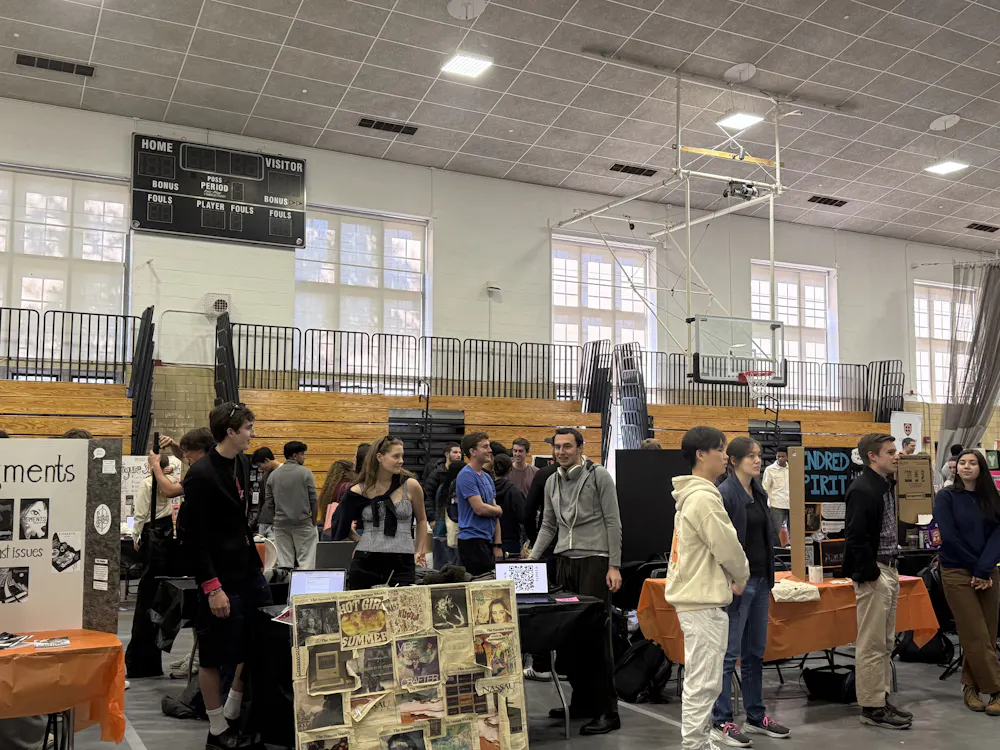
Students share mixed reactions as mandated officer and treasurer trainings return to in-person format
David EstradaThe University's student organization officers and treasurers returned to mandatory in-person training this fall after years of online sessions. Student reactions found parts of the training redundant or tedious, though most agreed the sessions were important.
The University's student organization officers and treasurers returned to mandatory in-person training this fall after years of online sessions. Student reactions found parts of the training redundant or tedious, though most agreed the sessions were important.