



The University Cottage Club filed an appeal last Monday with the Appellate Division of Superior Court to reverse the New Jersey State Department of Environmental Protection's October decision, which denied the club's petition to attain property tax-exempt status.
"The (DEP's) denial of historic site certification under (state law) was arbitrary and capricious," the appeal said, according to The Princeton Packet.
The appeal also claims DEP Commissioner Bradley Campbell's denial was unlawful and that Cottage Club never received a hearing to determine their eligibility for certification.
Cottage president John Richmond '04 could not be reached for comment.
According to state law, any nonprofit organizations classified as historic sites can file for certification as a tax-exempt property, but the DEP stipulates the public must have access to the site as well.
The Princeton Packet reported on Friday that Princeton Borough intends to file court papers opposing the club's certification.
In 2001, Cottage filed a petition with the DEP to have the building certified as a historic property, which would have exempted the eating club from local property taxes amounting to about $50,000 a year, Borough mayor Marvin Reed said.
Cottage Club attorney Thomas Olson requested a ruling on the matter earlier this year. Campbell responded on Oct. 17 that the club's petition was denied.

"As a private club, the building and property of the University Cottage Club are not and cannot be freely accessible on a regular basis to the public," Campbell wrote to Olson.
Campbell also wrote that all future applications that do not meet "objectively reasonable standards of public accessibility" would also be denied tax-exempt status.
State Assemblyman Reed Gusciora, who was involved in the Borough's fight against Cottage's petition, echoed Campbell's comments. He told the Daily Princetonian in November that the club was denied certification because of its inaccessibility to the public.
In its application to the DEP, though, Cottage cited a 1999 resolution from the club's board of governors that allowed for the building to be open to the community 12 times a year, with those dates published in a local paper.
Reed also expressed concern about the effect Cottage's certification would have on the other eating clubs.
If all the other eating clubs followed Cottage's example, the Borough would stand to lose as much as $500,000 in property tax revenue, he said.

Gusciora plans to draft legislation to help clarify the certification laws and present it to the State Assembly in January, The Princeton Packet reported.
The eating club is already on the New Jersey Register of Historic Places and National Historic Register of Historic Places, though these designations do not confer any tax benefits to the club.
Read More

Princeton University Orchestra and men’s ultimate frisbee team named in University’s latest hazing report
Andrew ArthurTwelve students in the Princeton University Orchestra and Men's Ultimate Frisbee team were found responsible for hazing violations in the University's latest Campus Hazing Transparency Report. Sanctions ranged from Dean's warnings to disciplinary probation.
Twelve students in the Princeton University Orchestra and Men's Ultimate Frisbee team were found responsible for hazing violations in the University's latest Campus Hazing Transparency Report. Sanctions ranged from Dean's warnings to disciplinary probation.

Murray-Dodge Café celebrates 50th Anniversary, drawing over 260 students
Hifza KaleemOn Wednesday, Murray Dodge Cafe celebrated its 50th anniversary, drawing more than 260 students to celebrate with free cookies and merchandise.
On Wednesday, Murray Dodge Cafe celebrated its 50th anniversary, drawing more than 260 students to celebrate with free cookies and merchandise.
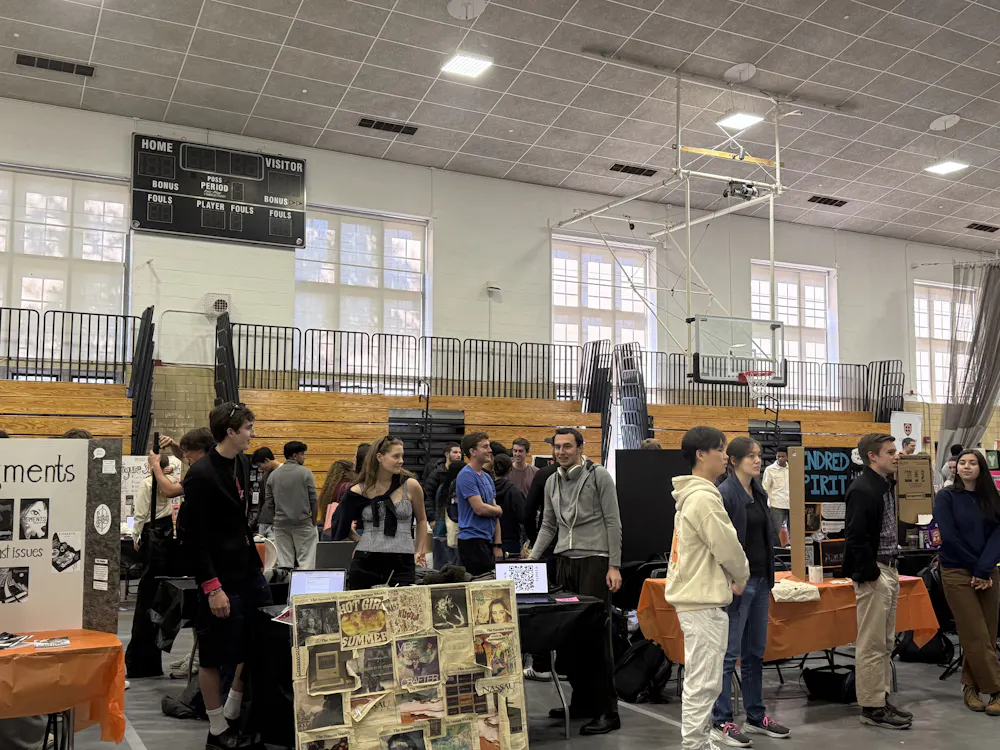
Students share mixed reactions as mandated officer and treasurer trainings return to in-person format
David EstradaThe University's student organization officers and treasurers returned to mandatory in-person training this fall after years of online sessions. Student reactions found parts of the training redundant or tedious, though most agreed the sessions were important.
The University's student organization officers and treasurers returned to mandatory in-person training this fall after years of online sessions. Student reactions found parts of the training redundant or tedious, though most agreed the sessions were important.