



"Would the press leak a classified plan to track down Saddam Hussein? What about a memo indicating that the top Defense official does not believe Saddam Hussein has weapons of mass destruction?"
Kevin Baine '71, a lawyer who devotes much of his practice to First Amendment and media litigation, posed these questions yesterday in Robertson Hall in the third lecture of the series, "Secrecy, Security, and Self-Government."
Sponsored by the Wilson School and the Program in Law and Public Affairs, Baine's lecture centered on the legal boundaries of unauthorized disclosure in the press.
"The fact that there is uncertainty among legal boundaries for leaking secrets is not a bad thing," Baine said. "The government does not push their power and the press does not push their freedom."
Baine, a Wilson School alumnus and a partner at Williams & Connolly, LLP, has served as lead counsel in litigation for many major media organizations. He has recently pursued copyright infringement claims on behalf of record labels against Napster and defended a television news organization's use of hidden cameras in a report on racial profiling by the police.
Barton Gellman '82, coordinator of the series and special projects reporter for The Washington Post, introduced Baine as "the first person he would call if the FBI showed up at his doorstep."
America has a long history of conflict between the protection of national secrets and the freedom of speech and the press, Baine said. "When Woodrow Wilson was President, he urged Congress to adopt measures for the criminal prosecution of the press for disclosing secrets," he said.
Ambiguities in laws intended to protect government secrets have actually made this conflict more manageable, Baine said.

Several statutes exhibit this ambiguity, including one that prohibits publishing certain information relating to national defense in times of war, he said.
Another statute concerns gathering or delivering defense information to aid a foreign government. "Some scholars think the statutes are not applicable to the press but rather for espionage acts since the statutes were part of the Espionage Act of 1917," he said.
In the 1971 Pentagon Papers case, The New York Times and The Washington Post published a classified study of U.S. involvement in Indochina commissioned by the Secretary of Defense. If the case was not ultimately thrown out for government misconduct and wiretapping, the two papers would have been prosecuted, Baine said.
He said the press withholds some information after weighing opinions from leading political officials. "When journalists call for comment, they would not ask the CIA if they could publish a story but instead focus on which parts would be objectionable," Baine said.
Withholding secret information continues because of its ethical and legal consequences. However, Baine said, "Part of our culture now is that we do not force the press to identify their sources."
For the lecture series, Gellman said he sought to select speakers "who know a lot about the subject and offer different perspectives." Former White House Chief of Staff John Podesta will be the next lecturer in the series.
Read More

Princeton University Orchestra and men’s ultimate frisbee team named in University’s latest hazing report
Andrew ArthurTwelve students in the Princeton University Orchestra and Men's Ultimate Frisbee team were found responsible for hazing violations in the University's latest Campus Hazing Transparency Report. Sanctions ranged from Dean's warnings to disciplinary probation.
Twelve students in the Princeton University Orchestra and Men's Ultimate Frisbee team were found responsible for hazing violations in the University's latest Campus Hazing Transparency Report. Sanctions ranged from Dean's warnings to disciplinary probation.

Murray-Dodge Café celebrates 50th Anniversary, drawing over 260 students
Hifza KaleemOn Wednesday, Murray Dodge Cafe celebrated its 50th anniversary, drawing more than 260 students to celebrate with free cookies and merchandise.
On Wednesday, Murray Dodge Cafe celebrated its 50th anniversary, drawing more than 260 students to celebrate with free cookies and merchandise.
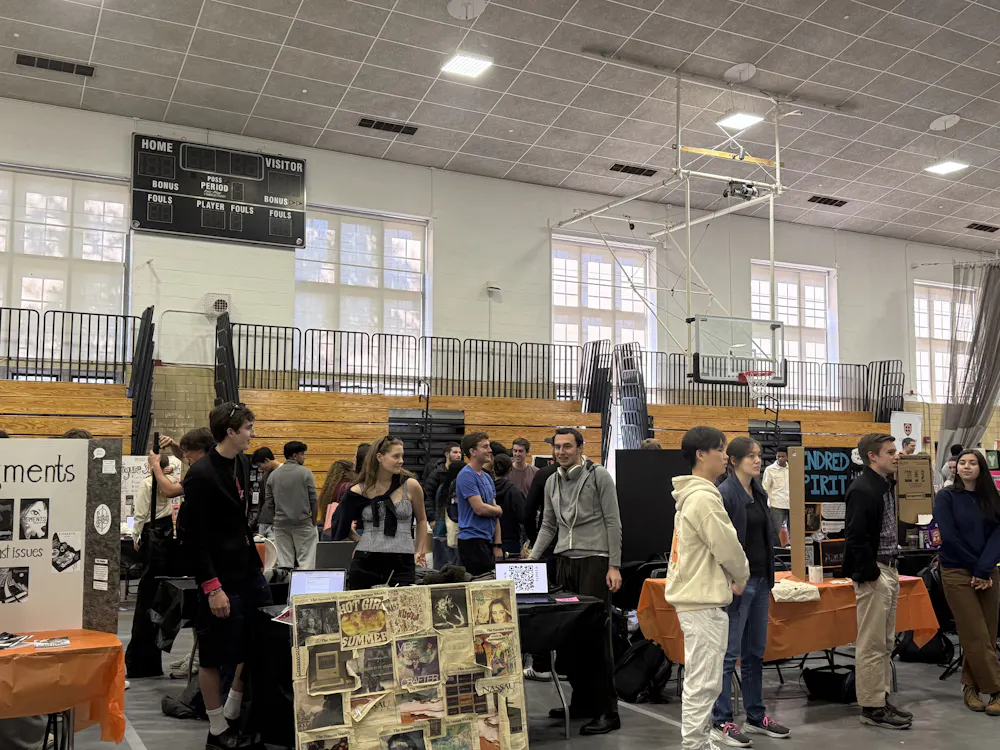
Students share mixed reactions as mandated officer and treasurer trainings return to in-person format
David EstradaThe University's student organization officers and treasurers returned to mandatory in-person training this fall after years of online sessions. Student reactions found parts of the training redundant or tedious, though most agreed the sessions were important.
The University's student organization officers and treasurers returned to mandatory in-person training this fall after years of online sessions. Student reactions found parts of the training redundant or tedious, though most agreed the sessions were important.