



Imagine walking on to one of the smallest campuses you've ever seen. As you walk into a dramatic hall — similar in beauty and presence to Princeton's Nassau Hall — images of venerated men and women stare at you from the depths of the canvases that line the walls. History resonates from the soul of the building.
The rest of the interior is reminiscent of the elegant beauty of Prospect House with antique artifacts indicating a rich history. But the setting is not that of Prospect House or Nassau Hall.
As you ascend to the main lobby up a story from the entrance, a wall of singing suspends you in your tracks. Peering into the room awash with late afternoon sunlight, you see a woman — no more than 25 years old — standing adjacent to a black grand piano. She is sweetly singing an aria from an opera that this writer never had the privilege of hearing. The notes range at least three octaves and the emotions of the lyrics are played out on the singer's face.
Then, the surreal scene is interrupted. A member of the small audience calls out, "More legato . . . suspend . . . suspend . . . and release."
Suddenly the reality of the situation sets in. "Okay, okay. Let's try that again. This time . . . ," she continued. In this reception area of the historical hall, adorned with antiques and ancient portraits, a voice class is being conducted.
The scene might seem foreign and strange — a world away from Princeton's politically charged lectures, quantitative study sessions and metaphysical precepts. On a campus with a music department that boasts 15 concentrators in a good year, musical scholarship is a rare commodity.
However, the scene in Westminster Choir College's Williamson Hall is relatively close, at least physically, to the University — at only about four blocks north of the engineering quadrangle.
Westminster is a small music college with an undergraduate program of roughly 330 students pursuing scholarship in music. Classes include music education, organ performance, piano, sacred music, theory and composition, voice performance and music theater.

At the graduate level, Westminster also has about 110 students who are working towards a Master of Music degree.
The story of Westminster began in 1920 when John Finley Williamson established the Westminster Choir at the Westminster Presbyterian Church in Dayton, Ohio. Within a few short years, Williamson had his volunteer choir singing at a professional level at national venues.
The early success motivated Williamson to start the Westminster Choir School in 1926 to professionally train musicians. The school moved to Ithaca, New York, in 1929 and became part of Ithaca College.
Then, in 1932, the institution moved to be close to major cities with symphonic orchestras and to a seminary that would complement the school's study of sacred music. With the help of Charles Erdman, pastor of the First Presbyterian Church and professor at the Princeton Theological Seminary, the Westminster Choir School moved to Princeton and was renamed Westminster Choir College.
At the time, Princeton President John Hibben helped Westminster's move as he lobbied the New Jersey governor for approval of college's charter. In those first years, Hibben also made the University chapel available for choral services and allowed the college to use University grounds for Westminster's annual spring festival. Close ties were forged between the University and Westminster.
Westminster continued to expand its renown during the 20th century, attracting many prominent musicians to its conservatory and faculty.

Then, in 1992, Westminster merged with Rider University.
Today, Westminster continues to attract topflight musicians. The school is home to musicians from 40 states and 18 countries.
And the curriculum at Westminster is designed to give students the opportunity to excel in both performance and at musical education. The school offers a wide variety of performance classes, including the graduate class for which the young woman was performing, "Opera Auditions: Preparations and Techniques."
These classes are designed to prepare the Westminster students for the trials and tribulations of the real world of music performance.
After sitting in on the seminar, I understood the breadth of Westminster's commitment to producing quality musicians. Professor Laura Brooks Rice, professor of voice and Opera Auditions' instructor, provided insightful criticisms only an accomplished performer and teacher of music could understand, with a blend of helpful notes and anecdotes to remind the students of their uncanny abilities as musicians.
"You should all be aware of your strengths going into an audition," she said, taking a moment to share a helpful nugget of wisdom to the class at the beginning of the session. "In this business, skill gives you confidence."
And preparation is not confined to the graduate level. From day one, incoming students are part of one of the many choirs on campus. Freshmen join the Chapel Choir and continue building upon their abilities as sophomores in Schola Cantorum. The Symphonic Choir — Westminster's largest and most famous group — is for juniors, seniors and graduate students.
Other groups include the auditioned Westminster Choir, which is home of the most talented voices, Westminster Singers, a group for students lacking the musical preparation for the Westminster Choir, and the Jubilee Singers, an ensemble focusing mainly on gospel music.
With such an importance placed on performance, life can be stressful at Westminster. Much like athletes competing at the top of their sport, vocalists at Westminster have to practice regularly and stay in top physical condition.
"I think the main difference [between a liberal arts education and a music education] is accommodating a practice schedule into your day. Just like classes for a liberal arts student, practicing is part of music," second year graduate student Heather Fetrow said. "As a singer, you also have to know your limit for certain things like eating, working out and other things. There's an extra level of commitment to your voice."
After singing and playing the trombone in high school, Heather made the commitment to pursue music for her career. She attended Westminster as an undergraduate and decided to stay another two years for her master's degree. She is now a member of Rice's Opera Auditions class.
Heather is in a position to teach and perform, combining both characteristics of a Westminster education. While acting as the graduate student assistant for the Chapel Choir, Heather also takes a variety of performance classes.
"I think a lot of people are looking for a combination of both performance and teaching. A lot of people want to teach and you can see that in the numbers in the music education majors," Fetrow said. "But you also have the opportunity to perform."
However, Heather said life at Westminster is not confined to the practice rooms.
"It's very much the work hard, play hard attitude," she confided. "When you go into New York and on tours and spend time with the same group of 40 people, that's when you really get to be social and make a lot of close friends."
In general, the Westminster experience is not unlike the lifestyle of a Princeton student. Heather said Westminster even has something that can be likened to the University's senior thesis. The college, at the end of a student's undergraduate education, strongly encourages students to have a recital to culminate their work.
And the performance is only the beginning of what is incorporated in these recitals. Students must write and present a paper on the piece and create the necessary programmatic materials that an audience at a professional performance would expect. Sometimes, Heather said, these programs include translations of the works and detailed notes about the pieces.
Just as seniors at the University complain about their theses, "We'd rather just sing," she joked.
But Westminster takes pride in preparing its students to tackle all aspects of the stressful business of making music.
At the end of our time together I asked Heather whether she thinks failure in an audition would reflect worse on her as an individual or her education at Westminster.
After pondering for a moment, she said, "Well, it's tough to say, but I think it reflects on both. We come from such a great program. It's there that they teach us all the skills we will need to succeed. But ultimately your performance or audition reflects on you."
With 77 years of performances and auditions under its belt, Westminster looks like it will continue to produce topflight musicians for years to come.
Soon a new generation of blossoming vocalists will battle the acoustics of Williamson Hall, trying to impress the stoic visages in the paintings and leave a lasting legacy on the music world.
Read More

Princeton University Orchestra and men’s ultimate frisbee team named in University’s latest hazing report
Andrew ArthurTwelve students in the Princeton University Orchestra and Men's Ultimate Frisbee team were found responsible for hazing violations in the University's latest Campus Hazing Transparency Report. Sanctions ranged from Dean's warnings to disciplinary probation.
Twelve students in the Princeton University Orchestra and Men's Ultimate Frisbee team were found responsible for hazing violations in the University's latest Campus Hazing Transparency Report. Sanctions ranged from Dean's warnings to disciplinary probation.

Murray-Dodge Café celebrates 50th Anniversary, drawing over 260 students
Hifza KaleemOn Wednesday, Murray Dodge Cafe celebrated its 50th anniversary, drawing more than 260 students to celebrate with free cookies and merchandise.
On Wednesday, Murray Dodge Cafe celebrated its 50th anniversary, drawing more than 260 students to celebrate with free cookies and merchandise.
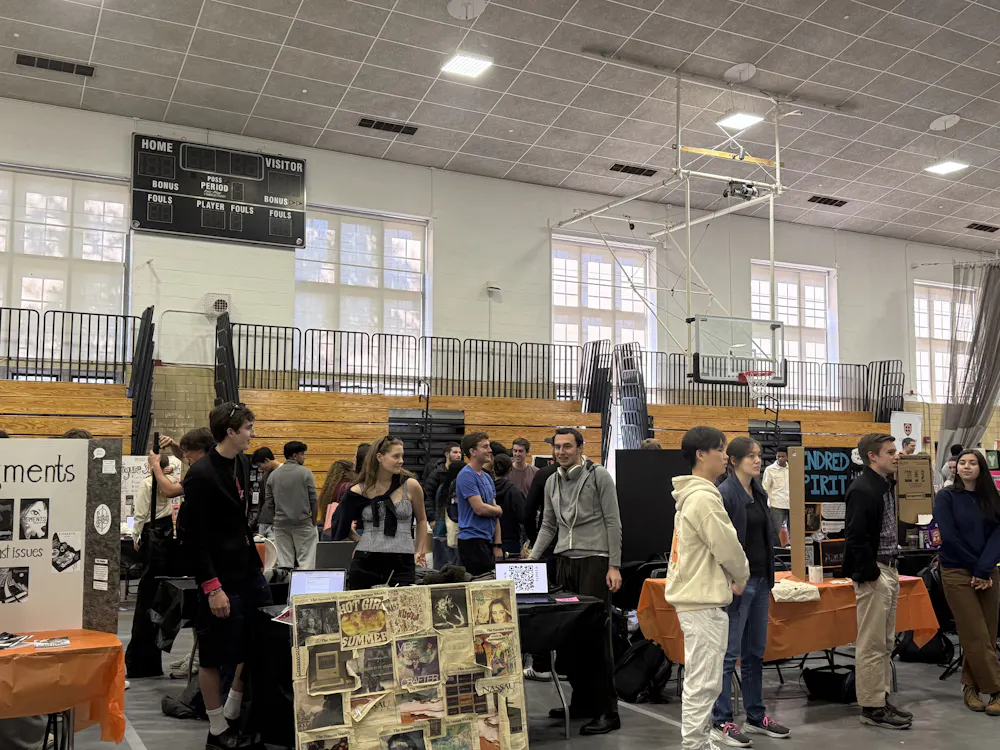
Students share mixed reactions as mandated officer and treasurer trainings return to in-person format
David EstradaThe University's student organization officers and treasurers returned to mandatory in-person training this fall after years of online sessions. Student reactions found parts of the training redundant or tedious, though most agreed the sessions were important.
The University's student organization officers and treasurers returned to mandatory in-person training this fall after years of online sessions. Student reactions found parts of the training redundant or tedious, though most agreed the sessions were important.