



Some speakers at last weekend's "Faith and the Challenges of Secularism" conference suggested a more appropriate title for the two-day event would have been "Secularism and the Challenges of Faith" because, they said, faith is often on the defensive.
The event — which was sponsored by the James Madison Program in American Ideals and Institutions — explored religion's role in modern society through lecture and panel discussions.
"The conference was a reminder that the lines between [faith and secularism] aren't drawn too starkly," said politics professor and James Madison Program chair Robert George. "I think it cleared away caricatured representations of these two views."
In each of the six one-and-a-half hour sessions, a keynote speaker opened a discussion topic that was then discussed by panelists.
John Finnis of Oxford University denounced theories of political liberalism in the face of religion. He used as an example his belief that the ethics of human cloning present society with a potentially slippery slope.
"Unless society takes a side, and the right side," Finnis said, "we will move from a community with embryo banks, to a community of slave beings whose organs are harvested."
Francis Beckwith of Baylor University further scrutinized secularism, saying it "puts restraints on public discourse."
Religious concepts have had a lasting impact on the country, said former University professor and author John DiIulio, Jr., who now teaches at the University of Pennsylvania. DiIulio spoke specifically about God's influence on American society.

"There is no constitutional basis for a clear line between church and state," he said. "No one who wants to be taken seriously believes in a wall of separation."
Expanding on DiIulio's argument, Pennsylvania State University professor Phillip Jenkins challenged the audience to find a single example of a "purely secular movement in American history." He suggested that abolitionism and the progressive and Civil Rights movements were examples of faith-based political events.
Father Richard John Neuhaus of the Institute on Religion and Public Life said society cannot be divorced from religion because religion presents truth. He invoked the words of Roman Catholic Pope John Paul II to defend his position, quoting the pontiff as saying, "'The Church imposes nothing — it simply proposes, and what it proposes is the Truth, and the Truth imposes itself.' "
Few Princeton students attended the conference. In the weekend's final session virtually all attendees were residents of the Princeton community and University faculty members.
"All the papers [presented by speakers] were uniformly thoughtful, well argued," George said.
Larry Kudlow, of CNBC's "Kudlow and Cramer," was billed as a keynote speaker but was unable to attend the conference at the last minute.
Read More

Princeton University Orchestra and men’s ultimate frisbee team named in University’s latest hazing report
Andrew ArthurTwelve students in the Princeton University Orchestra and Men's Ultimate Frisbee team were found responsible for hazing violations in the University's latest Campus Hazing Transparency Report. Sanctions ranged from Dean's warnings to disciplinary probation.
Twelve students in the Princeton University Orchestra and Men's Ultimate Frisbee team were found responsible for hazing violations in the University's latest Campus Hazing Transparency Report. Sanctions ranged from Dean's warnings to disciplinary probation.

Murray-Dodge Café celebrates 50th Anniversary, drawing over 260 students
Hifza KaleemOn Wednesday, Murray Dodge Cafe celebrated its 50th anniversary, drawing more than 260 students to celebrate with free cookies and merchandise.
On Wednesday, Murray Dodge Cafe celebrated its 50th anniversary, drawing more than 260 students to celebrate with free cookies and merchandise.
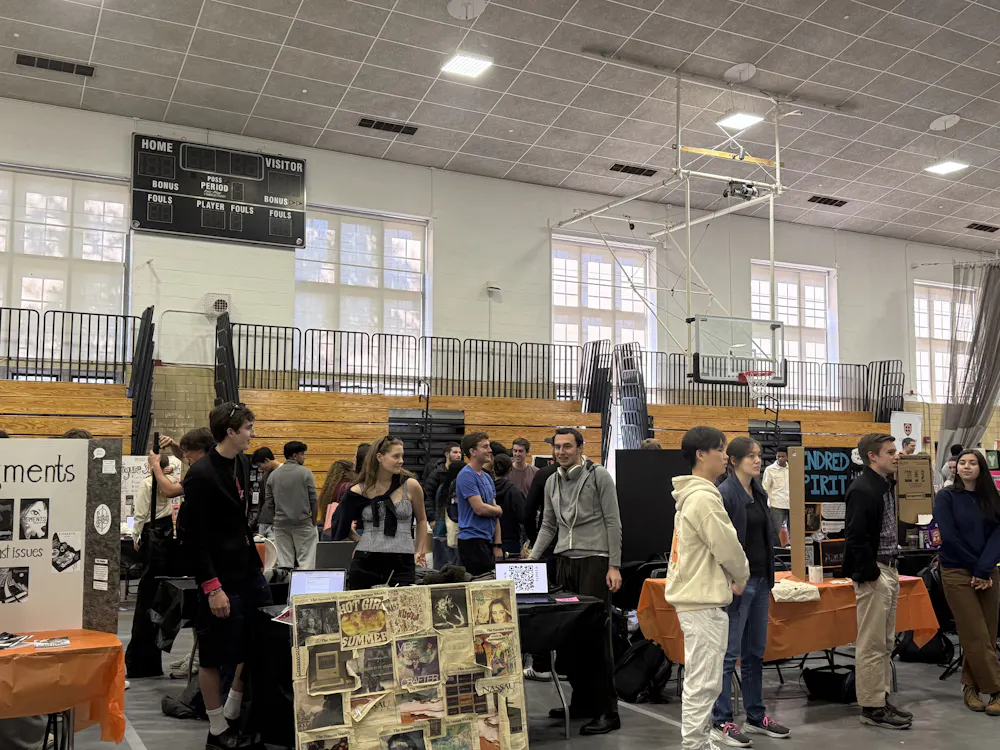
Students share mixed reactions as mandated officer and treasurer trainings return to in-person format
David EstradaThe University's student organization officers and treasurers returned to mandatory in-person training this fall after years of online sessions. Student reactions found parts of the training redundant or tedious, though most agreed the sessions were important.
The University's student organization officers and treasurers returned to mandatory in-person training this fall after years of online sessions. Student reactions found parts of the training redundant or tedious, though most agreed the sessions were important.