



Universities across the country benefited from the more than $2 billion Congress earmarked for academic research in 2003 — a 10 percent increase over 2002 that represents a continuing trend of rising "pork-barrel" funding — according to a survey by The Chronicle for Higher Education.
But Princeton did not indulge in the pork. The University, which has a total research budget surpassing $200 million, was listed in the study as receiving less than $1 million in earmarks.
The New Mexico Institute of Mining and Technology topped the list with $56.1 million in pork. Harvard University received $1.5 million, while Yale University had none.
Earmarks — noncompetitive funding directed by Congress — are controversial because they are not awarded through peer review, which determines the relative merit of project proposals. Instead, pork-barrel money often reflects a school's effectiveness in lobbying and the leverage of its Congressional representative.
While some schools advertise their success in securing earmarks, the University and most of its peers do not. President Tilghman and the University's Board of Trustees have repeatedly stressed the importance of obtaining funding solely through peer review.
"The very best people should judge what are the priority things to support," University Research Board chair William Happer said, rather than decision-making by "the caprice of the powerful."
The Chronicle reported that the University received an earmark of $700,000 for wind tunnel research and shared part of a $1.4 million earmark for a nanotechnology initiative.
University researchers explained that they obtained the money through peer-reviewed project proposals rather than political lobbying. But Jeffrey Brainard, coauthor of The Chronicle's report, said the funding still qualifies as earmarks because it was channeled through larger pork-barrel projects.

The wind tunnel research is part of an aerospace initiative supervised by the U.S. Air Force. One of the participants in the initiative, a technology company in Montana, lobbied its representatives to increase funding, explained co-principal investigator Richard Miles, a professor in the University's Department of Mechanical and Aerospace Engineering.
The University's other listing is part of $1.4 million that was earmarked after Picatinny Arsenal lobbied New Jersey Rep. Rodney Frelinghuysen to fund the Nano Valley Initiative.
According to The Chronicle, the initiative is involved with "using nanotechnology . . . to make components for warheads and explosive."
But James Sturm, director of the Princeton Institute for the Science and Technology of Materials, took issue with The Chronicle's characterization of the project, saying research done at the University as part of the Nano Valley Initative seeks to understand the fundamentals of microfluids and is not directly related to warheads.
Brainard maintained that his description of the overall initiative was culled from the language of the project's specific bill and was confirmed by federal agencies.
Sturm estimated that Princeton received less than 10 percent of the $1.4 million Nano Valley Initiative earmark, which it shares with research groups at Rutgers University and other institutions.

Princeton was awarded the funding after chemical engineering professor Sandra Troian submitted a project proposal that was selected through peer review, Sturm explained.
"All of our funding comes through the peer review process," said Diane Jones, director of the University's Office of Government Affairs. "That's not to say that all earmarks fund bad projects, but peer review is a better way to analyze which projects deserve funding."
Dartmouth College, ranked fourth in The Chronicle's survey, was the only Ivy League school in the top 50. In 2003, Dartmouth received $29.5 million in Congressional earmarks, the bulk of which went to its Institute for Security Technology Studies.
Founded in the wake of the Oklahoma City bombing, ISTS focuses on issues relating to cybersecurity, counterterrorism and homeland security.
Adam Golodner, associate director for policy at ISTS, said Congress has directed $51 million to the institute in the past three years because it meets "an express national need."
Golodner added that though Dartmouth does not lobby Congress for earmarks, the school has no policy against accepting such funding.
"Congress plays an important role in budgetary choices," he said.
Read More

Princeton University Orchestra and men’s ultimate frisbee team named in University’s latest hazing report
Andrew ArthurTwelve students in the Princeton University Orchestra and Men's Ultimate Frisbee team were found responsible for hazing violations in the University's latest Campus Hazing Transparency Report. Sanctions ranged from Dean's warnings to disciplinary probation.
Twelve students in the Princeton University Orchestra and Men's Ultimate Frisbee team were found responsible for hazing violations in the University's latest Campus Hazing Transparency Report. Sanctions ranged from Dean's warnings to disciplinary probation.

Murray-Dodge Café celebrates 50th Anniversary, drawing over 260 students
Hifza KaleemOn Wednesday, Murray Dodge Cafe celebrated its 50th anniversary, drawing more than 260 students to celebrate with free cookies and merchandise.
On Wednesday, Murray Dodge Cafe celebrated its 50th anniversary, drawing more than 260 students to celebrate with free cookies and merchandise.
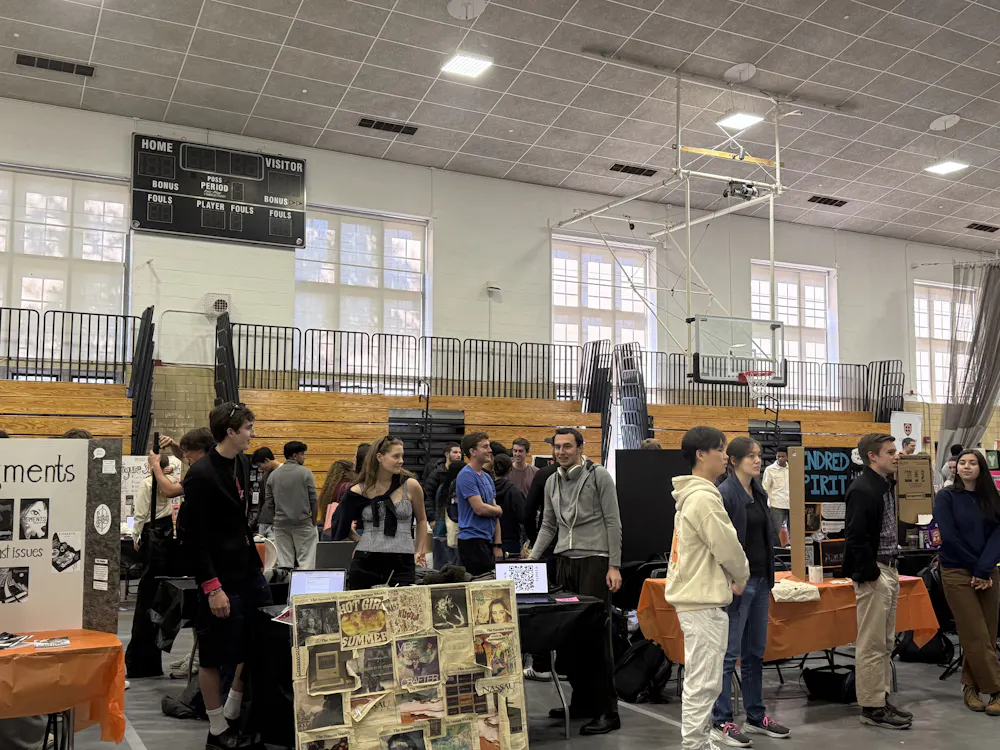
Students share mixed reactions as mandated officer and treasurer trainings return to in-person format
David EstradaThe University's student organization officers and treasurers returned to mandatory in-person training this fall after years of online sessions. Student reactions found parts of the training redundant or tedious, though most agreed the sessions were important.
The University's student organization officers and treasurers returned to mandatory in-person training this fall after years of online sessions. Student reactions found parts of the training redundant or tedious, though most agreed the sessions were important.