



A three-member panel discussed the reconstruction efforts in postwar Iraq and Afghanistan in Frist Campus Center yesterday afternoon.
The members of the panel were Robert Finn, GS '78, former U.S. ambassador to Afghanistan and visiting professor in Near Eastern studies, Julie Taylor, NES instructor, and Nicholas Guyatt, history lecturer.
The event was sponsored by the Global Issues Forum.
Finn said though there has been progress in reconstructing Afghanistan, problems remain.
Roads are being built, a primitive communications system is being established and warlords who were governing many provinces are slowly giving up power.
"This government is very slowly beginning to govern more and more of the country," he said. "Are there still problems? Lots. Will these continue to be problems? Yes."
Finn said several steps still need to be taken to restore the government to democracy, including the construction of a large highway, the formation of an ethnically-balanced national army and an increase in the size of the police force.
In Iraq, Finn said there has been a lot of progress contrary to popular opinion.

Princeton history professor Julie Taylor emphasized incorporating Shiite clerics into the Iraqi reconstruction process. Otherwise the process is not democratic enough, she said.
"Currently we are working to have the constitution drawn up by appointed officials instead of elected officials, who would most likely be Shiite clerics," she said.
Guyatt questioned America's motivation for invading Iraq and its unilateral approach to foreign affairs. He said that until weapons of mass destruction are found, the Bush administration's explanation for invading Iraq will not be satisfactory.
But he also challenged pacifists, arguing that though weapons of mass destruction are still missing, they are still not fully justified in their position.
"If they were saying no on war, what were they saying yes to? A yes to Iraq under sanctions and Saddam seems to maybe be a worse Iraq," he said.
Read More
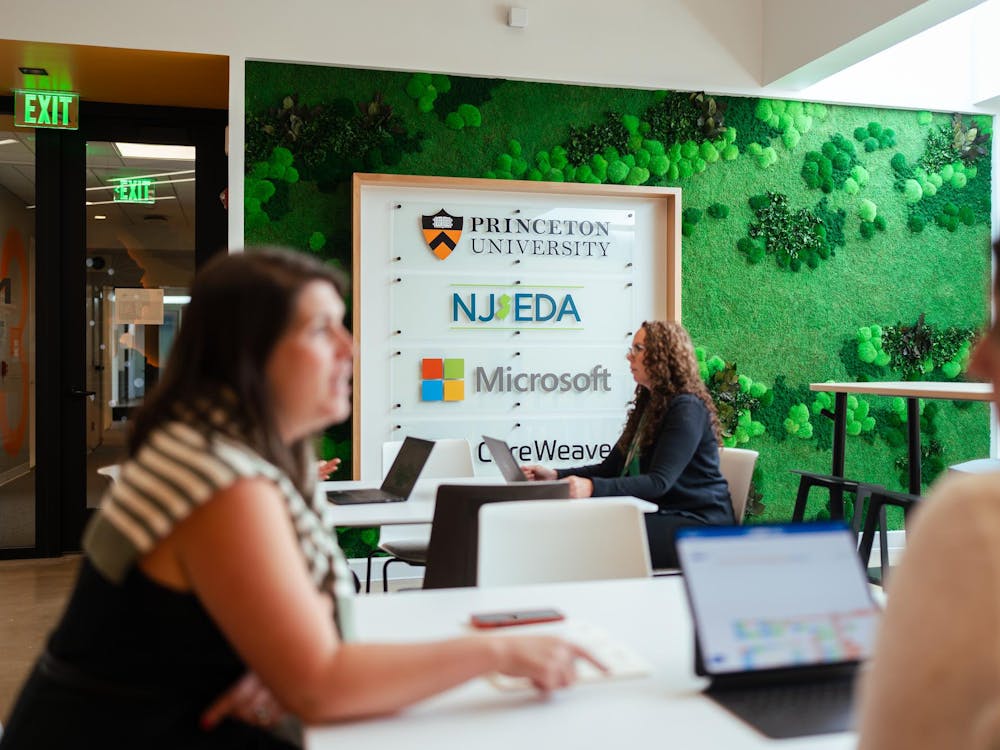
NJ AI Hub marks first anniversary with inaugural startup cohort
Zihan (Frank) XuFourteen selected start-ups receive weekly workshops, reverse pitches, corporate introductions, among other guidance over 12 weeks. The “AI accelerator” helps to test each company’s technology and fast-track its path to commercialization.
Fourteen selected start-ups receive weekly workshops, reverse pitches, corporate introductions, among other guidance over 12 weeks. The “AI accelerator” helps to test each company’s technology and fast-track its path to commercialization.
Three Princeton alumni awarded 2026 Fields Medal
Clara DochertyThe three alumni who received the medal are Yu Deng GS ’15, John Pardon ’11, and Jacob Tsimerman GS ’11.
The three alumni who received the medal are Yu Deng GS ’15, John Pardon ’11, and Jacob Tsimerman GS ’11.

Major gift from Leinweber Foundation to strengthen theoretical physics research
Daphne Lewis and Haeon LeeThe University is joining a national network of institutions advancing theoretical physics research, following the major gift. The foundation has committed over $165 million to top fundamental science research institutions during a period of uncertainty for research funding.