



Starting today, scholars and diplomats from around the world will discuss the changing role of the European Union at a landmark three-day conference at the Wilson School.
The conference, entitled "The European Union: Its Role and Power in the Emerging International System," is set to begin today at 10 a.m. with opening remarks from Wilson School Dean Anne-Marie Slaughter '80 and the conference co-chairs, lecturer Wolfgang Danspeckgruber and professor Ezra Suleiman.
The conference will focus on the position of the European Union in world politics, but will also address the union's history. It marks a key part of the University's effort to emphasize international studies in light of the recent establishment of the Princeton Institute for International and Regional Studies.
"At this conference we wanted to see what possible role [the European Union] has in managing international crises," Suleiman said. "We're going to be concentrated on its more international role."
"We also want to look at the E.U.'s role in [a] unipolar world where the U.S. is the dominant force," he said. "We want to examine its role in the trans-Atlantic relationship and look again at the predominant role of U.S. in the relationship. Can [the European Union] be a partner with U.S.?"
In particular, he said the conference would focus on the E.U.'s ability to deal with international crises, such as ethnic conflict in the Balkans, Iraq and Afghanistan.
The conference will host a number of important diplomats. Robert Finn GS '78, a visiting professor at the University who has just returned from serving as U.S. ambassador to Afghanistan, will be part of a panel, as will three European ambassadors to the United States: Eva Nowotny from Austria, Gunter Burghardt, the E.U. ambassador and Wolfgang Ischinger of Germany.
"We would like to make this an ongoing discussion and debate," Suleiman added. "We hope to publish a series of volumes out of these conferences."'

The co-organizers also believe the conferences will result in the publication of new papers and volumes about the emerging role of the European Union as an international force.
The Liechtenstein Institute on Self-determination and the Program on European Politics and Society organized this weekend's event.
Planning for this weekend's conference began about a year ago when Suleiman and Danspeckgru-ber met to discuss future events for the two programs.
"[The conference] was a natural development when you look at the European area and what has become very serious divisions between the U.S. and Europe," Suleiman said.
A week ago, German Foreign Minister Joschka Fischer was slated to give a foreign policy speech here at Princeton but had to cancel the speech at the last moment. He is expected to come within the next few months.
Suleiman said he hopes the discussions from the conference do not end this weekend. Subsequent meetings to develop this weekend's findings are being planned in cities around Europe, including Paris, Berlin and St. Petersburg.
Read More

Princeton University Orchestra and men’s ultimate frisbee team named in University’s latest hazing report
Andrew ArthurTwelve students in the Princeton University Orchestra and Men's Ultimate Frisbee team were found responsible for hazing violations in the University's latest Campus Hazing Transparency Report. Sanctions ranged from Dean's warnings to disciplinary probation.
Twelve students in the Princeton University Orchestra and Men's Ultimate Frisbee team were found responsible for hazing violations in the University's latest Campus Hazing Transparency Report. Sanctions ranged from Dean's warnings to disciplinary probation.

Murray-Dodge Café celebrates 50th Anniversary, drawing over 260 students
Hifza KaleemOn Wednesday, Murray Dodge Cafe celebrated its 50th anniversary, drawing more than 260 students to celebrate with free cookies and merchandise.
On Wednesday, Murray Dodge Cafe celebrated its 50th anniversary, drawing more than 260 students to celebrate with free cookies and merchandise.
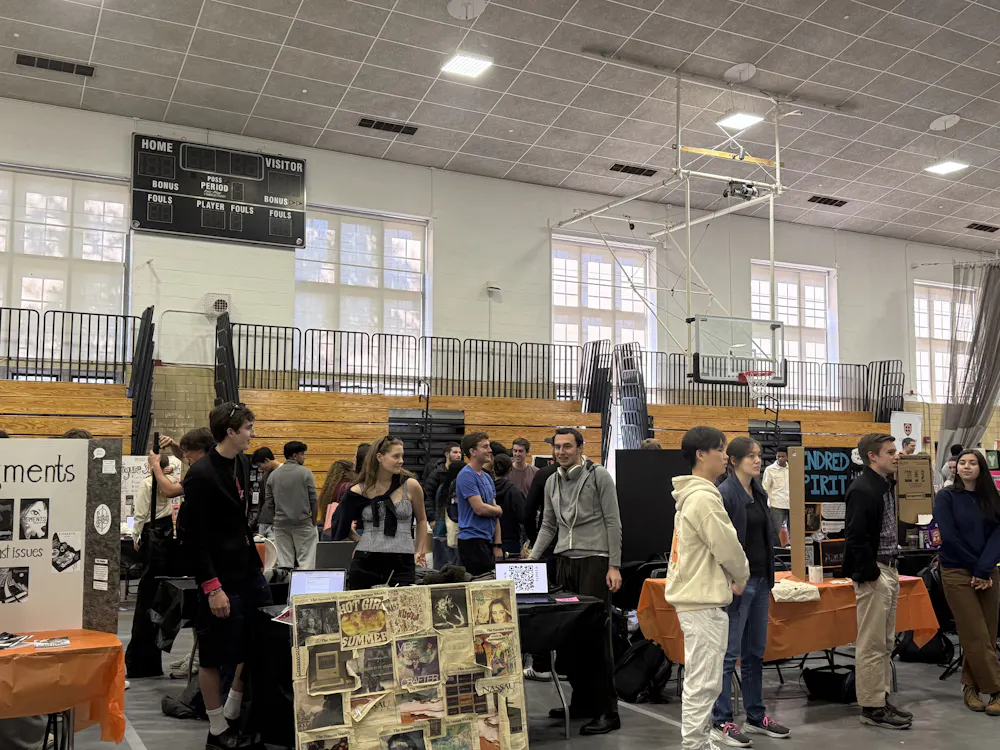
Students share mixed reactions as mandated officer and treasurer trainings return to in-person format
David EstradaThe University's student organization officers and treasurers returned to mandatory in-person training this fall after years of online sessions. Student reactions found parts of the training redundant or tedious, though most agreed the sessions were important.
The University's student organization officers and treasurers returned to mandatory in-person training this fall after years of online sessions. Student reactions found parts of the training redundant or tedious, though most agreed the sessions were important.