



In 1995, frustrated by the amount of attention he was able to afford his patients, pediatrician Alan Greene '81 set out to make medical history. He and his wife, Cheryl, founded drgreene.com, a child healthcare site dedicated to bridging the ever-growing gap between parents and pediatricians.
"I felt I was writing quick prescriptions," Greene said. "As the pace got faster and faster, some of the families I was working with got upset." Moreover, beyond children's annual physicals, parents were hesitant to make appointments to discuss non-urgent issues. "He was often not a part of the family's life at pivotal times. His input was not available during critical development and health decision-making Cheryl Greene said.
Then one of his patient's parents suggested that he create a website that addressed parents' non-urgent questions and archive the responses online. And drgreene.com was born.
At the time, the concept of creating such a website was novel. "It was the same year Netscape first came out," Greene said. The American Medical Association has recognized Greene as the first physician to go online with a website.
Greene began telling his patients about the website and encouraged them to ask him questions that he could address online. Each night, Greene would attempt to address one question.
"I would take my experience as a dad and as a pediatrician and look at the questions and answer it in a one or two page article," Greene said.
At the same time, Cheryl Greene worked on designing and implementing the website. Said Greene, "Cheryl creates the entire online world that enables [drgreene.com] to happen." To make the website a possibility, Cheryl Greene taught herself the necessary web technologies. "She is in many ways the heart and soul of the site," Greene said.
The response to the site was overwhelming. "The families in the practice loved it! We felt really connected," Greene said.

"His patients felt there was an open door, day and night, to ask the questions that were important to them," Cheryl Greene said.
Soon, something unexpected happened. "We started getting questions from all over the planet," Greene said. People from across the globe — even one lone soul in Antarctica, according to Greene — wrote in, seeking the doctor's advice.
Then tragedy struck. In March of 1996, Cheryl Greene was diagnosed with stage three, high-risk breast cancer. Doctors gave her less than a year to live. At first, Greene believed they should shut down the website so he could spend time with his wife and their newborn son, Austin.
However, Cheryl Greene didn't agree. "I want to leave a legacy," he said she told him. "Let's do this thing together." He agreed.
"When it appeared that we had lost everything," Greene said, "this was something that came into focus. It was a clarifying moment."
"We worked together," said Cheryl Greene, "and in working we found inspiration."

Today, nearly seven years later, she has been given a clean bill of health and drgreene.com is more popular than ever. The site receives nearly 17 million hits per month, roughly double last year's average. More than 300,000 unique visitors, of whom 40 percent are international, log-on each month.
The drgreene.com of today contains much more than the 2,000 in-depth articles written by Greene. "When it became clear that we were getting so many more questions than could be answered [in in-depth articles], we started chats," Greene said. He is now available on the chat forum for one hour each weekday to communicate directly with parents.
In addition to the chat forum, drgreene.com features a bulletin board where parents can communicate with one another, as well as a growing multimedia library.
Greene continues to help finance with his own resources the considerable costs of his website, ever mindful of his commitment to keeping drgreene.com accessible to everyone. To support themselves, the Greenes continue to hold other jobs. Greene is currently the chief medical officer of A.D.A.M., a company that produces multimedia products for medical professionals. He also speaks as a pediatrician and as a doctor who has had abundant experience with the web.
Though he continues to support drgreene.com, Greene believes the public has a role to play in supporting his website and similar resources. "In order for [drgreene.com] to be healthy and sustainable in the long run . . . a government or foundation needs to decide that this is going to be worthwhile, or people need to start paying the pennies a piece or some combination of that."
He remains hesitant, however, to charge visitors for access to the site, believing it is often those least able to afford to pay for access who need the information the most. "Our goal is to not put barriers up to anybody," Greene said, noting also that many visitors to drgreene.com are from developing nations.
Tying his goal of making drgreene.com accessible to people the world over, Greene said, "In my own journey, I moved the apostrophe to after the 's." He was, of course, referring to the words "Princeton in the Nation's service." Long before 1996, when President Harold Shapiro added the lines ". . . and in the service of all nations," Greene was thinking of how he could help people across the globe.
Looking ahead
Greene said he hopes more physicians will do what he has done. He noted the current culture of the medical practice does not do enough to encourage this kind of communication between patients and their doctors.
Greene takes issue with the Hippocratic Oath, for example. "The central promise of the Hippocratic Oath is to keep knowledge of medicine a secret," he said. "My goal is to absolutely turn that upside down."
Greene said, "As much as I appreciate the Hippocratic Oath — it's been the heart and soul of medicine for millennia — I think it's time for it to be put aside." To that end, in 2000 Greene chaired a committee that sought to create a new oath for doctors, one that encourages open communication and propagates "the idea that each person is responsible for their own health." The final product was what has been dubbed "The Millennium Health Oath."
Besides working more abstractly to change the culture of medicine, Greene and his wife have helped other medical professionals create their own websites. Donnica Moore '81, one of Greene's classmates when he was at Princeton, benefited from the Greene's experience and has now established her own web presence at DrDonnica.com.
Moore and Greene actually met after graduating from Princeton. "I found one of the most powerful things about Princeton happens after you leave — and that's the network of alumni," said Greene. "There's a connection there and from that good and creative things come."
What's next for Dr. Greene?
"I'm getting to write a book that I've always wanted to write," he said enthusiastically. His first work is titled, "From the First Steps to the First Kicks: Nurturing Your Child's Development from Pregnancy Through the First Year of Life."
Read More

Princeton University Orchestra and men’s ultimate frisbee team named in University’s latest hazing report
Andrew ArthurTwelve students in the Princeton University Orchestra and Men's Ultimate Frisbee team were found responsible for hazing violations in the University's latest Campus Hazing Transparency Report. Sanctions ranged from Dean's warnings to disciplinary probation.
Twelve students in the Princeton University Orchestra and Men's Ultimate Frisbee team were found responsible for hazing violations in the University's latest Campus Hazing Transparency Report. Sanctions ranged from Dean's warnings to disciplinary probation.

Murray-Dodge Café celebrates 50th Anniversary, drawing over 260 students
Hifza KaleemOn Wednesday, Murray Dodge Cafe celebrated its 50th anniversary, drawing more than 260 students to celebrate with free cookies and merchandise.
On Wednesday, Murray Dodge Cafe celebrated its 50th anniversary, drawing more than 260 students to celebrate with free cookies and merchandise.
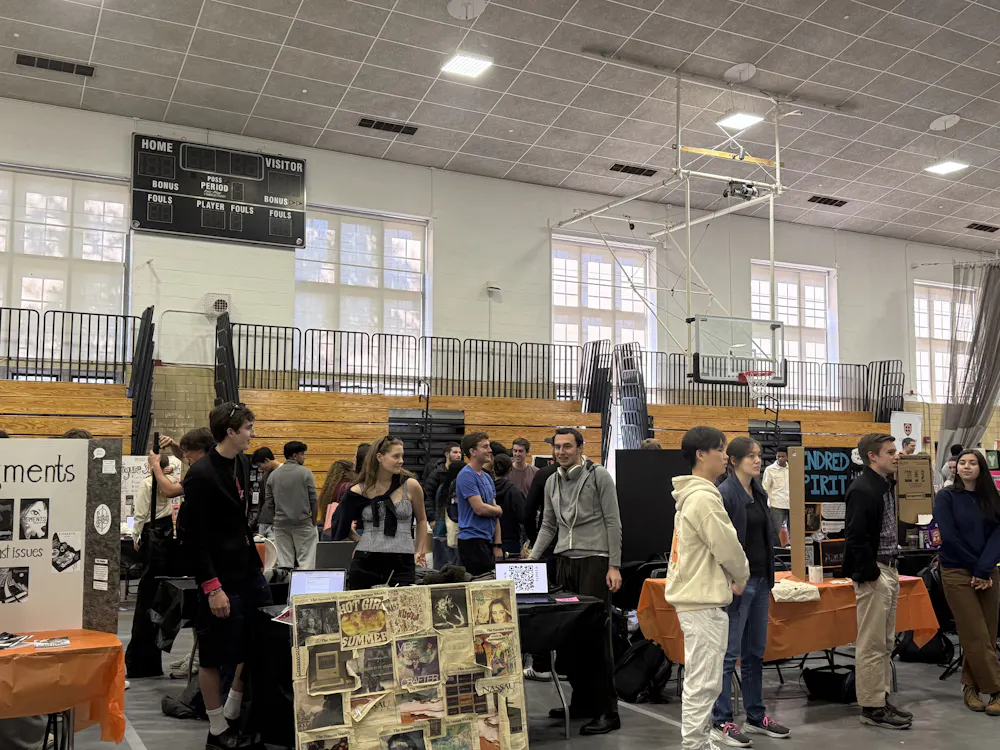
Students share mixed reactions as mandated officer and treasurer trainings return to in-person format
David EstradaThe University's student organization officers and treasurers returned to mandatory in-person training this fall after years of online sessions. Student reactions found parts of the training redundant or tedious, though most agreed the sessions were important.
The University's student organization officers and treasurers returned to mandatory in-person training this fall after years of online sessions. Student reactions found parts of the training redundant or tedious, though most agreed the sessions were important.