



"Secrecy, Security and Self-Government: How I Find Out Secrets And Why I Publish Them" was the topic of discussion yesterday in Robertson Hall. And who could be better to give the lecture than a Pulitzer-Prize winning journalist who has mastered the art of getting the cat out of the bag?
Barton Gellman '82, a Wilson School graduate, special projects reporter for The Washington Post and a recipient of the 2002 Pulitzer Prize for coverage of the Sept. 11 attacks and the subsequent war on terrorism, discussed how and why he broke some of his biggest stories.
The lecture is the second in a series, sponsored by the Wilson School and the Program in Law and Public Affairs.
Professor Christopher Eisgruber, the director of the Program in Law and Public Affairs, said the series is intended to increase knowledge about public policy.
Drawing lines
Early in his lecture, Gellman described how when releasing sensitive information that governments attempt to keep secret, "we [journalists] draw lines, but we draw them ourselves."
Gellman said he believes that a government cannot be held accountable for what it does when the public does not know what it is doing.
Gellman discussed commonly-held fallacies about reporting. For instance, some people believe that contacts will attempt to call or approach reporters out of the blue. Obtaining information is not such an easy task to undertake, Gellman said. He described how a certain amount of work must be done to get a source to talk.
'SWAG'
"How do I find out government secrets?" Gellman asked the audience rhetorically.

He said he uses what many refer to as the acronym SWAG (scientific wild ass guess). Assumptions are not published in a paper, but they may initiate a train of thought that leads to a final, valid piece of reporting.
Gellman emphasized the importance of analyzing information that may seem obscure or irrelevant.
Still, Gellman says he "abandons a lot more guesses than [he] confirms."
Gellman says he has been approached by government officials, including national security adviser Condoleezza Rice, and asked not to release certain details of government actions.
Responsibility
One audience member at the lecture suggested that reporters, by remaining silent about certain topics, may in fact be partially responsible for harmful actions taken by government officials.
Gellman said reporters are sometimes obligated to withhold "very relevant" information, and "we [journalists] hate it."

He said being an investigative jounalist is potentially dangerous. Methods taken by reporters are often similair to those taken by those who work in intelligence gathering for governments, Gellman said.
Gellman described the painstaking effort made by journalists to get information from hesitant sources.
Back and forth
He described how he must go in a circle sometimes with his contacts. He may begin with one source who will withhold something interesting. The next person he interviews may give a different story. Then, Gellman will have to go back to the original source for verification.
If a source releases information to Gellman that he believes will be damaging to the source in some way, Gellman takes the source's status into account.
If it is a high-ranking, experienced official, he will not feel compelled to discuss with the source the possible consequences of the disclosure.
At that stage, Gellman states, "they're big people . . . grownups." If the source is low-ranking, however, he will go over the his notes with the source and see what he or she does not want to be published.
Reporters do, after all, "take steps to protect the innocent," Gellman said.
Read More

Princeton University Orchestra and men’s ultimate frisbee team named in University’s latest hazing report
Andrew ArthurTwelve students in the Princeton University Orchestra and Men's Ultimate Frisbee team were found responsible for hazing violations in the University's latest Campus Hazing Transparency Report. Sanctions ranged from Dean's warnings to disciplinary probation.
Twelve students in the Princeton University Orchestra and Men's Ultimate Frisbee team were found responsible for hazing violations in the University's latest Campus Hazing Transparency Report. Sanctions ranged from Dean's warnings to disciplinary probation.

Murray-Dodge Café celebrates 50th Anniversary, drawing over 260 students
Hifza KaleemOn Wednesday, Murray Dodge Cafe celebrated its 50th anniversary, drawing more than 260 students to celebrate with free cookies and merchandise.
On Wednesday, Murray Dodge Cafe celebrated its 50th anniversary, drawing more than 260 students to celebrate with free cookies and merchandise.
Students share mixed reactions as mandated officer and treasurer trainings return to in-person format
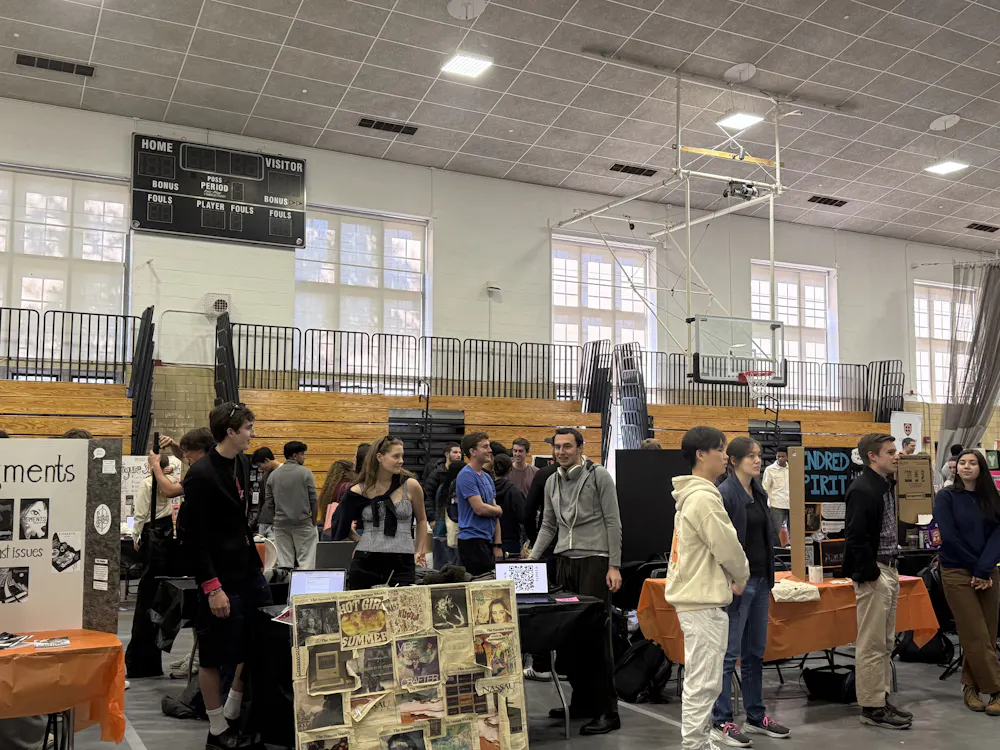
David EstradaThe University's student organization officers and treasurers returned to mandatory in-person training this fall after years of online sessions. Student reactions found parts of the training redundant or tedious, though most agreed the sessions were important.
The University's student organization officers and treasurers returned to mandatory in-person training this fall after years of online sessions. Student reactions found parts of the training redundant or tedious, though most agreed the sessions were important.