



The Historical Society of Princeton announced yesterday that it has received a donation of roughly 65 pieces of Albert Einstein's furniture from the Institute for Advanced Study.
The collection, which furnished Einstein's home on 112 Mercer St., consists of pieces dating back to the 18th century.
Shortly after Einstein came to America in 1933, the German underground reportedly smuggled his furniture to America under a fictitious shipping address.
"The fact that they survived the Nazi regime, like Einstein himself, makes them . . . more precious to us," said Gail Stern, the society's director.
Some people have expressed concern that Einstein did not want his house or possessions to become a memorial to him.
"We want to use these materials in a responsible way," Stern said yesterday. She said she hopes to respect Einstein's wishes while providing the public with a unique opportunity to learn about his daily life.
The furniture, most of which belonged to Einstein's cousin and second wife Elsa, includes Einstein's treasured Biedermeir style grandfather clock, his well-loved tub armchair and wood music stand.
The music stand has particular significance to historians as a symbol of Einstein's creative genius.

"The idea [of the theory of relativity] came to me while playing my violin, instead of studying for my physics class," Einstein once said according to the society's press release.
The collection of furniture will give the public an opportunity to see "what drove his passions [and] what causes he fought for," said the Society's Curator and assistant director, Maureen Smyth.
Though Einstein's home on Mercer Street is privately owned and closed to the public, the collection will give "a glimpse into the life of this great physicist," said Dee Patberg, the society's president.
The society recently received an $18,000 grant from the New Jersey Historical Commission to hire a professional conservator and catalog the furniture collection.
The conservator's initial estimate to clean and conserve the Einstein collection is about $60,000.
"We're just going to be able to put them in a more prestine condition for people to enjoy them," Smyth said.

At the moment, there are plans to create a longterm exhibition of the furniture.
Until then, however, the majority of the collection will be stored in an undisclosed location.
Read More

Princeton University Orchestra and men’s ultimate frisbee team named in University’s latest hazing report
Andrew ArthurTwelve students in the Princeton University Orchestra and Men's Ultimate Frisbee team were found responsible for hazing violations in the University's latest Campus Hazing Transparency Report. Sanctions ranged from Dean's warnings to disciplinary probation.
Twelve students in the Princeton University Orchestra and Men's Ultimate Frisbee team were found responsible for hazing violations in the University's latest Campus Hazing Transparency Report. Sanctions ranged from Dean's warnings to disciplinary probation.

Murray-Dodge Café celebrates 50th Anniversary, drawing over 260 students
Hifza KaleemOn Wednesday, Murray Dodge Cafe celebrated its 50th anniversary, drawing more than 260 students to celebrate with free cookies and merchandise.
On Wednesday, Murray Dodge Cafe celebrated its 50th anniversary, drawing more than 260 students to celebrate with free cookies and merchandise.
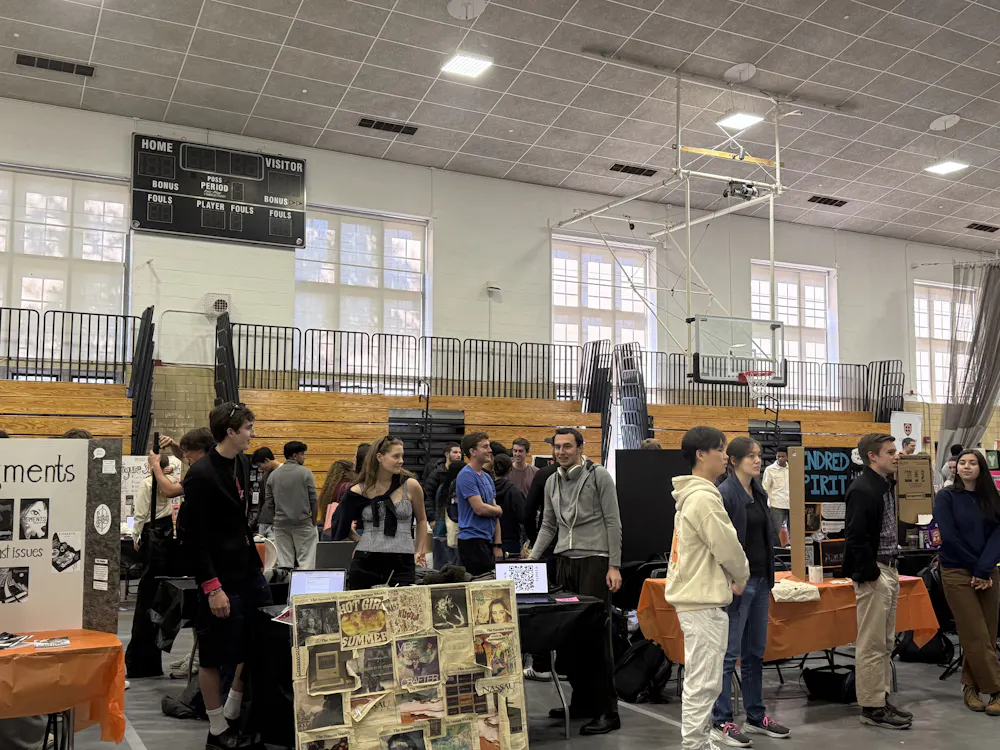
Students share mixed reactions as mandated officer and treasurer trainings return to in-person format
David EstradaThe University's student organization officers and treasurers returned to mandatory in-person training this fall after years of online sessions. Student reactions found parts of the training redundant or tedious, though most agreed the sessions were important.
The University's student organization officers and treasurers returned to mandatory in-person training this fall after years of online sessions. Student reactions found parts of the training redundant or tedious, though most agreed the sessions were important.