



Suzanne Goldenberg, the U.S. correspondent for Britain's Guardian newspaper, spoke yesterday at the Wilson School and argued that the postwar situation in Iraq is chaotic and rapidly deteriorating.
"According to Mr. Bush, anyone who has actually been to Iraq will tell you that that the situation is improving every day," Goldenberg said. "That's not what I saw."
"The impression that I got from [the Iraqi people] is overwhelmingly that things are not getting better. Things are getting worse. What I saw and what they told me about was chaos," she said.
The lecture was entitled "A Fearful, Lawless, and Broken Place: War and Occupation in Iraq," and the lecture hall was packed with faculty and community members, though student attendance was slim.
Goldenberg was one of the few Western journalists who chose to stay in Iraq when war broke out earlier this year. She was in the now-famous Firdouz Square on April 9 to watch the first toppling of a statue of Saddam Hussein.
She returned to Iraq in September to cover the reconstruction effort.
In her lecture, Goldenberg argued that disorder and chaos have been caused by the sudden destruction of a highly-centralized society.
"The main feeling I got . . . was that people feel that they have no control over their lives. They can't predict what's going to happen next," Goldenberg said.

Under Saddam Hussein, Iraq had a very centralized economic and political culture, Goldenberg said.
"It was a very effective dictatorship," she argued. "Saddam may have ruled through fear and brutality, but he ruled through institutions."
Goldenberg criticized the Bush administration's slow response to reestablishing law and order in Iraq.
"The problem was, there was nothing immediately erected [in the dictatorship's] place," she said, noting that it took three months for the Iraqi Governing Council to be established.
Goldenberg also criticized the structure and authority of the council. Given that half of the Iraqi population is under the age of 30, and many of the new council members have been out of Iraq since before they were born, "[the council members are] unknown to Iraqis," she said.
Goldenberg also said the perception that U.S. Administrator L. Paul Bremmer III controls the government of Iraq is "pretty accurate."

"With no [strong] institutions," Goldenberg said, "you have a golden opportunity for people who are out to grab power — and power for themselves."
"Criminal gangs, radical clerics, tribal sheikhs — increasingly, they hold more power over Iraq almost every day," she said.
Goldenberg also spoke of the sadness some Iraqis expressed to her.
"When I went to Iraq six months after the war, people were still talking to me about what it was like to see their city looted," she said.
"They really blame the Americans for having their city looted — for allowing this kind of lawlessness and disorder to breed."
According to Goldenberg, Iraqis want American troops out of the country.
"While officials in the Bush administration will still say that we are here to make life better for Iraqi people, the Iraqi people think otherwise," she said.
Goldenberg also criticized the way the war was waged.
"The unfortunate consequence of the way this war was fought is that you don't have international development work," she said.
When asked if she thought the Bush administration recognized the extent of the problem in Iraq, Goldenberg said, "I think that, increasingly, they understand what a disaster has been created, but I think their response is that they will get out as soon as they can rather than rebuild the country."
Goldenberg has won several journalism awards. In 2001 she was named "Journalist of the Year" in Britain's What the Papers Say awards and "Journalist of the Year" in Britain's Foreign Press Association awards.
Read More

Princeton University Orchestra and men’s ultimate frisbee team named in University’s latest hazing report
Andrew ArthurTwelve students in the Princeton University Orchestra and Men's Ultimate Frisbee team were found responsible for hazing violations in the University's latest Campus Hazing Transparency Report. Sanctions ranged from Dean's warnings to disciplinary probation.
Twelve students in the Princeton University Orchestra and Men's Ultimate Frisbee team were found responsible for hazing violations in the University's latest Campus Hazing Transparency Report. Sanctions ranged from Dean's warnings to disciplinary probation.

Murray-Dodge Café celebrates 50th Anniversary, drawing over 260 students
Hifza KaleemOn Wednesday, Murray Dodge Cafe celebrated its 50th anniversary, drawing more than 260 students to celebrate with free cookies and merchandise.
On Wednesday, Murray Dodge Cafe celebrated its 50th anniversary, drawing more than 260 students to celebrate with free cookies and merchandise.
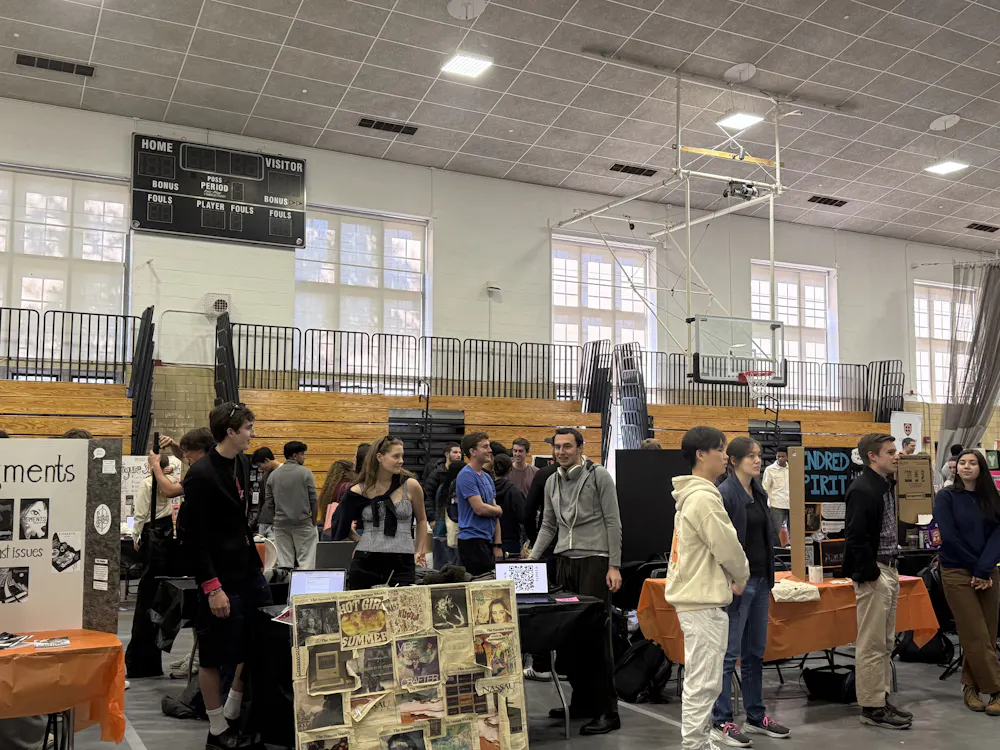
Students share mixed reactions as mandated officer and treasurer trainings return to in-person format
David EstradaThe University's student organization officers and treasurers returned to mandatory in-person training this fall after years of online sessions. Student reactions found parts of the training redundant or tedious, though most agreed the sessions were important.
The University's student organization officers and treasurers returned to mandatory in-person training this fall after years of online sessions. Student reactions found parts of the training redundant or tedious, though most agreed the sessions were important.